
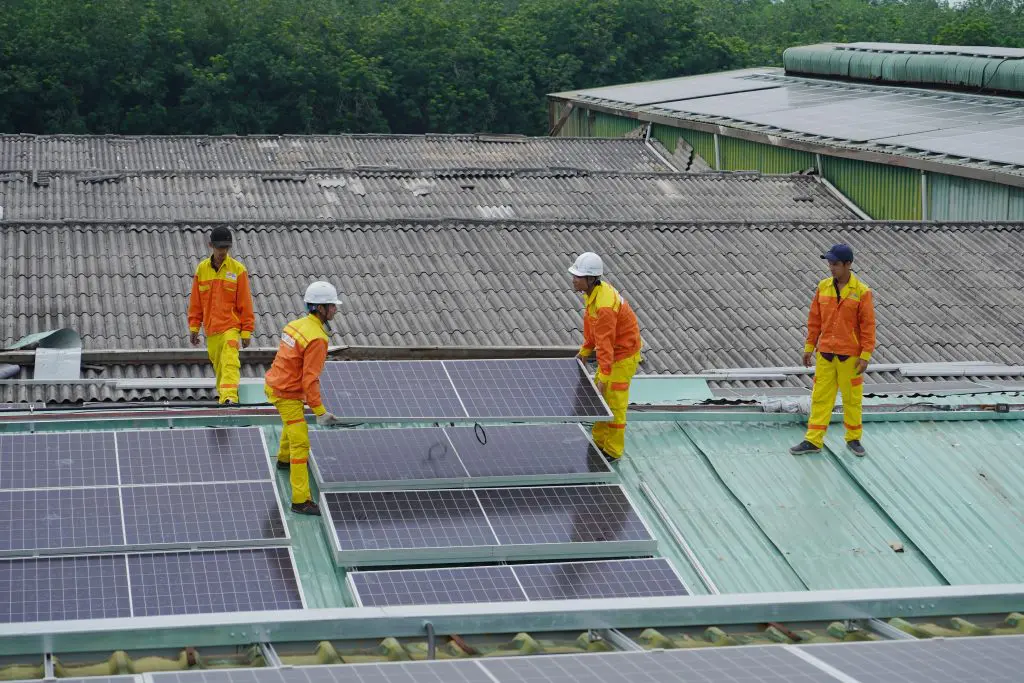
Workers installing solar panels on a roof. Photo by Trinh Trần via Pexels.
Key points
Indonesia is blocking its support for the Asean power grid until export deals offer “win-win” prices and fairly shared benefits.
Four Asean countries have already linked grids; Indonesia is pushing for better terms on its planned low-carbon exports, especially to Singapore.
President Prabowo has launched a 100GW solar drive, needing an estimated US$70bn–73bn in investment and backed by higher power purchase rates.
Developers say the renewable energy plans could bring tens of billions of dollars, tens of thousands of jobs and major tax revenues, with some projects aiming to supply Singapore by 2029.
Indonesia, the region’s emerging clean energy exporter, is withholding support for the Asean power grid initiative until more favourable terms are reached.
The initiative, first envisioned over two decades ago, is modelled after the EU’s integrated energy market to facilitate clean energy trading and shore up regional energy security.
At the recent energy-focused Enlit summit in Jakarta, Indonesia’s energy and mineral resources minister Bahlil Lahadalia said electricity prices under proposed cross-border clean energy deals are still “not yet win-win”.
Bahlil said Indonesia remains open to sharing its vast energy resources with neighbouring countries, but export contracts must not disadvantage the supplying nation.
“Win-win means it’s profitable for each party. The benefit must be fairly shared; it can’t be 70-30,” said Bahlil, citing a recent conversation with his Malaysian counterpart on implementing the Asean power grid, which has gained momentum in recent years after decades of inertia as countries seek to decarbonise their grids.
“The price shouldn’t just be whatever you want. That is not acceptable.”
To date, four Asean countries – Laos, Thailand, Malaysia and Singapore – have already integrated their grids.
Given its high solar, hydropower and geothermal potential, Indonesia has actively pursued low-carbon electricity exports, particularly with Singapore, where authorities have already granted conditional licences to six projects to bring in 3 gigawatts (GW) of clean power.
These projects, however, still require regulatory approval from Indonesia. A higher export tariff for Indonesian renewable power could also narrow the existing premium Singapore places on the green attributes of electricity generated from Indonesia.
Vanda RE, a joint venture led by Singapore-based renewables developer Gurin Energy and one of the firms with a conditional import license, said in a separate media briefing that there are potentially “a lot of wins” for Indonesia.
Addressing Bahlil’s comments, Gurin Energy’s Indonesia country manager Enda Ginting said that roughly US$50bn worth of foreign direct investment is “sitting around the corner”, in addition to tens of thousands of jobs and technology transfer in the renewables sector.
Vanda RE said it estimates its project alone will bring US$3.5bn of prospective investments, 60,000 jobs over the construction and operations phase and US$1.76bn in government tax revenue to Indonesia.
Despite remaining regulatory hurdles, Enda remains hopeful that its solar and battery project in Indonesia will start supplying energy to the Singapore market by 2029.
New 100GW solar target
On the sidelines of the Enlit conference, Bahlil also told journalists that the government plans to revise its power supply plan to accommodate an additional 100GW of solar generation, which Indonesian president Prabowo Subianto announced in August.
The country’s persistent oversupply of power, due to its massive investment in fossil fuel plants in recent years, has historically held back private investments in solar projects.
Indonesia plans to scale its installed solar capacity, up from just 1.5GW currently, within the next three years. Under the first phase of the programme, roughly 5.5GW of new capacity has been launched, with plans underway to put out 25GW to 30GW of additional tenders, said Bahlil.
The solar programme builds on Indonesia’s existing plans to add 69.5GW of new power generation capacity by 2034 to meet its growing domestic energy needs, of which 70% will come from new and renewable energy sources.
According to Bahlil, the planned solar additions will require roughly US$70bn–73bn in new investments.
Bahlil previously stated the programme will primarily be funded through private business entities and independent power producers, with Indonesia’s sovereign wealth fund Danantara stepping in if certain tenders lack commercial viability. The country is also courting investors from Asean and China to help fund its solar expansion plans.
To incentivise solar investments, state utility PLN will purchase the power generated at US$0.05 to US$0.06 per kilowatt-hour (kWh) – above the typical US$0.03 to US$0.04 per kWh rate for coal-fired power.
“This is not a small market… it is a massive market. To achieve this, there must be collaboration between the government, academics and the business community.”
This page was last updated October 5, 2026
Written by

Gabrielle See is an award-winning journalist based in Singapore who has written for Green Central Banking since 2025. She has covered the intersections of finance, geopolitics and energy transition in Asia over the past five years for regional and international publications, including CNBC, Eco-Business, Southeast Asia Globe and the Business Times.