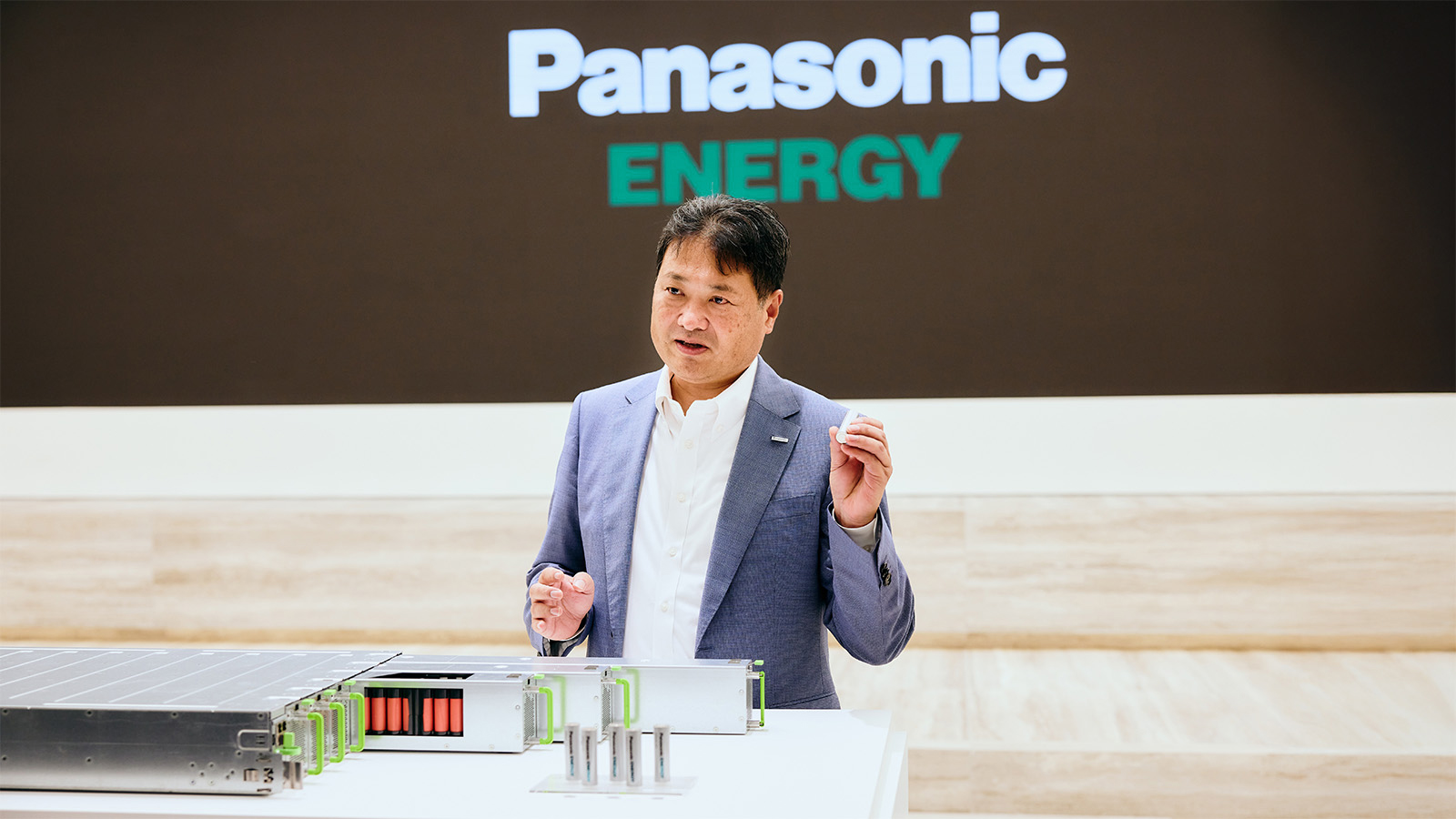
Alongside the development of our supply infrastructure, Panasonic Energy is actively proposing and developing next-generation power solutions. In AI servers, power loads fluctuate significantly and instantaneously depending on the quality and volume of computational processing required. As a result, solutions are now needed not only to provide backup power during outages but also to manage power peaks and handle sudden fluctuations in power load. Furthermore, as the power consumption of data centers continues to expand at a rapid pace, improving their overall energy efficiency has become a critical and growing challenge.
In response to these challenges, Tadanobu states, “We aim to be a provider of power solutions for data centers that offers solutions capable of adapting to our customers’ evolving needs.”
The BBU, the company’s current core product, not only provides backup power during outages, but it also absorbs sudden fluctuations in server power demand and helps level out power loads through peak shaving. It is also moving forward with the development and proposal of new power solutions. Prime examples include the Capacitor Backup Unit (CBU), which incorporates a supercapacitor—suited for repeatedly delivering and absorbing large amounts of power in shorter intervals than a BBU—to absorb sudden fluctuations in power load that occur on a daily basis, and the High-Voltage Direct Current (HVDC) compatible BBU, which helps to improve the overall energy efficiency of data centers.
For the CBU, Panasonic Energy is modularizing the supercapacitors developed and manufactured by Panasonic Industry Co., Ltd. The company plans to begin mass production of the first-generation modules during fiscal year 2027 and will also begin development of the second-generation modules. Additionally, the design of the HVDC-compatible BBU is largely complete, and the company aims to finalize preparations for mass production during fiscal year 2027. The company plans to expand the range of value it can offer to customers through this new product lineup, building on its current BBU offering.
A key feature of these product developments is that they begin with co-creation with customers.
Panasonic Energy is engaged in ongoing discussions with its hyperscaler*4 customers from the conceptual stage, exploring next- and future-generation power solutions for data centers. The concepts, necessary system functions, and output requirements determined through these discussions are not only incorporated into the power design of the BBUs and CBUs but also into the specifications for battery cell performance, materials, cell chemistry, mechanical design, and control algorithms, enabling extensive development to proceed well before a wider product launch.
*4. Operators that run large-scale data centers and provide cloud services
Tadanobu: “We are not simply scaling up our existing products. We are developing and proposing integrated power solutions tailored to the evolution of semiconductors and the unique system configurations of each customer.”
Building on its strong relationships with customers, Panasonic Energy considers its ability to offer integrated solutions—from battery cells to final systems—to be one of its key strengths.
This development framework also contributes to enhanced safety. In data centers, a single incident—such as a fire—could result in the loss of a large number of digital assets. For this reason, BBUs must meet extremely high safety standards. Panasonic Energy enhances the safety of the entire system by combining high-quality cells with a Battery Management System (BMS) that continuously monitors the cells, gas suppression measures to prevent the spread of fire in the event of a malfunction, and a mechanical design that accounts for thermal stress.
Tadanobu: “As the load increases, the impact of factors such as thermal stress also grows, making it more difficult to ensure safety. Therefore, we need to design solutions that align with our customers’ pace of evolution, taking into account materials, mechanisms, and algorithms. Based on the trust we have built with our customers, we are able to work with them on next- and future-generation solutions even before their plans are publicly disclosed.”
To support this development work, Panasonic Energy opened the Energy Innovation Square, a lithium-ion battery research and development center, in Kadoma, Osaka and began full-scale operations in September 2026. At this facility, the company conducts an integrated process ranging from battery cell material development to design, prototyping, and analysis, with the aim of accelerating the development of next-generation batteries. Leveraging this development infrastructure, the company is also working to achieve the high-power output required for next-generation products.
To increase the output of BBUs, the company is working to improve performance by simultaneously advancing battery cell chemistry and system mechanical design with the goal of achieving output of over 200 W per cell in the medium term.