
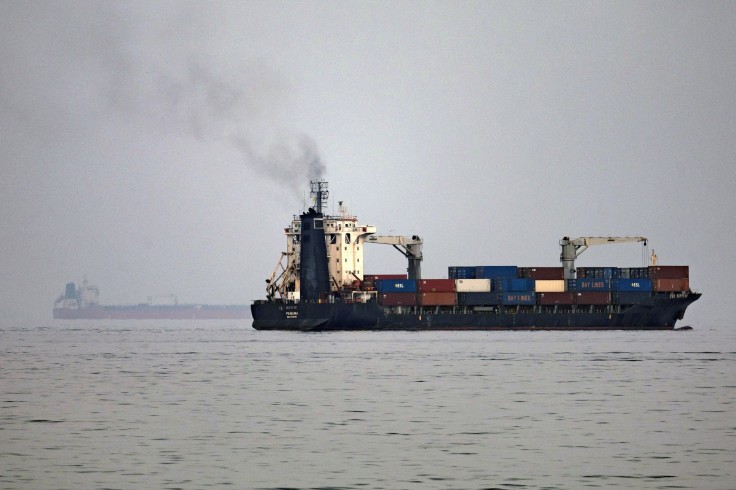
The Panama-flagged container shipping vessel Ten Neptune transits the Gulf of Oman off the coast of Khor Fakkan in the emirate of Sharjah in the east of the UAE on October 13, 2026. The International Monetary Fund (IMF) has sharply cut growth forecasts for the Middle East and Central Asia in 2026, citing “a longer closure of the Strait of Hormuz, compared with the baseline assumptions in the April” report, and predicting a major rebound in 2027 based on the expected reopening of the waterway.
Photo by AFP via Getty Images
The Briefing:Up to 50 commercial vessels carrying oil, liquefied petroleum gas, chemicals and other potentially hazardous cargoes are believed to have been targeted in cyberattacks, with Iran as the primary suspect — although U.S. authorities are also examining a possible Russian connection.Some vessels also received bomb threats and intimidating messages warning crews against transporting American cargo.Some crew members may have been unaware that their vessels’ networks had been compromised, exposing a critical cybersecurity vulnerability in the global maritime sector.
U.S. authorities are investigating possible Russian involvement alongside Iran in a wave of cyberattacks targeting as many as 50 commercial vessels carrying oil, liquefied petroleum gas, chemicals and other potentially hazardous cargoes — a series of incidents that may have left some crews unaware that their onboard systems had been compromised.
The scope of the investigation suggests that state-backed actors may be opening a dangerous new front against global shipping — and if Tehran’s role is confirmed, it would mark an expansion of the broader 2026 US-Iran conflict from Middle Eastern waters into global shipping lanes, including routes directly serving American ports along the Gulf Coast.
From the Strait of Gibraltar to American Shores
One of the first confirmed incidents involved the VL Prosperity, a Liberian-flagged supertanker carrying approximately 2.3 million barrels of crude oil from Egypt’s Sidi Kerir terminal to Galveston, Texas. Iranian media reported that the vessel was attacked on August 7 while passing through the Strait of Gibraltar, allegedly losing communications for approximately 30 hours. U.S. investigators later examined the ship’s systems after indications that its network had been compromised. Iran’s semi-official Mehr News Agency published details of the attack before U.S. authorities had publicly acknowledged it, framing the incident as a successful strike.
Coast Guard and FBI personnel boarded the VL Prosperity in the Atlantic Ocean on August 21 — a team that included Coast Guard cyber specialists, law enforcement officers, a vessel inspector, and FBI Cyber Action Team members, according to Maritime Executive. A second vessel was boarded on August 24 after authorities received indications that its network may also have been compromised. The vessel was subsequently identified in reporting as the Kohaku. Neither boarding turned up evidence of active operational disruption at the time.
A third vessel, the Vivit Africa, extended the picture beyond U.S.-bound shipping. The Liberian-flagged LNG carrier had departed Lake Charles, Louisiana, carrying American liquefied natural gas destined for a terminal off Rovigo, Italy. In early September, its crew reportedly lost access to some internal control systems while crossing the Mediterranean, prompting suspicions of a cyberattack, although investigators had not established the cause. The vessel never offloaded its cargo at the Italian terminal, eventually diverting to Algeciras, Spain.
Crews Left in the Dark Aboard Compromised Ships
Among the most alarming details to emerge from the investigation: in several cases, crew members were entirely unaware that their ships’ networks may have been compromised. That gap — a breached system and a crew still operating under the assumption that nothing is wrong — illustrates how deeply vulnerable the maritime sector remains.
Modern commercial vessels depend on interconnected systems governing navigation, propulsion, steering, and ballast control. The FBI said there were no reports of operational disruptions, vessel instability, physical danger to crews or environmental impacts following the Coast Guard’s investigation of the VL Prosperity. However, Bloomberg reported in October that investigators had found evidence of temporary unauthorised access to a digital system connected to the vessel’s propulsion, although they had not determined which functions the attackers could control.
Bomb Threats and a Doctrine of Maritime Hybrid Warfare
The digital intrusions did not arrive in isolation. According to the Wall Street Journal, some vessels received bomb threats and other intimidating messages warning crews against transporting American cargo. The Coast Guard deployed cyber protection teams to at least four ships approaching U.S. ports, according to i24NEWS. The combination of suspected cyber intrusions and psychological pressure suggests a possible maritime hybrid-warfare strategy, aimed not only at disrupting vessels but also at unsettling the people operating them.
Anthropic separately reported in September that an Iran-linked threat actor had used its Claude AI tool to conduct reconnaissance on U.S. naval forces, compile information on naval movements and research vulnerabilities in shipboard systems, including maritime satellite communications equipment and industrial control products.
A War Expanding Into New Domains
Cyber operations have played a supporting role throughout the broader US-Iran conflict, with coordinated strikes reportedly disrupting Iranian command and control networks, while pro-Iran hacktivists threatened retaliatory digital attacks — efforts initially constrained by widespread internet blackouts inside Iran. That equation now appears to be shifting.
With Iranian naval capacity under severe pressure following recent military operations, Tehran appears to be investing heavily in asymmetric capabilities — cyberattacks against energy infrastructure among the most cost-effective. Separately, the U.S. Treasury’s Financial Crimes Enforcement Network identified approximately $14.7 billion in financial activity potentially linked to Iranian shadow banking networks between January 2025 and August 2026, according to a November 23 announcement.
Washington Responds With a New Institutional Architecture
The Coast Guard announced on August 31 the establishment of its Office of Maritime Cybersecurity Policy (CG-MCP), which will serve as its central authority for developing and implementing cybersecurity policies governing ports, vessels and maritime facilities.
U.S. officials have stopped short of formally attributing the campaign to Tehran or Moscow. But with up to 50 ships potentially compromised, bomb threats sent to active voyages, and incidents spanning routes from the Mediterranean to the Atlantic, the central question is no longer whether maritime cyberwar has arrived — it is how extensively it has already taken hold.
© {{Year}} Latin Times. All rights reserved. Do not reproduce without permission.