Intelbrief / Washington Postures for Potential Escalation in the Conflict with Iran

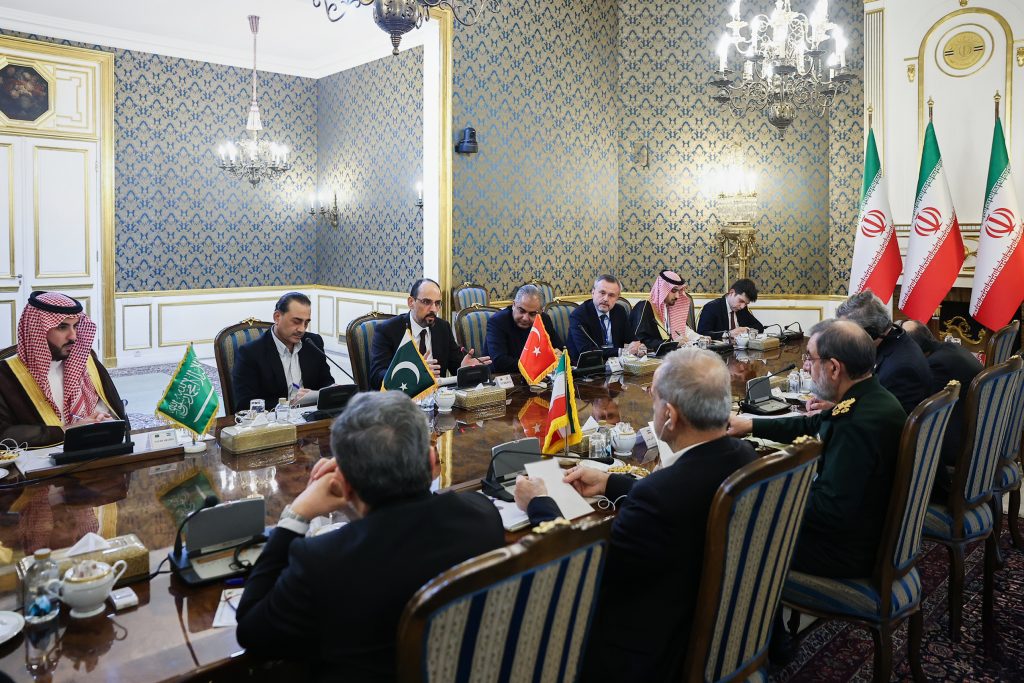
Iranian Presidency Office via AP
Bottom Line Up Front
Iranian leaders are working to deter a renewed U.S. air campaign by threatening “zero red lines” retaliation throughout the region, including against U.S. military personnel.
Any Iranian strike that causes mass U.S. casualties or damages a U.S. warship risks setting off significant U.S. escalation on Iranian civilian targets.
Recent U.S. intelligence suggests Iran might attack high-value U.S. or allied targets, but Iran’s track record with such attacks is poor.
Some hardline Iranian commanders advocate a ground offensive against the Arab Gulf states, an option that would likely expose Iran’s military shortcomings.
Iranian leaders are working to deter U.S. President Donald Trump from following through on his threats to conduct a “short but intense” U.S. air campaign on Iran after the midterm elections on Tuesday. High-level Iranian officials have painted Iran’s intended retaliation in stark terms, claiming Iran’s response will follow “zero red lines,” representing a “prolonged, all-out war,” not limited in time or target selection, if the United States launches an attack. Mahdi Mohammadi, a senior adviser to Mohammad Bagher Ghalibaf, the lead negotiator and speaker of Iran’s Majles (parliament), said on social media last week that Iran views the coming part of the war as existential. He wrote: “We are in a surprise phase of the war, and we will not fight a classic war … It will be an asymmetrical, fierce and conclusive war that will target the enemy’s strong points and weak spots.” Although Ghalibaf supports the concept of a negotiated settlement, his aide’s posting reflects the views of many hardline leaders, some opposed to any negotiations, who publicly claim, “the only language Washington understands is force.” This view has been further reinforced since last June, when Operation Midnight Hammer set the current conflict cycle into motion, though the kinetic aspects have ebbed and flowed.
Fearing the consequences of renewed U.S.-Iran warfare, regional leaders have intensified efforts to promote a regional solution to the U.S.-Iran conflict. These leaders, as do moderate Iranian leaders, assess that a return to active combat will only result in significant damage without shifting the conflict’s fundamentals or setting the stage for a compromise. The week’s meetings and statements by mediators appear intended, at least in part, to empower moderate Iranian leaders who insist that only a diplomatic solution — and not a major Iranian escalation — can guarantee the regime’s security over the long term. Iranian moderates have in recent weeks come under intense political attacks from the hardliners who maintain that the United States is intent on overthrowing Iran’s regime, and Washington can only be deterred by inflicting unacceptable damage on U.S. interests and the global economy.
On Monday, senior officials from the “Mecca Pact” states – Türkiye, Pakistan, and Saudi Arabia – visited Tehran for talks with the head of Iran’s Supreme National Security Council and Iranian Revolutionary Guard Corps (IRGC) Major General Mohsen Rezaei, and President Masoud Pezeshkian. The discussions produced no major breakthroughs but signaled to Washington that regional powers are seeking to head off U.S. or Iranian escalation. Some reports suggested the Saudi agenda at the meetings included enlisting Iranian assistance to persuade the Houthi-led Ansarallah movement in Yemen to cease its offensive operations against Saudi-backed Yemeni forces and its missile attacks on Saudi civilian infrastructure.
The Iran-Mecca Pact sessions were followed by a one-day visit to Tehran by Qatari mediators seeking to orchestrate a return to the June U.S.-Iran Memorandum of Understanding (MOU). That agreement collapsed shortly after it was signed, but its core provisions remain a basis for ongoing indirect U.S.-Iran discussions. Qatar’s national bank holds at least $6 billion of Iranian Central Bank assets that were to be released by the U.S. under the MOU, and the potential unfreezing of the funds under any new U.S.-Iran deal remains a point of leverage for Qatari mediators. Last week, Pakistan’s Army Chief of Staff, Asif Munir, visited Tehran to encourage Iranian diplomatic flexibility, and he returned to Iran to attend the Mecca Pact meeting. Also on Monday, speaking at the University of Cambridge, Oman’s Foreign Minister Sayyid Badr Al Busaidi, who mediated U.S.-Iran nuclear talks before the war, reiterated Oman’s calls for a “non-aggression pact” among the eight Gulf states — the six Arab Gulf monarchies, Iran, and Iraq — as a “fundamental step toward establishing sustainable regional security.”
Placing little faith in the diplomacy, Iranian hardliners insist that Tehran leave no uncertainty about the scope, scale, and target set for Iran’s response if Trump attacks again after the U.S. midterms. Iranian leaders have made no secret about their intentions to expand the war and maximize the damage they will cause if a third round of fighting breaks out. Iranian decision makers believe their most effective strategy, to date, has centered on inflicting major damage on U.S. bases across the Middle East and closing the Strait of Hormuz. These tactics, regime leaders claim, brought the U.S. to a strategic dead end and forced Washington to consider concessions. Iranian hardliners assert that Iran’s counter-attacks have, more broadly, reset the strategic architecture of the Gulf, calling into question decades of Arab Gulf state reliance on a U.S. security umbrella. The hardliners insist that only by “doubling down” on Iran’s existing strategy can Tehran hope to deter Washington from ever attacking Iran again.
Senior Iranian officials, including Rezaei and his top IRGC associates, have backed up their threats by adding specificity, asserting Iran will strike civilian energy infrastructure and underwater fiber optic cables that carry Internet and other communications traffic. Last week, Iranian media published a list of intended targets, naming specifically: bridges, railway networks, international airports in Saudi Arabia, Kuwait, and other Gulf states, underwater cables in the Persian Gulf, petrochemical plants, power plants, desalination plants, technology and artificial intelligence (AI) companies, and hotels and shopping centers in the Middle East. Other IRGC figures have threatened that Iran will use newly developed advanced missiles, with technology possibly supplied by Russia, to attack U.S. warships that are now mostly at least 500 miles off Iran’s coast. Iran reportedly has already tried to hit U.S. warships, but its launches were intercepted or missed. U.S. ships are moving and require Iran to change the course of its weapons in flight — a difficult capability to master. A successful Iranian strike on a U.S. ship, particularly if the attack causes mass U.S. casualties or massive damage, would likely prompt President Trump to escalate air strikes on Iran dramatically, including targeting senior Iranian officials.
Iran also appears determined to expand its attacks beyond the region. UK authorities are investigating a possible Iranian role in a purported plot last month to attack American personnel and B-1 bombers stationed at RAF Fairford, a base in southern England. The plot was thwarted by security personnel, assisted by the local population, but the B-1 bombers were subsequently withdrawn. Two Iranian officials, one of them a member of the IRGC, told the New York Times last week that U.S. diplomats and personnel would also be targeted by Iran. A recent memo circulated by Director of National Intelligence Jay Clayton warned that Iran was in the “advanced stages” of planning to attack U.S. officials abroad, including possibly on U.S. soil. Iranian leaders have suggested that senior officials would be legitimate targets as a response to the U.S. and Israeli strikes on senior Iranian officials both in 2025 and 2026. However, U.S. and Western security authorities have largely succeeded in excluding Iranian security personnel from their territories, and Iran would likely have to subcontract its attacks. In the past, purported Iranian assassination and other terrorist plots have relied on hapless non-Iranian operatives who have been arrested before they could do harm.
As part of its retaliation, Iranian leaders are sure to back expanded Houthi strikes against Saudi Arabia and other Gulf states, and possibly against Israel as well. Iran might also try to tap Lebanese Hezbollah to conduct strikes on Israel, although the group, reeling from Israel’s ground offensive in south Lebanon, has said in recent days it would be reluctant to rejoin Iran’s war effort. Still, Hezbollah has spent the past three months preparing for a possible resumption of hostilities with Israel, after receiving an infusion of tens of millions of additional dollars from Iran, according to Lebanese security personnel briefed on its activities.
Some IRGC commanders have gone so far as to advocate Iranian ground operations against U.S. forces based in some of the Arab Gulf states, in the event of renewed U.S. attacks. Various U.S. and regional media outlets have reported this month that Iranian officials have warned their regional counterparts that Iranian ground units could cross into neighboring states that host U.S. forces. Some reports suggest an objective of an Iranian ground offensive might be to reach the major U.S. base at Camp Arifjan, in Kuwait, in an attempt to capture U.S. military personnel. However, most experts assess Iran lacks the sealift and other logistical requirements for a successful amphibious landing or invasion of any of the Gulf states, particularly if U.S. forces counter the attempt in real time.