The pressure may ease next year: the World Bank projects a 7 per cent decline in overall commodity prices in 2027 and Brent at $79 a barrel. Food prices, however, are expected to rise by a further 7 per cent. This benign outlook assumes no major Middle East escalation, a recovery in Russian oil exports, fewer Black Sea shipment disruptions and manageable El Niño-related crop losses.
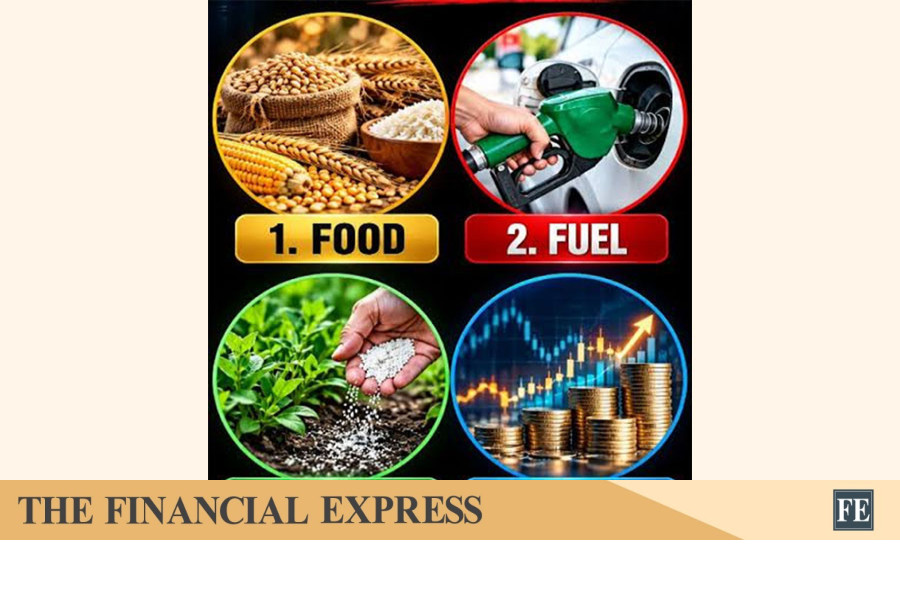
If these assumptions fail, the consequences could be severe. In an adverse scenario, Brent could average $105 a barrel in 2027 and food prices could exceed their 2022 level. The four Fs-food, fuel, fertiliser and finance-are interconnected; their combined effects could overwhelm countries facing high import bills, scarce foreign exchange and mounting debt.
The danger is not necessarily a global food shortage: the World Bank expects grain supplies in 2026-27 to remain about 3 per cent above their 2024-25 level. But adequate supplies do not guarantee affordability or access. The ability to finance imports, sustain production and protect vulnerable households will determine how severely countries are affected.
FUEL: THE FIRST TRANSMISSION CHANNEL: The Middle East conflict has delivered a major shock to energy markets. Although crude oil exports from the Gulf have recovered substantially through alternative routes and pipelines, shipments of refined petroleum products remain severely constrained. By September, these exports were still below half their pre-conflict levels, while liquefied natural gas shipments were only about one-quarter of previous volumes.
Crude prices alone therefore do not capture the full disruption. Diesel and jet fuel prices have risen considerably more than crude because of shortages of refining capacity and disruptions to product exports. European natural gas prices had nearly tripled from pre-conflict levels by mid-October, according to the World Bank.
These increases affect agriculture and food distribution. Oil powers farm machinery, irrigation and transport; natural gas is a major input in nitrogen fertiliser. Higher energy costs therefore raise the cost of producing, processing and transporting food.
The World Bank estimates that global oil production will decline by 5.5 million barrels a day, or 5.2 per cent, in 2026. Supply may recover in 2027, but refining capacity could lag, keeping some fuel markets tight.
FERTILISER: THE DELAYED AGRICULTURAL SHOCK: Fertiliser is the second channel, where timing matters as much as the scale of price movements. Urea prices averaged $857 a tonne in April before falling to an average of $399 in the third quarter, following an easing of supply constraints and increased exports from China. But this improvement does not tell the whole story. Diammonium phosphate (DAP) prices continued to rise, reflecting shortages and high costs of key inputs, particularly sulphur and ammonia. Disrupted supplies and higher natural gas prices have also raised production costs.
The World Bank projects fertiliser prices to rise by 14 per cent in 2026 before declining towards 2025 levels in 2027, assuming Gulf supplies recover and major producers maintain exports.
For farmers, however, a temporary price spike can have consequences long after prices retreat. Fertiliser purchases and application are tied to planting schedules, available credit and expected crop returns. Farmers who reduce application because fertiliser becomes unaffordable cannot necessarily recover lost yield potential when prices fall. The effects may appear months later in lower harvests and farm incomes. This is particularly concerning where farmers have limited access to credit and governments lack the fiscal capacity to sustain input subsidies.
FOOD: CLIMATE AND TRADE COMPOUND THE PRESSURE: The World Bank forecasts that food prices will rise by 7 per cent in 2027 and grain prices by 9 per cent. Its forecasts for rice and sugar prices have been revised upwards by 21 and 12 per cent, respectively, compared with the April outlook, partly reflecting El Niño risks.
Weather is not the only concern. The conflict in the Black Sea has disrupted grain shipments from a region accounting for about 30 per cent of global wheat exports. These disruptions contributed to a 14 per cent increase in global grain prices between June and September. Further attacks on maritime infrastructure or export restrictions could tighten supplies and push prices higher.
The 2026-27 El Niño is expected to be the strongest since 1950, when comparable records began. Its effects will vary across regions, bringing drought to some agricultural areas and excessive rainfall or flooding to others. Rice, sugar, palm oil and other tropical commodities are particularly exposed. Global supplies may remain adequate overall, but individual countries and regions could still suffer substantial production losses.
Trade restrictions could amplify these pressures. Governments facing domestic price increases may restrict food exports to protect consumers. Such measures can be politically attractive in the short term, but transfer costs to importing countries and increase uncertainty in international markets. India’s rice export restrictions in 2023 illustrate how domestic food-security concerns can disrupt international supplies.
The World Bank’s baseline suggests El Niño’s global price impact may remain manageable, but import-dependent and climate-vulnerable countries may still face serious difficulties.
FINANCE: THE MULTIPLIER OF ALL THREE SHOCKS: Finance is the fourth and potentially most consequential channel. Higher fuel, fertiliser and food prices increase foreign-exchange needs. A country’s ability to pay, not the international price alone, determines how much of the shock it can absorb.
Countries with adequate reserves, diversified suppliers and fiscal space may absorb higher costs temporarily. Those with weak external balances and heavy debt service face difficult choices between essential imports, consumer protection, farm support and debt payments.
The World Bank highlights the vulnerability of low-income and fragile economies to commodity-price shocks. Higher energy costs can feed into food inflation and wider price pressures, complicating monetary policy. Governments may face pressure to raise interest rates to contain inflation even as tighter monetary conditions weaken investment and economic activity.
Repeated crises have eroded fiscal space. Blanket energy and food subsidies are costly and often poorly targeted, but abrupt withdrawal can impose severe hardship on low-income households.
Bangladesh illustrates this dilemma. Its fuel import bill more than doubled to a record $10.63 billion in 2025-26, equivalent to about 14 per cent of total imports. In April, the Finance Ministry projected that energy and fertiliser imports would cost $5.62 billion between March and June, compared with $3.01 billion a year earlier. The annual subsidy bill was also projected to rise to approximately $8 billion.
These pressures come on top of existing foreign-exchange constraints and substantial financing requirements. Bangladesh’s efforts to secure additional support from the IMF and World Bank underline how an external commodity shock can intensify domestic vulnerabilities. The challenge is not simply to secure supplies, but to pay for them without undermining macroeconomic stability.
ACT BEFORE THE NEXT PLANTING SEASON: Policy must address the four shocks as an interconnected challenge.
First, energy importers should diversify suppliers, maintain adequate reserves and manage foreign exchange carefully. Essential fuel and fertiliser imports should be prioritised ahead of critical agricultural seasons.
Second, governments should assess fertiliser needs early, secure supplies before planting and ensure timely delivery. Targeted support for small farmers is more sustainable than broad subsidies that strain public finances.
Third, food exporters should avoid unnecessary restrictions and publish timely data on production, stocks and trade. Transparency can reduce uncertainty, discourage panic buying and prevent domestic measures from worsening market disruptions.
Finally, international financial institutions must address the financing consequences of external shocks. Countries facing temporary foreign-exchange shortages need timely concessional and emergency financing to maintain essential imports and protect vulnerable households. Where debt is already unsustainable, additional lending alone cannot provide a lasting solution; debt restructuring may be necessary. Assistance should also support social protection, agricultural production and climate resilience, rather than merely financing short-term consumption.
A global food and energy catastrophe is not inevitable. The World Bank’s baseline still anticipates some moderation in commodity prices next year. But that outlook depends on improving geopolitical conditions, recovering trade routes and manageable agricultural losses. The adverse scenario shows how quickly the picture could change if these assumptions fail.
The next crisis may not originate in any single commodity market. It could emerge from the interaction of fuel shortages, expensive agricultural inputs, climate-related production losses and the inability of financially constrained countries to absorb higher import costs. The time to prepare is before the next planting season, not after the damage has been done.
Dr. Golam Rasul is a Professor of Economics at the International University of Business Agriculture and Technology (IUBAT), Dhaka.
[email protected]