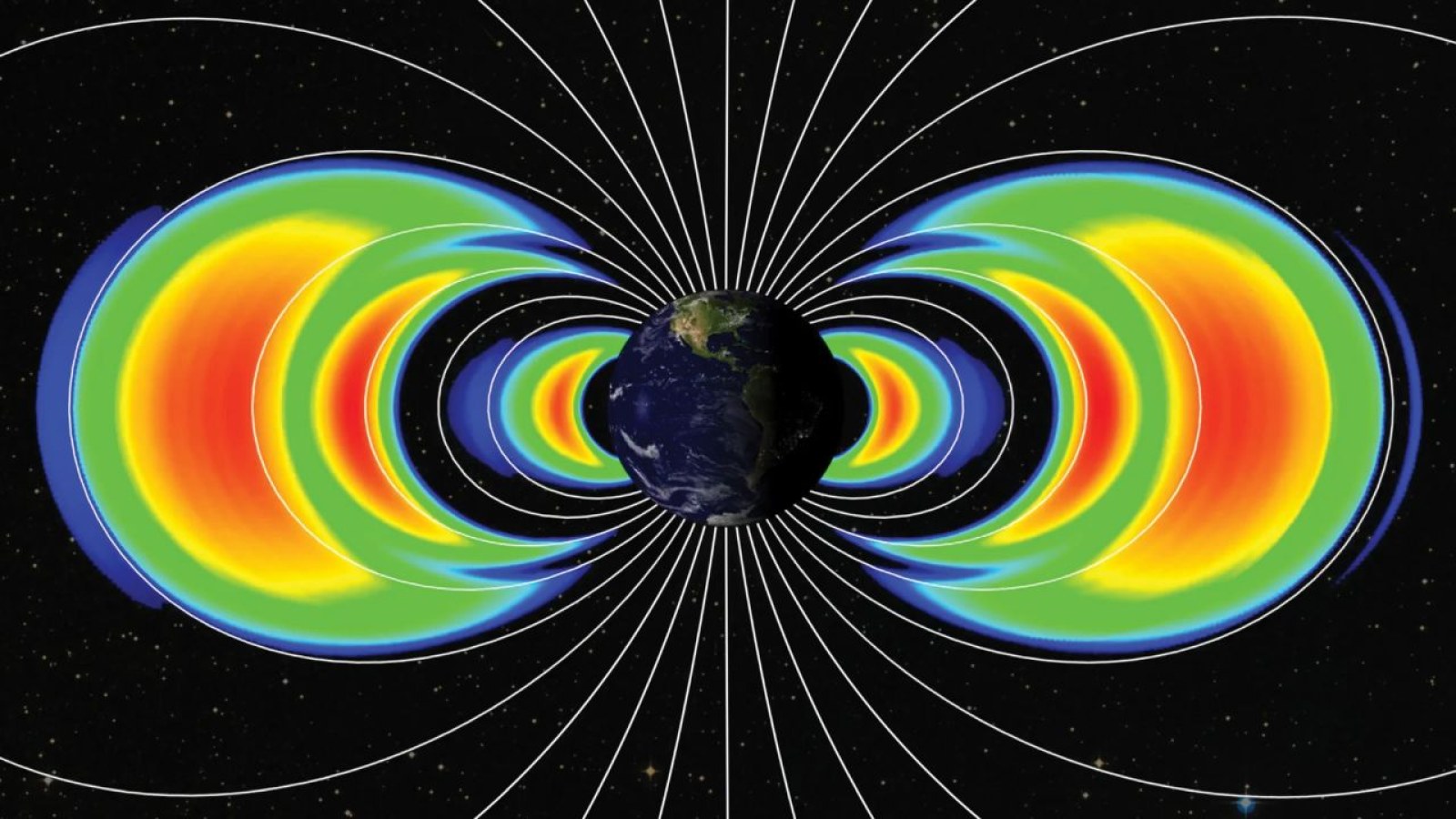
High-energy electrons that scientists believed could not get inside a sharp boundary in Earth’s radiation belts were instead created there during the May 2024 solar superstorm, according to a new study in Geophysical Research Letters. Data from Japan’s Arase satellite show the electrons were accelerated locally rather than pushed in from the outer belt.
The finding matters because the boundary had served as a kind of mental map for the space industry. If extreme storms can generate so-called killer electrons, a long-established term for electrons carrying millions of electron volts, in a zone usually considered sheltered, then satellites flying through that region may face radiation hazards that current models do not fully capture.
The study, led by Yoshizumi Miyoshi of Nagoya University’s Institute for Space-Earth Environmental Research, was published Oct. 26 and announced by the university two days later. It is a peer-reviewed observational study of one extreme event.
Electrons Accelerated From Within
The barrier dates to 2014, when NASA’s Van Allen Probes revealed an exceptionally sharp inner edge for the most energetic electrons, roughly three Earth radii from the planet’s center. University of Colorado Boulder physicist Daniel Baker, who led that research, compared it to a solid wall. “It’s almost like these electrons are running into a glass wall in space,” Baker said at the time, according to BBC Sky at Night Magazine.
Then came the storm of May 10 and 11, 2024, which reached G5, the top of NOAA’s geomagnetic storm scale. Around 3 million electron volts, Arase recorded electron flux rising more than 5,000-fold over pre-storm levels during the storm’s recovery phase, ScienceAlert reported. Lower-energy electrons increased first, higher-energy electrons followed about half a day later, and those above 3 million electron volts surged roughly a day after the initial rise.
The pattern pointed to a local source. The electron distribution peaked near the barrier itself rather than tapering inward from the outer belt, which is what inward transport would produce. “Here we show that this barrier can be breached under extreme space weather conditions,” Miyoshi said.
A Drained Plasmasphere Let Chorus Waves Take Over
The mechanism involves two players — normally, the inner region is wrapped in the plasmasphere, a dense cloud of cold, charged gas that dampens certain electromagnetic waves. The May 2024 storm stripped much of that plasma away. Miyoshi told The Daily Galaxy that the plasmasphere usually recovers in about two days but took roughly 4.3 to 4.7 days after this storm.
In that thinned environment, natural radio emissions called chorus waves flourished. These waves usually scatter electrons and help remove them. This time, they appear to have pumped energy into electrons instead. Miyoshi said the waves sound like birdsong when converted into audio.
Independent observations line up with the result. A separate 2024 peer-reviewed study using the PROBA-V satellite reported electrons above 2 million electron volts reaching deep into the inner belt during the same storm, and NASA’s CIRBE CubeSat detected two temporary radiation belts that formed after it. The Arase study adds the most detailed explanation yet of how electrons gained their energy where they were found.
Satellites and Crews Face a Shifted Hazard Zone
Killer electrons can penetrate spacecraft shielding, build up electrical charge inside components and trigger discharges that damage electronics or shorten a satellite’s working life. “Such knowledge is important for assessing radiation risks to spacecraft,” Miyoshi said. The concern is greatest for satellites in medium Earth orbit, spacecraft climbing toward geostationary orbit, and crewed missions that travel beyond low Earth orbit and pass through the belts.
Ordinary households will not feel the electrons themselves. The connection runs through services that depend on satellites, including GPS navigation, timing signals used by banks and power grids, weather data, and satellite communications. Operators already plan for radiation, but zones considered quiet may need wider safety margins during extreme storms.
The timing also matters. Solar Cycle 25 reached its peak in late 2024 and is now in a declining phase, but that does not mean the risk has passed. NOAA Space Weather Prediction Center research scientist Mark Miesch noted in May that some of history’s largest solar storms struck years after the sunspot peak. “We’re not out of the woods yet,” Miesch said, according to The Watchers.
Evidence Strength and Remaining Questions
The study’s strength is direct measurement from a satellite that has watched the belts continuously since 2017. Its limitation is scale. The conclusions rest on one superstorm, the strongest in about two decades, and storms of that strength arrive only once every 20 to 25 years on average. Whether smaller but more frequent storms can drive the same process remains an open question.
The finding does not mean Earth’s natural radiation protection has failed — the electrons Arase recorded gradually declined until another solar storm arrived in October 2024, and the barrier appears to hold under ordinary conditions. What changes is the assumption that the most energetic electrons can never appear inside it.
For readers, no personal action is needed. Aurora watchers, ham radio operators, and anyone curious about space weather can follow storm watches and G-scale alerts from the NOAA Space Weather Prediction Center, which issues the official forecasts for the United States. The researchers say the next step is building the plasma and wave behavior into forecast models, so operators can see in advance when a storm is draining the plasmasphere and opening the door to local acceleration.
What Readers Want to Know
What is the “impenetrable barrier”? It is a sharp inner boundary, about three Earth radii from the planet’s center, that NASA’s Van Allen Probes found in 2014 for the most energetic electrons in the radiation belts.
Did a solar storm break Earth’s radiation shield? No. The study shows electrons were accelerated inside the boundary during an extreme storm. The barrier appears to hold under ordinary conditions.
What are killer electrons? It is an established term for electrons with energies of millions of electron volts that can penetrate spacecraft shielding and damage electronics.
Which satellites face the greatest risk? Spacecraft that fly through the belts, including many in medium Earth orbit, those heading to geostationary orbit, and crewed missions beyond low Earth orbit.
Is the solar maximum still underway? Solar Cycle 25 peaked in late 2024 and is declining, but NOAA scientists warn that major storms can still occur for several years after the peak.
Do I need to do anything to protect myself? No personal action is needed. Space weather alerts are issued by the NOAA Space Weather Prediction Center.
© 2026 NatureWorldNews.com All rights reserved. Do not reproduce without permission.