
International investors see new opportunities.
After nearly 15 years of choosing Vietnam as its manufacturing hub, ITO Group continues to expand its investment with a new factory project in Linh Trung Export Processing Zone, Ho Chi Minh City. Mr. Peter James Opdahl, Chairman of ITO Group, shared that this decision reflects the company’s confidence in Vietnam’s long-term prospects, particularly in the high-tech and manufacturing automation sectors.
ITO Group is a provider of industrial automation solutions, with the total value of equipment supplied globally reaching nearly $1 billion. The new 12,000 m2 factory in Linh Trung Export Processing Zone will serve the production of equipment for various industries.
Notably, this is the first project approved under the special “green channel” investment procedure mechanism of the Ho Chi Minh City Export Processing Zones and Industrial Parks Management Board. According to Mr. Opdahl, this mechanism helps businesses shorten the implementation process and strengthen confidence in the investment environment.
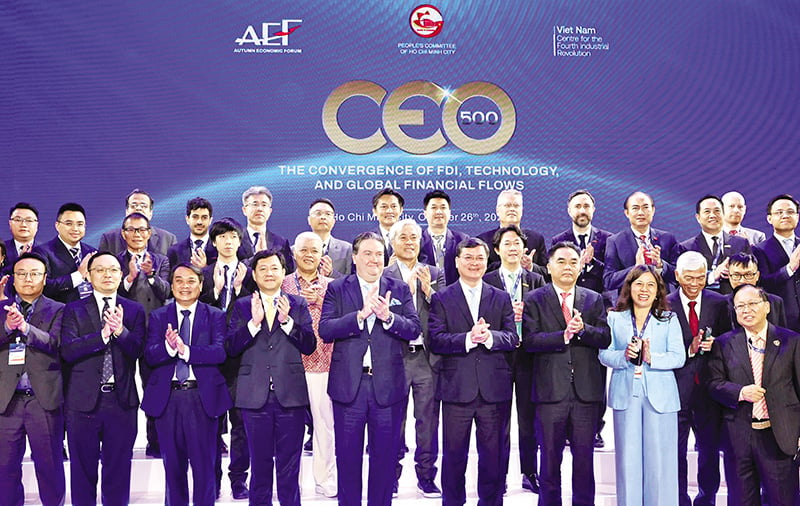 Delegates attending the Autumn Economic Forum 2026. Photo: Le Toan
ITO Group’s continued expansion demonstrates that Vietnam still holds a significant position in the manufacturing strategies of international corporations. However, investment opportunities are no longer limited to factory construction, but are expanding into new technologies, services, and market development.
Having participated in Intel’s investment activities in Ho Chi Minh City about 20 years ago, Ge Jun, CEO of TOJOY Enterprise Services, sees new opportunities upon returning to Vietnam this time, for the Autumn Economic Forum 2026, taking place from October 26-29 in Ho Chi Minh City.
TOJOY operates a platform connecting over 7 million entrepreneurs globally, supporting businesses in expanding their operations into international markets. Upon returning to Ho Chi Minh City, the company presented three project groups in the low-income economic sector, smart service devices utilizing artificial intelligence ( AI ), and construction robots, all of which are considered to have significant growth potential in Vietnam.
In the low-cost economic sector, TOJOY targets applications serving tourism , urban transportation, and emergency logistics. The company plans to collaborate with local authorities and partners to implement 3 to 5 pilot projects, aiming for operational launch in 2027.
For AI-powered smart service devices, the immediate plan is to deploy 500 devices in high-traffic locations, with an estimated total investment of $1.5 to $3 million. In the long term, the company aims to expand the network to over 2,000 devices.
In the construction sector, TOJOY plans to deploy approximately 30 intelligent robots in the initial phase, gradually expanding to around 300 robots. These technologies aim to automate certain construction processes, increase productivity, and improve workplace safety.
These plans are still in the proposal stage, but they demonstrate the interest of international businesses in the potential application and commercialization of technology in Vietnam. According to Mr. Ge Jun, all three project groups are oriented towards localization through cooperation with domestic businesses and adapting technological solutions to actual conditions.
While ITO Group and TOJOY see potential in the manufacturing platform and technological application capabilities, Amazon Global Selling highly values the opportunity to bring Vietnamese goods directly to global consumers.
Larry Hu, Director of Amazon Global Selling for Southeast Asia , noted that Vietnam is emerging as a bright spot thanks to its manufacturing capabilities, tech-savvy young workforce, and strong entrepreneurial spirit. This is also why Amazon Global Selling has chosen Vietnam as its Southeast Asia operational hub starting in 2025.
In one year, the number of Vietnamese products sold on Amazon increased by approximately 35%, while the number of Vietnamese sellers registering trademarks increased by nearly 30%. These results demonstrate the growth potential of cross-border e-commerce. Instead of simply participating in order-based production, Vietnamese businesses have more opportunities to build brands, expand distribution channels, and directly access international markets.
Amazon Global Selling aims to strengthen partnerships with local communities to identify industries and products with a competitive advantage, thereby supporting businesses in reaching global consumers.
Improving the quality of capital flows and increasing domestic value.
Investment plans in high-tech manufacturing, AI, e-commerce, and digital infrastructure reflect Vietnam’s opportunities in the process of shifting international capital flows. However, the challenge lies not only in attracting projects but also in ensuring that these capital flows are sustained and generate value in the economy.
According to Fazurin Jamaludin, Head of the International Monetary Fund (IMF) in Vietnam and Laos, Vietnam has the opportunity to benefit from the wave of AI-based technology development, but is also vulnerable to energy shocks. Meanwhile, the supply chain serving AI remains highly concentrated in a few economies, creating risks to growth prospects.
The IMF representative also specifically noted the structural issues that need to be addressed to strengthen the foundation for sustainable growth. In particular, Vietnam’s total factor productivity (TFP) has steadily declined in recent years. This situation stems from several causes, including limited access to capital for some businesses and uneven allocation of resources across the economy.
Therefore, IMF representatives argue that structural reforms should be considered a priority to improve productivity and resource efficiency. At the same time, Vietnam needs to continue modernizing its monetary and fiscal policy frameworks, strengthening policy credibility, and enhancing the resilience of its economy.
If macroeconomic stability is a condition for maintaining investment attractiveness, then the capacity to create value domestically determines the extent to which capital flows contribute to long-term growth. In this respect, Associate Professor Dr. Nguyen Huu Huan, Vice Chairman of the VIFC-HCMC Executive Agency, believes that while Vietnam’s FDI attraction and exports have achieved significant results, its domestic value creation capacity still has much room for improvement.
Citing data from the Organization for Economic Cooperation and Development (OECD), Mr. Huan stated that foreign-sourced value-added accounts for approximately 48%; the remaining 52% is generated domestically, including contributions from FDI enterprises. In projects announced during the 2020-2024 period, research and development (R&D) activities accounted for only 1.9% of total investment capital.
Therefore, Vietnam urgently needs to attract new-generation capital flows linked to R&D, engineering training, and technology cooperation, while simultaneously enhancing the capacity of domestic suppliers. This is also consistent with Resolution 10-NQ/TW of the Politburo , which focuses on developing a strong domestic industrial ecosystem and establishing substantive linkages between FDI enterprises and Vietnamese businesses.
To implement this transformation, enhancing the capacity of domestic businesses must go hand in hand with developing a production ecosystem that meets the new demands of the international market.
Ishita Dhamani, Senior Partner in Supply Chain Advisory Services at Ernst & Young Advisory (EY Singapore ), argues that competitiveness depends not only on the efficiency of individual factories but also on the ability to connect production, logistics, energy, and data. Standards for emission reduction, traceability, and information transparency are increasingly impacting international trade.
Therefore, businesses need to apply digital technology to connect data between production, transportation, and energy consumption stages. Simultaneously, developing smart logistics, reducing emissions, and strengthening public-private partnerships will contribute to improving the quality of the supply chain.
These requirements also align with the assessments of investors such as ITO Group and TOJOY regarding the need to develop supporting businesses, train human resources, and localize technology. However, the process of upgrading technology, infrastructure, and business capabilities requires long-term capital and appropriate resource allocation mechanisms.
This is also a key issue for the development of VIFC-HCMC. According to Mr. Nguyen Huu Huan, attracting investment needs to be linked to the goal of developing domestic suppliers, training human resources, research, design, and commercializing technology. The effectiveness of capital flows must be evaluated by productivity, technological capacity, and the added value created in the economy.
Vietnam not only aspires to become an attractive destination for new technology investment, but is also determined to become a reliable partner, a crucial link in the global supply and value chain, a hub for innovation, and a place where partners can create new development models and growth drivers.
To foster a spirit of cooperation in the new era, we hope that international partners will not only invest in Vietnam, but also invest alongside Vietnam; not only manufacture in Vietnam, but also collaborate in research and development, promote innovation, and create new value chains that are competitive regionally and globally.
Excerpt from the opening remarks at the Autumn Economic Forum 2026 by Prime Minister Le Minh Hung.