‘If the temperature remains very high, which is likely to be the case because of El Nino, it may lead to a shortfall in wheat production.’
‘If that happens, we will be in a very, very difficult situation as far as food security is concerned.’

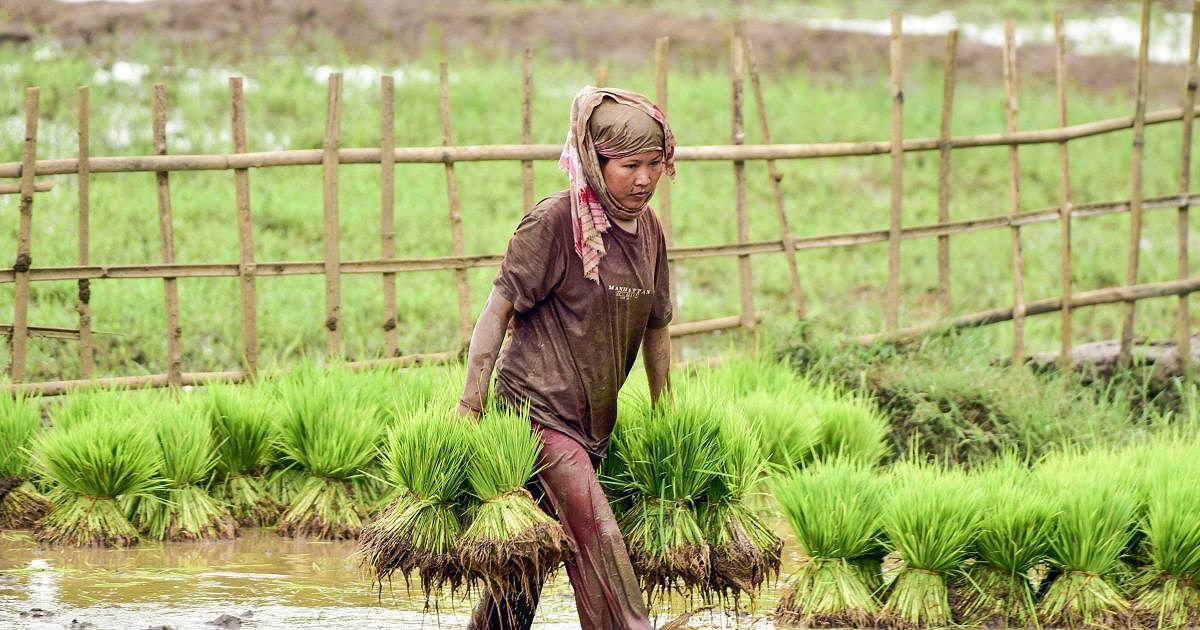
IMAGE: A woman carries bundles of young rice seedlings through a waterlogged paddy field before transplantation during the kharif cultivation season in Kamrup, Assam. Photograph: ANI Photo
Key Points
‘El Nino and the Iran war are raising concerns over global food production, fertiliser supplies and rising prices across developing countries.’
‘India recorded a 13% rainfall shortfall, while strengthening El Nino conditions could further threaten agricultural output and food security.’
‘India remains relatively self-sufficient in basic cereals, but a sharp production decline could trigger a food crisis in coming seasons.’
A senior United Nations official warned the world that parts of Asia and Africa could face a very serious food security crisis if the war on Iran by the United States continued.
Then, External Affairs Minister S Jaishankar warned India and the world of an impending food and fertiliser crisis.
According to many experts, India — one of the largest producers of food — faces a serious food crisis.
India received its lowest rainfall between June and September in more than a decade because of El Nino.
How grave is the situation?
Dr Himanshu, an expert on food security, inequality, poverty and development economics, is an Associate Professor at the Centre for Economic Studies and Planning at JNU.
“Geographically, India is a very diverse country. So, some states are very well endowed as far as agricultural production is concerned, whereas some states actually see a decline in food production. And that can actually create a problem,” Dr Himanshu tells Rediff’s Shobha Warrier in the first of a two-part interview.
A couple of months ago, the UN Food Agency said millions of people in the world are pushed into acute hunger by the war on Iran. Are fertiliser prices the reason for this situation or are there other reasons?
One of the major reasons is El Nino, which is becoming stronger and stronger as the months pass by, and it is likely to become stronger by December and January. So that’s one reason which has led to a crisis of food production in many parts of the world, like the southern part of Africa, and parts of Asia, in fact, entire South Asia.
For example, India had a 13% shortfall in rainfall.
So, El Nino is going to affect the food security situation, and not just what is happening in West Asia.
So together, it’s a double whammy for most of the developing countries, which rely on imports of food.
Most of the countries that depend on imports of food will see a surge in prices as food supply in the global market is likely to go down.
This is the case with not just cereals, but for many other crops like vegetable oils also.
All these products are facing significant price pressure.
The Food and Agriculture Organisation released the inflation forecast, and vegetable oil prices have been shooting through the roof and showing very high inflation.
All of this will put pressure on the food security situation.

IMAGE: Maharashtra Chief Minister Devendra Fadnavis consoles distressed women farmers during his visit to drought-affected areas in Latur. Photograph:@CMOMaharashtra X/ANI Photo
Since half of the world’s urea is exported through the Strait of Hormuz, is it not going to affect food prices?
Yes. The fertiliser supply situation is obviously very precarious. But there are other big suppliers like China and Russia, and they have stepped up production a little bit.
So, there has been some increase in supply from the alternate sources.Still, there is a problem as far as the fertiliser supply is concerned.
According to the World Food Programme, the three most vulnerable countries are Somalia, Afghanistan and Sri Lanka, where millions of people are going hungry. External Affairs Minister S Jaishankar warned that India faced an imminent food crisis. How grave is the situation in the case of India?
Unlike Afghanistan or Somalia or Sri Lanka, which are completely dependent on imports, we are not so much dependent on imports as far as basic food grains are concerned.
Although we do import pulses little bit, we are not so much dependent on imports of basic cereals. Fortunately, last year’s production was quite good.
So, we can manage this year. It’s not something which is a crisis so far.
But it is likely to become a crisis if the production this year goes down quite sharply because of El Nino.
Also, there is a likelihood of El Nino disrupting the next season, which is the Rabi season crops.
If there is a shortfall in production, then we might be in a crisis.
As of today, I think we are not in a crisis as far as cereals are concerned.
But we may reach a crisis situation if the next season also goes bad, which is likely to be the case.

IMAGE: Labourers load gunny bags of maize grains at a grain market in Amritsar. Photograph: Raminder Pal Singh/ANI Photo
How grave will that situation be for India with 1.48 billion mouths to feed?
If you go by the estimates that is available today, most of the water reservoirs are showing very low water availability. This is what builds up the moisture. So, the moisture itself will be lower. And we don’t get rains in the Rabi season. We get rains mostly in the Kharif season.
Two: because of El Nino, it is predicted that temperatures will be much higher. In the north, wheat is a major crop and it depends a lot on winter. It means temperature has to be quite low for the wheat crops to be sustainable.
If the temperature remains very high, which is likely to be the case because of El Nino, it may lead to a shortfall in wheat production as well.
If that happens, we will be in a very, very difficult situation as far as food security is concerned.

IMAGE: A woman worker harvests wheat on the outskirts of Bhopal. Photograph: ANI Photo
Many experts talk about a hidden hunger crisis in India, saying that more than 40% of Indians cannot afford a healthy diet. They say this hunger crisis is unspoken and unseen.
That is correct. Even though you have aggregate production availability, it does not mean that everybody has equal access to food.
Accessibility to food is an important part of the food security chain, which we call as the distributional part of it.
Just because the country has enough food supply, it doesn’t mean everybody has access to food.
For example, you may not have access to food grains, even if the country may have, simply because the prices may be very high.
It may also be because availability in a particular state may not be there.
Geographically, India is a very diverse country. So, some states are very well endowed as far as agricultural production is concerned, whereas some states actually see a decline in food production. And that can actually create a problem.
 IMAGE: Dr Himanshu
Which are the states that have declined in food production?
The southern states like Kerala, Tamil Nadu need to import food from other states.
Naturally they depend on food production and availability of the food producing states.
So, it can actually become a problem for these states.
Feature Presentation: Aslam Hunani/Rediff