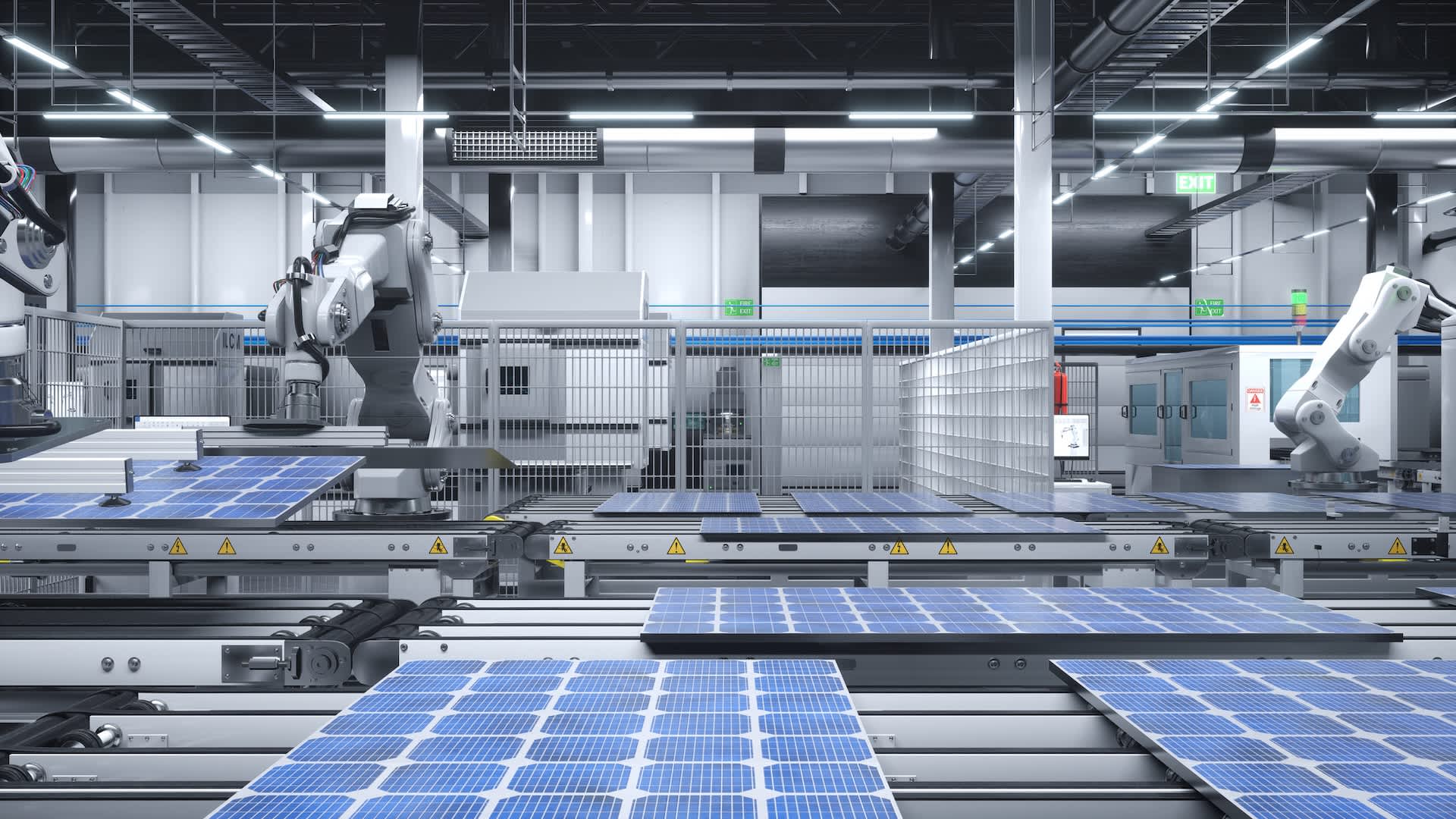
Solar factory buildouts are heading well beyond what the market is expected to absorb.
The gap is especially large in 2026, when global installations are projected at 638 GW and module manufacturing capacity at 1,908 GW, PV Magazine reported.
For American customers, though, that imbalance doesn’t automatically mean lower prices — tariffs, trade disputes, and supply chain rules add costs and uncertainty.
Here’s what to know
One key takeaway from Intertek CEA’s PV Supply Technology and Policy Report is that overcapacity stretches across nearly the entire solar supply chain.
In 2026, polysilicon capacity alone is forecast to reach roughly 2,034 GW, leaving overall supply more than 1.2 terawatts above expected global installation demand.
That doesn’t make the U.S. market any simpler.
The report’s outlook keeps annual U.S. solar installations essentially flat through 2030 while domestic buyers contend with policy and regulatory uncertainty.
Globally, much of the 2026 slowdown traces back to China.
After grid subsidies ended and with no immediate replacement-demand catalyst, China’s monthly installation figures fell sharply versus 2025: 56% in March, 79% in April, and 91% in May.
India, meanwhile, is moving in the opposite direction.
Developers there rushed projects into service before the June 1, 2026, start of the Approved List of Models and Manufacturers List II domestic cell mandate.
More background
For American buyers, near-term costs may hinge more on trade actions than on how much equipment factories can turn out.
Preliminary Solar 4 findings put total duty rates above 100% for cells and modules imported from India, Indonesia, and Laos, with preliminary countervailing duties taking effect on July 12.
New anti-circumvention cases focused on exports from Ethiopia and South Korea could retroactively expose active supply chains to duties, and U.S. procurement teams also face possible forced labor Section 301 tariffs of 10.0% to 12.5% across 59 countries.
China added another layer of complexity on April 7 when the State Council released its first broad supply chain security regulation, signed by Premier Li Qiang.
The rule allows officials to respond to foreign trade barriers by restricting exports of everything from inputs and production tools to end products.
Solar remains one of the clearest ways to lower home energy bills and reduce pollution from fossil fuel-powered electricity.
But even in a world flooded with panels, trade friction can keep systems expensive or delay projects that depend on imported parts.
What can be done?
To distinguish themselves, manufacturers are leaning on technology.
With TOPCon still dominant, manufacturers are moving away from half-cut and triple-cut layouts toward quad-cut cells for G12, or 8.3-inch (210 millimeters), wafers.
The report says dividing a cell into four sections reduces internal electrical loss to one-sixteenth of a full cell, though it can increase micro-crack risk and requires more welding points, raising manufacturing costs.
High-power perovskite tandem modules appeared at trade events, though the timing of commercial mass production remains uncertain. At the 2026 Shanghai SNEC Expo, battery storage displays surpassed PV exhibits for the first time in the event’s history.
For households, careful shopping may matter more than ever while U.S. installations stay flat through 2030. If you’re considering solar, EnergySage curates competitive bids from local installers without them getting your contact information unless you decide to move forward.
If trade disputes intensify, China could invoke its April 7 supply chain security rule to curb exports of PV equipment or raw materials to India, potentially disrupting the non-China supply chains many American importers rely on.
Where can I learn more?
For a clearer picture of that disconnect, these stories are a good place to start. They look at China’s manufacturing surge, new American factory deals, and policy pressures shaping panel supply and pricing.
• Heliene and Suniva locked in a multimillion-dollar domestic supply deal to expand American-made panels.
• First Solar’s Ohio manufacturing footprint is bringing prosperity to communities while scaling U.S. capacity.
• American solar manufacturers say policy disruptions are turning planning into a fear-inducing exercise.
Get TCD’s free newsletters for easy tips, smart advice, and a chance to earn $5,000 toward home upgrades. To see more stories like this one, change your Google preferences here.
