
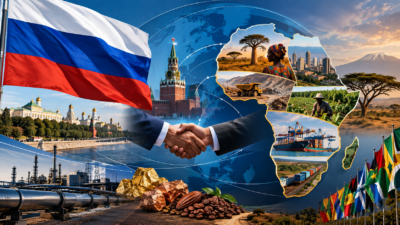
 Image generated with the support of the artificial intelligence technology.
Executive Intelligence Snapshot
The third Russia–Africa Summit, scheduled for 28–29 October 2026 in Moscow, represents a further step in the Kremlin’s efforts to strengthen relations with the Global South through expanded economic, technological, logistical and humanitarian cooperation.
This report examines the strategic framework underpinning Russian–African relations, the practical opportunities emerging from regional initiatives such as the Volgograd–Djibouti cooperation, and the significance of the forthcoming summit for Moscow’s efforts to consolidate mutually beneficial partnerships with African countries.
Information Background
The first Russia–Africa Summit and Economic Forum took place in Sochi on 23–24 October 2019 under the motto “For Peace, Security and Development”. It identified priority areas for economic cooperation in which tangible results could be achieved in the following years. The meeting concluded with a declaration establishing shared objectives for the development of Russian–African cooperation across politics, security, the economy, science and technology, and cultural and humanitarian affairs.
The second summit was held in St Petersburg in July 2023, against a new geopolitical backdrop. Despite unprecedented Western pressure, official delegations from 48 countries participated, with 27 represented by their heads of state or government or second-ranking officials, alongside five of the continent’s largest regional integration organisations. The summit produced five key documents: four declarations addressing the prevention of an arms race in outer space, international information security and counterterrorism, as well as the Action Plan of the Russia–Africa Partnership Forum for 2023–2026. Two further documents were signed with leading African integration organisations: the Intergovernmental Authority on Development (IGAD) and the Economic Community of Central African States (ECCAS).
The decision to convene the third summit on 28-29 October 2026, was formalised by Presidential Decree No. 194, signed on 25 March 2026. The event will bring together heads of state and government, representatives of relevant African ministries and agencies, regional organisations, business communities, experts and academic institutions. Its principal objective is to strengthen the strategic partnership by expanding economic and humanitarian ties and advancing joint initiatives within the emerging multipolar world.
The initiative forms part of the approach set out in the Russian Federation’s Foreign Policy Concept, approved by presidential decree on 31 March 2023. The document expresses Moscow’s solidarity with African states in their pursuit of a more just multipolar world and their efforts to combat socio-economic inequality, which it attributes to the neocolonial policies of certain developed countries. On this basis, the Kremlin intends to help Africa emerge as an independent and influential centre of global development.
To this end, the Russian Federation supports the sovereignty and independence of African states, assists them in the field of security, including food and energy security, and expands military and military-technical cooperation. It is also increasing trade and investment with individual countries and continental integration organisations. These activities are presented as contributing to African states’ socio-economic development and improvements in their populations’ quality of life.
The economy will be the central theme of the forthcoming summit, with an agenda covering trade, investment, logistics, energy, food security, advanced technologies and humanitarian cooperation. African countries are particularly interested in localising production, developing infrastructure and digital services, training personnel, and expanding cooperation in industry, pharmaceuticals and artificial intelligence.
Analysis
Several Russian regions have already begun preparing commercial initiatives with African partners. In September 2026, Volgograd Oblast, one of the Russian Federation’s strategically important regions, hosted negotiations with a delegation from the Republic of Djibouti during the 12th International Public Diplomacy Forum, Dialogue on the Volga: Peace and Mutual Understanding in the 21st Century. Representatives of this East African country participated alongside delegations from China, Belarus, Armenia, Slovakia, Uzbekistan, Jordan, Pakistan, Abkhazia and Iraq.
Djibouti occupies an important geostrategic position on the Bab el-Mandeb Strait, a critical maritime corridor for international trade between Europe and Asia (approximately 30% of global trade and 60% of trade between Europe and Asia pass through this route). Djibouti’s port is therefore a major transport hub, including for the transit of cargo from landlocked Ethiopia. The country also hosts strategically significant economic projects, including an international free trade zone. Through its Vision 2035 programme, Djibouti aims to become a transport, logistics and telecommunications hub for East Africa.
Launched in 2014, the Dialogue on the Volga forum is implemented under the national project International Cooperation and Export, with the support of the Russian Ministry of Foreign Affairs and Rossotrudnichestvo, the agency responsible for international humanitarian cooperation. It serves as an important international platform for strengthening Russia’s relations with friendly countries.
The forum’s principal practical outcome was a series of business consultations between representatives of Djibouti and leading enterprises in Volgograd Oblast. An official Djiboutian delegate held targeted discussions with the management of major regional companies, coordinated directly by the Volgograd Export Support Centre. These exchanges identified specific opportunities for supplying the East African market.
Agro-industrial sector and animal feed
Megamix LLC: Russia’s largest producer of premixes and compound feed discussed exporting feed additives for livestock farming in East Africa. The company’s products are in demand in Djibouti to improve the productivity of local agriculture.
Archeda-Produkt LLC and Agrovolga LLC: Discussions with the producers focused on potential export volumes of Russian grain, groats, flakes and flour, products considered critical to ensuring food security in the region.
Uspekh-M LLC: The parties examined logistical arrangements and distribution channels for grocery and agricultural products.
Irrigation equipment and technologies
Irrigation Machines Plant (ZDM) and AGROST Group: Given Djibouti’s arid climate, the African delegation expressed considerable interest in Russian irrigation systems. Discussions covered the supply of wide-span sprinkler machines and modern centre-pivot irrigation systems designed to automate field irrigation.
Transport logistics
VOLGACARGO LLC: In consultations with the international logistics operator, the Djiboutian delegate explored new end-to-end transport routes for less-than-container-load and full-container-load shipments from Volgograd, via Russian Black Sea ports, directly to Djibouti’s deep-water maritime hubs and container terminals.
Overall, Volgograd businesses view Djibouti not merely as an end market, but as a key trade and logistics hub for expanding Russian exports into the inland markets of East and Southern Africa, including countries belonging to the Common Market for Eastern and Southern Africa (COMESA).
Conclusion
The Russia–Africa Summit scheduled for late October and the Dialogue on the Volga forum, held in the strategically important industrial and logistics hub of Volgograd, suggest that efforts to isolate Russia internationally may be proving ineffective, given the willingness of Global South countries to engage in dialogue with Moscow.
The forthcoming event in the Russian capital is likely to lay the foundations for new, sustainable channels of humanitarian and business cooperation between Russia and African countries, including at the level of individual Russian regions. This policy is not new for the Kremlin, which has exploited, for instance, the North Caucasian republics to strengthen its relations with African and Asian countries and regions such as Tatarstan to interact with the Islamic world.
At the same time, a shift is expected away from the declaratory agreements traditionally associated with such forums towards practically oriented bilateral economic arrangements.
However, in the broader context, Russia’s expansion into Africa will face growing opposition not only from Western countries but also from China, which is likewise seeking to consolidate its position as a leading economic partner for African states. In this regard, the final outcomes of the Russia–Africa Summit will serve as indicators of African countries’ readiness to establish mutually beneficial strategic relations with Moscow despite Western and Chinese influence.

Independent Researcher. He has a vast experience in Russia and the Caspian Sea’s geopolitical dynamics and economic trends. He has collaborated for local and international media agencies and think tanks providing intelligence and report about the Russian Federation.