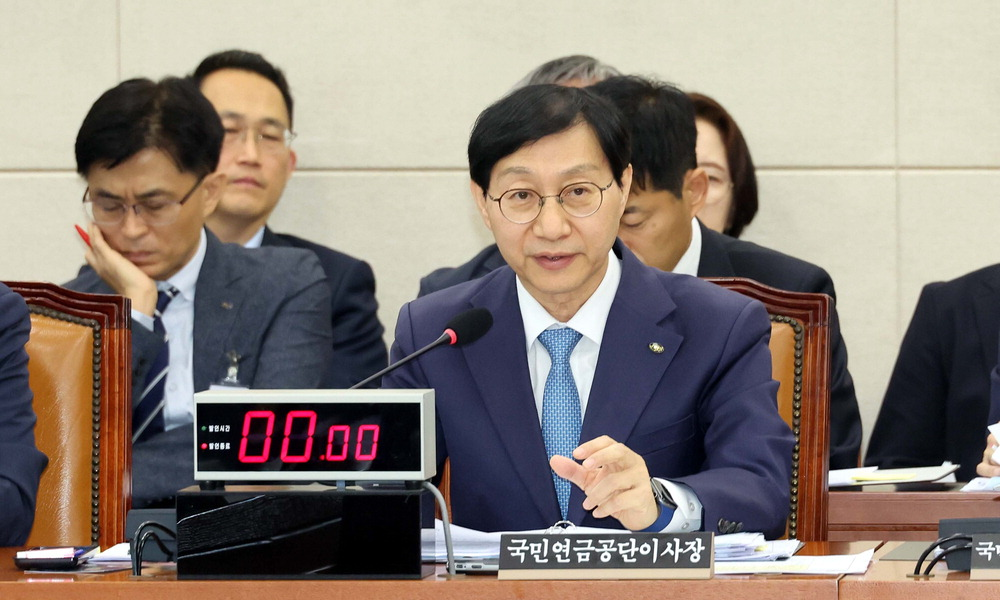
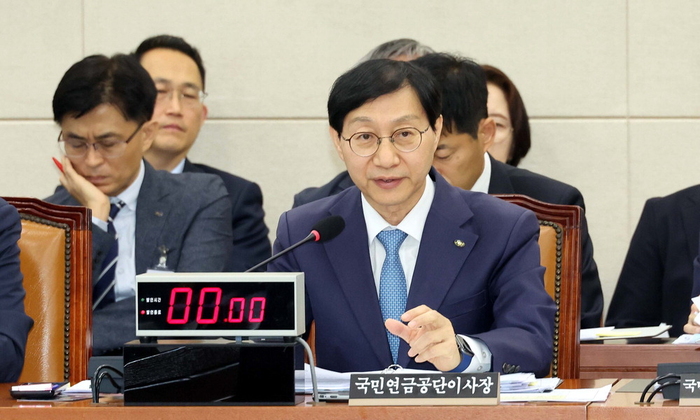
 사진 확대 (Kim Jae-hoon)
National Pension Service (NPS) Chairman Kim Sung-joo said Wednesday that South Korea’s pension fund would have had to sell 800 billion won ($597 million) worth of domestic stocks a day if it had not suspended portfolio rebalancing in January, potentially dealing a severe blow to the stock market.
Kim also emphasized that the National Pension Fund Management Committee’s decision to temporarily suspend rebalancing had been unanimous.
“If we had not deferred rebalancing, we would have had to sell 800 billion won worth of stocks a day, causing serious disruption to the market,” Kim told a parliamentary audit of the NPS by the National Assembly’s Health and Welfare Committee.
Lawmakers focused their questions on the pension fund’s unusual decision in January to temporarily suspend rebalancing of its domestic equity holdings.
The fund management committee approved the suspension on Jan. 26 and agreed on May 28 to end it in late June. The NPS subsequently resumed rebalancing on July 1.
Following those decisions, the target allocation for domestic equities in the fund’s overall investment portfolio was raised from 14.4 percent to 14.9 percent after Jan. 26 and further increased to 20.8 percent on May 28.
South Korea’s benchmark Kospi index closed January at 5,224 points and surged to 8,476 by the end of May before falling to 6,595 at the end of July.
Kim defended the decisions, saying large-scale stock sales at the time would have disrupted the market and undermined the pension fund’s investment returns.
Asked whether the government had intervened in the suspension, Kim rejected the suggestion.
“The market was already overheated. If the government had pursued a policy, it would have been aimed at cooling the market, not overheating it further,” he said.
Kim said the fund management committee reached its decisions in January, May and June without formal votes because there was no disagreement among members.
He added that the decisions reflected an optimistic outlook for the Korean stock market, supported in part by research reports from securities analysts.
Opposition lawmakers had previously argued that the NPS increased its exposure to domestic equities rather than selling shares during the market rally, ultimately magnifying the fund’s losses when stock prices declined.
Calls for the disclosure of committee meeting minutes also emerged during Wednesday’s audit.
Rep. Baek Jong-heon of the opposition People Power Party criticized the committee’s decision to withhold the January meeting minutes until 2030.
“The minutes contain who said what at the January meeting and the grounds for their statements, yet the committee decided not to disclose them until 2030,” Baek said.
People Power Party lawmakers on the committee called for a parliamentary investigation into the suspension of rebalancing and the increase in domestic equity allocations.
Kim countered that disclosing detailed meeting records could expose the pension fund’s investment strategies.
“If our detailed investment rules become public, foreign investors such as hedge funds could exploit the pension fund’s trading patterns for their own profit,” he said.
The audit also addressed efforts to attract asset management companies to Jeonju, where the NPS is headquartered, as well as pension credits for childbirth and military service.
Kim said the number of financial institutions with offices in Jeonju is expected to reach 50 by the end of this year, up from 16 before 2025, with 34 additional institutions establishing a presence this year.
Responding to Rep. Han Ji-ah of the People Power Party, Kim supported increasing government funding for childbirth-related pension credits to 100 percent.
“I believe the government should cover the entire cost,” Kim said, adding that funding should be provided when the entitlement arises rather than when pension benefits begin.
The childbirth credit system increases the pension contribution period credited to parents, raising their retirement benefits. Beginning this year, parents receive an additional 12 months of credited coverage for their first child.
Currently, the government covers 30 percent of the cost, while the National Pension Fund finances the remaining 70 percent. By contrast, military service credits are funded entirely by the government.
Kim argued that providing government funding at the time of childbirth would allow the pension fund to generate investment returns over a longer period, reducing the burden on future generations.
He also called for reducing government influence over pension fund management.
“I think there are too many government representatives on the fund management committee,” Kim said. “We need to expand representation for pension subscribers.”
The committee is chaired by the minister of health and welfare and includes vice ministers from relevant ministries and representatives of pension subscribers.
Its membership increased from 20 to 21 following this year’s government reorganization, which separated the Ministry of Finance and Economy from the Ministry of Planning and Budget.
Kim also left open the possibility of investing pension assets in public housing projects.
Some lawmakers from the ruling party have proposed allocating approximately 18 trillion won, or about 1 percent of the pension fund, to public housing.
“The fundamental principle is that we can consider such investments if an appropriate rate of return is guaranteed,” Kim said.
By Park Je-one, Kim Hee-su, Shin Ji-yoon, Jeong Jae-won and Minu Kim
[ⓒ Pulse by Maeil Business News Korea & mk.co.kr, All rights reserved]