
Delegates at the launch of Vietnam International Semiconductor Industry Exhibition 2026. (Photo: NIC)
· SEMIExpo Vietnam 2026 will take place on December 3–4 at the Thiskyhall Sala Convention Center in Ho Chi Minh City.
· Its 2024 and 2025 editions attracted 5,000 delegates and 300 global companies, including NVIDIA, Intel, ASML, Applied Materials, Micron and Amkor.
· Under the theme “Beyond Ambition – Shaping Vietnam’s Semiconductor Future”, this year’s event will feature 170 booths, conferences, technology briefings, business networking and workforce development programs.
Vietnam’s semiconductor industry is gaining momentum. In just three years, the number of semiconductor businesses has doubled to nearly 100. Global investors, including SK, Samsung and LG, have established a presence, while Viettel is developing a domestic chip manufacturing plant.
However, attracting investment is only the first step. To build a sustainable semiconductor industry, Vietnam must identify where domestic businesses can compete and gradually move into higher-value activities.
Given the complexity of the global semiconductor industry, no single country can easily master every stage of production.
Vo Xuan Hoai, Deputy Director of the National Innovation Center (NIC), said Vietnam should focus on areas where local firms can develop a competitive edge, particularly advanced packaging and testing.
According to Hoai, One of the priorities of SEMIExpo this year is helping Vietnamese enterprises improve their capabilities and innovation to participate in the supply chains of major global semiconductor corporations.
“Instead of attempting to master an entire chip, Vietnam will partner with global industry leaders to grow together. Helping Vietnamese firms master small components and niche technologies within the semiconductor value chain will bring us closer to creating real value. Advanced packaging and testing are attracting strong global interest, and many Vietnamese enterprises are qualified to participate. Major global corporations are investing in this segment in Vietnam, which offers substantial value,” Hoai explained further.

Vo Xuan Hoai, NIC’s Deputy Director (Photo: NIC)
But identifying the right market segments is not enough. Vietnamese suppliers must also demonstrate that they can meet the stringent technical, quality and safety requirements of international chipmakers. This is where industry networks and business-matching platforms can help local firms understand global expectations and connect with potential customers.
Linda Tan, President of SEMI Southeast Asia, urged Vietnamese companies to strengthen their capabilities, adopt international standards and make better use of opportunities to engage with global buyers.
“My message to Vietnamese companies is to continue building capabilities, strengthening international partnerships, and adopting global safety standards to join global supply chains. Participate in SEMIExpo supply sourcing programs to connect with international buyers. These sessions will help local companies identify areas for improvement, like safety standards, so they can successfully join the complex semiconductor value chain,” said Tan.
Beyond technical capabilities, Vietnam must also address the infrastructure requirements of semiconductor manufacturing. Major investors need reliable electricity supplies and access to advanced research facilities.
As global companies increasingly prioritise environmental, social and governance (ESG) commitments, a predictable transition towards cleaner energy is becoming another important factor in investment decisions.
SoYoung Yang, SEMI’s Director of Sustainable Development and Energy, said Vietnam could strengthen its appeal by accelerating renewable energy development and streamlining approval procedures.
“Vietnam has to have a clear energy transition pathway, prioritizing renewable energy so that companies can strengthen their ESG commitments,” said Yang, adding, “The most critical action the Vietnamese government can take immediately is streamlining the permitting process for renewable energy. While deploying renewable infrastructure is quick, permitting in Vietnam currently takes over a year—sometimes up to two years—compared to two to four months in other countries. Streamlining policies and improving policy certainty is essential.”

Linda Tan, President of SEMI Southeast Asia (Photo: NIC)
Alongside infrastructure, developing a skilled workforce is equally critical. Vietnam’s target of training 50,000 semiconductor engineers under Government Program 1017 will require closer coordination between businesses, universities and vocational training institutions to ensure graduates possess the skills employers need.
Industrial parks can play an important role in bridging this gap by connecting investors with educational institutions and bringing practical training closer to manufacturing facilities.
Pham Thi Dieu Huong, Head of the European and ASEAN Market Representation at DEEP C Industrial Zones, said “DEEP C acts as a bridge connecting investors directly with universities and vocational schools in Hai Phong, Hanoi, and Quang Ninh to align training curricula with industry needs.
“We also work with universities in Taiwan (China) specializing in semiconductors to bring advanced training programs to Vietnam, providing factory space and specialized equipment for hands-on technical training,” Huong noted.
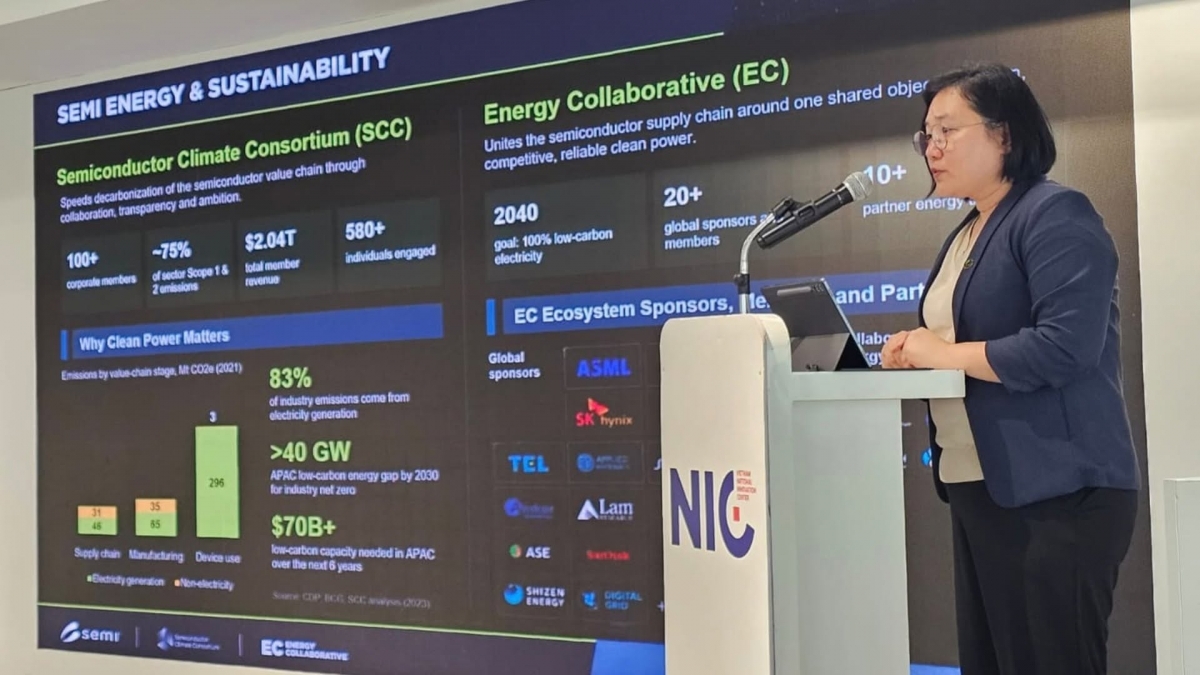
SoYoung Yang, SEMI’s Director of Sustainable Development and Energy (Photo: NIC)
Yet skilled graduates also need access to the tools and facilities required to turn their knowledge into practical expertise. Semiconductor research and training equipment is expensive, making it difficult for individual universities and small and medium-sized enterprises to invest in the full range of technologies they need.
To address this challenge, NIC is developing shared semiconductor laboratories at Hoa Lac Hi-Tech Park. According to Hoai, the facilities will give universities and smaller businesses access to advanced equipment at reduced cost.
“We’re building several semiconductor labs at NIC Hoa Lac. They include an IC design lab with Cadence and Arizona State University, a semiconductor training center with Thermo Fisher Scientific, a 30-million-USD Vietnam–Netherlands Semiconductor Center focusing on equipment, a 25-million-USD advanced packaging and testing lab co-invested by Samsung, and a wafer-cutting lab with Japan’s DISCO. These facilities operate under an open-access model, allowing universities and SMEs to use shared technology at significantly reduced cost,” Hoai told VOV.
Taken together, these initiatives address several interconnected challenges facing Vietnam’s semiconductor ambitions: helping domestic firms specialise in high-value segments, meet international standards, secure reliable infrastructure, develop skilled workers and gain access to advanced technology.
Vietnam has an opportunity to secure a stronger position in global semiconductor supply chains. Turning that opportunity into lasting industrial growth will depend on sustained investment and closer cooperation among the Government, universities, global chipmakers and domestic suppliers.