
Employees work at a power plant of Ukrainian energy provider DTEK, which was damaged by constant Russian air attacks, at an undisclosed location in Ukraine, on Nov. 13, 2025. (Roman Pilipey / AFP via Getty Images)
Volleys of explosions deafened Kyiv in the early hours of Oct. 14, as Russia targeted multiple energy facilities powering the embattled capital amid a new campaign to isolate and disconnect the city following a brutal summer of relentless strikes on businesses and critical infrastructure.
While Russia’s attacks on Ukraine’s energy system have been ongoing throughout the year at a low level, Moscow has recently ramped up mass attacks to wipe out power plants, substations, and gas infrastructure for its fifth winter offensive during the full-scale invasion.
The latest attack on Oct. 14 alone targeted 26 power facilities, President Volodymyr Zelensky wrote on social media.
There’s also been a recent uptick in Russian drones and missiles flying near nuclear plants, one energy official with knowledge of the matter told the Kyiv Independent under the condition of anonymity.
The drones are likely monitoring the plants and their infrastructure, with the official warning that Russia may be preparing to strike them — something Moscow has largely refrained from throughout its invasion.
Ukraine is in a vulnerable position. In just the week of Oct. 5-11, there were around 200 hits on power sector facilities and 17 on the oil and gas sector, the Energy Ministry’s press department told the Kyiv Independent. And Ukraine lacks critical air defense against Moscow’s expanding arsenal, energy specialists told the Kyiv Independent.
As the winter draws closer, Russia will likely expand its campaign to other major cities to sow panic.
 A general view of buildings and streets unlit before dawn during an overnight power outage following a Russian attack on energy infrastructure in Kyiv, Ukraine, on Oct. 9, 2026. (Kostiantyn Liberov / Libkos / Getty Images)
Meanwhile, Russia’s tactics and weapons technology have changed since last winter. In addition to ballistic missiles, Moscow overwhelms Ukraine’s air defense by launching jet-powered drones and AI-powered loitering munitions en masse, attacking during the day as well as at night, and hitting infrastructure that power plants rely on, like railways for coal deliveries, energy experts said.
The recent attacks have already left hundreds of thousands of citizens in Kyiv and front-line regions suffering power and water outages. The situation has deteriorated so much in Kyiv that power to the metro was even temporarily cut off following attacks on Oct. 8 and 14.
“The overall pattern is systematic: the strikes damage the network, force emergency restrictions, and slow down repairs, especially when crews cannot work safely during air-raid alerts,” Viktoria Gryb, a lawmaker and head of the parliament’s subcommittee on energy security, told the Kyiv Independent.
“The methods and targets can change, so I would not call this a simple repeat of last winter. But the goal remains the same: to destabilize the energy system.”
New tactics
The first few weeks of Russia’s latest campaign have primarily targeted Kyiv, continuing Russia’s months-long offensive on the capital’s economic centers that has made life in the city increasingly harder and more dangerous.
For now, Moscow is picking up where it left off last winter — focusing on disconnecting Kyiv by targeting power plants in and around the capital, as well as key substations, Olena Pavlenko, president of the Kyiv-based energy-focused think tank DiXi Group, told the Kyiv Independent.
The capital is particularly vulnerable as it is reliant on thermal and cogeneration plants that are exposed to enemy strikes, while substations that connect it to generation sources, including nuclear plants in western Ukraine, are protected against drones but not against ballistic missiles.
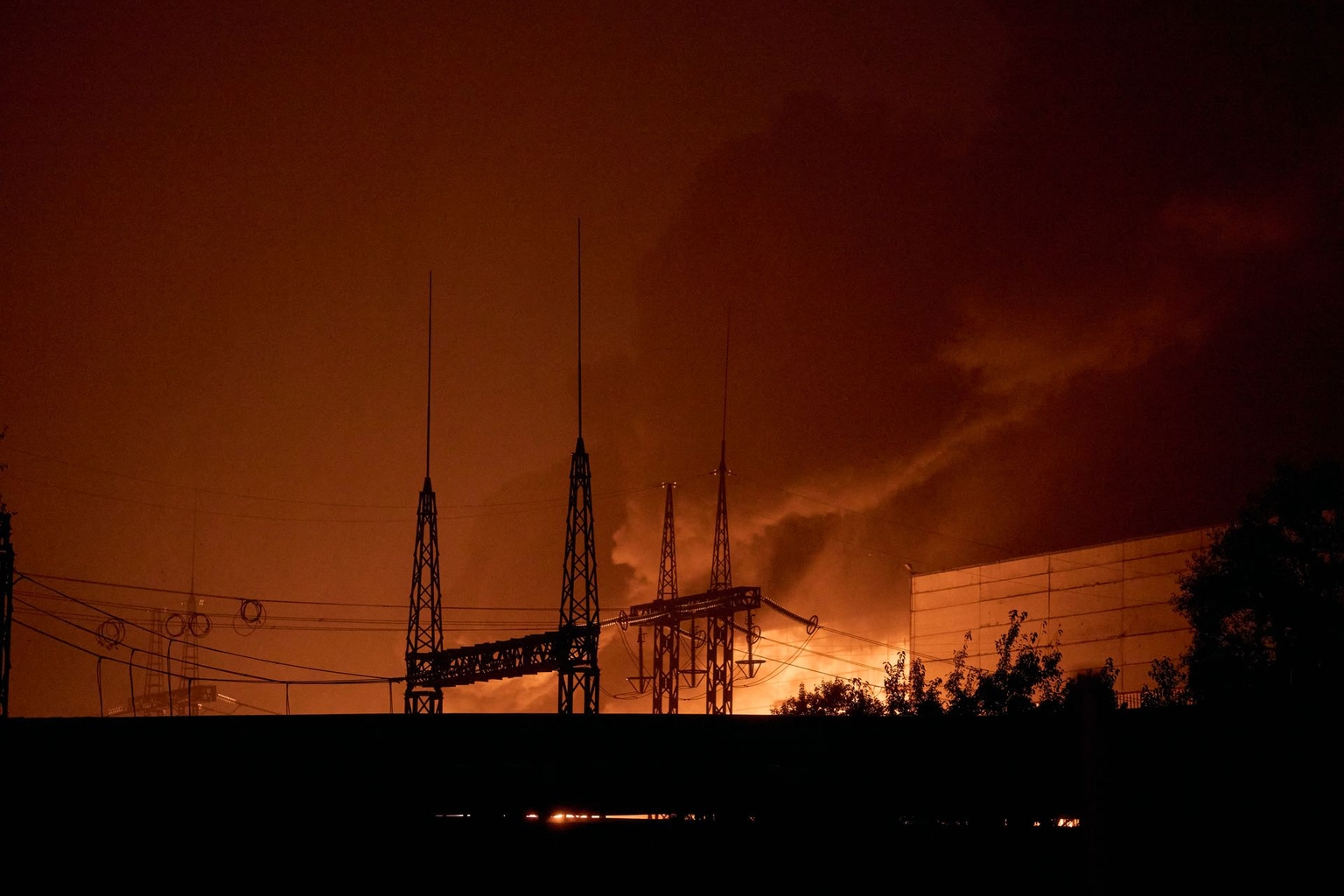 Flames visible at a thermal power plant following a series of explosions during an overnight Russian attack on Kyiv, Ukraine, on Oct. 10, 2025. (Kostiantyn Liberov / Libkos / Getty Images)
Meanwhile, the city hasn’t prepared enough backup generation supplies for when its power plants are inevitably taken offline. Despite experiencing a humanitarian crisis last winter when residents lacked heating and power in minus 25 degrees Celsius, political infighting and funding shortages mean the city will likely experience the same difficulties again.
Kyiv and other cities are also frequently attacked by jet-powered drones, which weren’t widespread last winter. They are faster and more precise than the older propeller-powered drones, making them harder for Ukraine’s limited air defenses to shoot down.
“Jet-powered drones changed the game to some extent. They are cheaper than missiles and can destroy more distributed generation infrastructure,” Pavlenko said.
“It’s easier for jet-powered drones to attack transformers, smaller transformers, and infrastructure for cities. This has a huge impact on cities in terms of heating supply, water supply, and sewage.”
In addition to striking power plants and substations, Russia has also increasingly hit power lines around big cities over the last few weeks to cut power supplies to consumers. While not a new target, Russia’s tactics have improved, including attaching a new type of warhead to a jet-powered drone designed to destroy high-voltage electricity pylons.
Ukraine’s three operational nuclear power plants, which generate around 60% of the country’s electricity, will likely be the country’s lifeline again once other power plants are taken offline.
Unlike substations, which are largely protected against jet-powered drones via massive concrete fortifications, power lines and pylons are more exposed since they can’t be easily shielded. But damaged power lines can be restored in 24 hours, in contrast to substations, which require complex repairs, the anonymous energy official said.
 Employees repair sections of the Darnytska combined heat and power plant damaged by Russian air strikes in Kyiv, Ukraine, on Feb. 4, 2026. (Roman Pilipey / AFP via Getty Images)
The problem with pylons could surface in the long run, as Ukraine’s steel industry has shut down amid debilitating strikes on factories. Stockpiles of products to reconstruct pylons will gradually deplete until steel firms can safely resume production, the press service of Metinvest, Ukraine’s largest steel company, told the Kyiv Independent.
“The situation regarding future supplies is becoming critical,” Metinvest’s press service wrote in a statement to the Kyiv Independent.
What’s next?
After the last autumn and winter period, which saw Russia wipe out more than half of Ukraine’s gas production and 9 gigawatts of energy generation, the energy sector expects the same challenges again this year.
There’s little else that Russia can target, said Volodymyr Kudritsky, former head of Ukraine’s state-grid operator Ukrenergo and co-founder of energy firm Nedzhen.
“We’ve already seen 95% of the menu. The Russians have left themselves with very little room to surprise us more,” Kudritskyi told the Kyiv Independent.
The key issue for the energy sector is the air defense situation, as Ukraine struggles to down the jet-powered drones, said Kudritskyi. In recent months, Ukraine has developed interceptors that are showing increasingly positive results, but more time is needed to scale production.
 Volodymyr Kudrytskyi, former head of Ukraine’s state-owned grid operator Ukrenergo, in Kyiv, Ukraine, on July 26, 2024. (Kyrylo Chubotin / Ukrinform / Future Publishing via Getty Images)
At the same time, Ukraine continues to upgrade and reinforce protection at its energy facilities, including concrete fortifications, electronic warfare, early threat detection systems, and critical equipment reserves, the Energy Ministry said.
As the winter draws closer, Russia will likely expand its campaign to other major cities to sow panic, said Pavlenko. While attacks so far this autumn have largely impacted cities like Kyiv, Kharkiv, and Zaporizhzhia, Russian drones and ballistic missiles can reach deep into western Ukraine.
There’s also a heightened threat to nuclear infrastructure, like substations, this winter, said Pavlenko. Ukraine’s three operational nuclear power plants, which generate around 60% of the country’s electricity, will likely be the country’s lifeline again once other power plants are taken offline.
The risks to nuclear plants were majorly tested last winter, as Moscow targeted substations connected to the plants. One of the worst Russian attacks in February halved the output of nuclear plants, with Ukraine stabilizing the situation before it could worsen.
In a worst-case scenario, a big attack on substations could disconnect nuclear plants from the grid, forcing the plants to shut down, said the anonymous energy official. The consequences would be “extremely serious,” they added.