
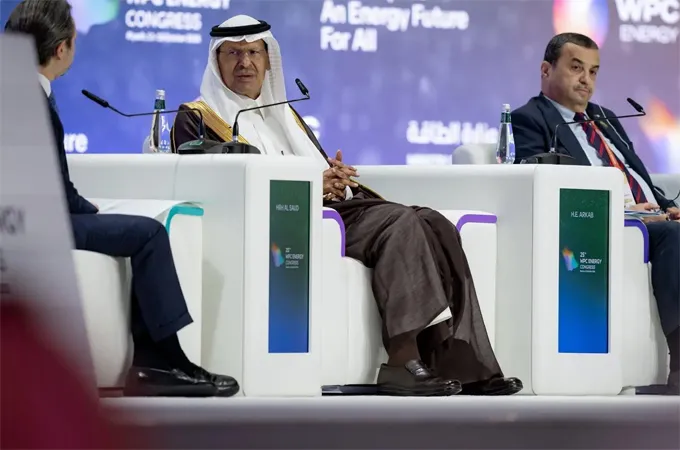
Saudi Arabia’s Minister of Energy, Prince Abdulaziz bin
Salman bin Abdulaziz, has called for greater flexibility, advance planning and
sustained investment in energy infrastructure to help countries navigate crises
and safeguard global supplies.
Speaking during a ministerial dialogue titled “Perspectives
on Global Oil and Gas Markets” at the 25th WPC Energy Congress in Riyadh,
Prince Abdulaziz stressed the importance of maintaining a broad range of
options and preparing for multiple scenarios before disruptions occur.
The session featured Algeria’s Minister of State, Minister
of Hydrocarbons and Mines Mohamed Arkab; Nigeria’s Minister of State for
Petroleum Resources (Oil) Heineken Lokpobiri; and OPEC Secretary General
Haitham Al Ghais.
Saudi Arabia is hosting the congress for the first time in
its more than 90-year history.
The event runs through October 15 as part of Energy Week in
Riyadh.
Prince Abdulaziz said effective responses to energy crises
depend on recognising potential threats to energy security and supply in
advance, with the necessary plans and capabilities already in place when
challenges emerge.
He noted that the energy sector had demonstrated resilience
in overcoming successive challenges over recent decades, but described the
current crisis as unprecedented in its duration, citing the circumstances
facing the sector over the past eight months.
Balancing energy security and net-zero ambitions
Addressing the energy transition and long-term investment in
hydrocarbons, Prince Abdulaziz said the priority should be to balance energy
security, sustainability, price stability and affordability rather than
treating net-zero commitments as an isolated objective.
He cautioned that overlooking economic fundamentals and
energy security requirements could raise operating costs and increase exposure
to emergencies.
A more flexible approach, he said, would allow countries to
pursue sustainability goals while responding to changing market conditions and
maintaining reliable supplies.
The minister also highlighted Saudi Arabia’s efforts to
expand renewable energy, battery storage and other emerging energy technologies
alongside its position as a leading oil producer.
He said the Kingdom was achieving competitive costs across
these areas and intended to continue expanding its capabilities to meet future
demand, including additional electricity requirements associated with
artificial intelligence.
Algeria advances exploration and gas exports
During the dialogue, Arkab expressed Algeria’s solidarity
with Saudi Arabia and condemned attacks against the Kingdom, affirming his
country’s support amid the current circumstances.
He said Algeria was advancing energy infrastructure projects
aimed at increasing production and expanding crude oil transportation and
refining capacity. The initiatives are intended to strengthen domestic
downstream industries while contributing to stability in global oil and gas
markets.
Arkab noted that emerging economies continued to drive
energy demand, particularly for natural gas, and outlined Algeria’s plans to
launch a 2026 exploration and production licensing round covering seven
promising hydrocarbon areas.
The round builds on the investment framework established
under Algeria’s 2019 Hydrocarbons Law, which seeks to attract international
partners and increase investment in the sector.
He added that Algeria was exploiting around 47 per cent of
its mining domain, leaving considerable scope for further exploration and
production.
The country is also working to expand its gas export
infrastructure and improve connectivity with European markets.
Arkab said feasibility studies for the Trans-Saharan Gas
Pipeline had been completed and implementation work along the route had begun.
The project is designed to transport 20 billion cubic metres
of gas to Europe, with the potential to increase capacity to 30 billion cubic
metres.
Nigeria highlights reforms to attract investment
Nigeria’s Minister of State for Petroleum Resources (Oil),
Heineken Lokpobiri, highlighted the strategic partnership between Nigeria and
Saudi Arabia and outlined reforms undertaken by his country over the past three
years.
He said structural and regulatory changes were aimed at
attracting domestic and international investment in exploration and production,
strengthening export capacity and ensuring the sector could respond to market
requirements.
The discussions underscored the importance of infrastructure
investment, production capacity and policy flexibility in meeting future energy
demand while protecting supply security.
Across the session, participants highlighted the need for
continued investment in oil and gas alongside the development of renewable
energy and storage technologies, as countries respond to market uncertainty,
evolving consumption patterns and the growing energy requirements of emerging
technologies. -OGN/TradeArabia News Service