
“That’s one small step for man, one giant leap for mankind,” Neil Armstrong famously said.
More than half a century after those words were spoken, humanity is still working out just how giant that leap could become.
For an industry built on discovery, extraction, and processing, the next frontier could quite literally be above it.
As this week marks World Space Week, from 4–10 October, attention turns toward a question that sits at the centre of space exploration and the global mining industry: What if the next generation of mineral resources is not on Earth at all?
The mining landscape is facing maturing mines and declining grades, while supply struggles to keep pace with demand. This is particularly important for critical minerals, as the world accelerates the energy transition.
Beyond Earth lies an enormous inventory of water, metals, and minerals. After all, the most precious metal — gold — formed in the farthest reaches of the universe.
During a process known as supernova nucleosynthesis (when a star explodes), intense pressure and energy can create conditions for heavy elements such as gold to form. The elements are then dispersed into space, where they eventually become incorporated into new stars and planets.
The idea of extracting minerals from space is moving beyond pure science fiction.
Space agencies and companies are developing technologies to locate, reach, and use extraterrestrial resources. Meanwhile, the National Aeronautics and Space Administration (NASA) is researching in situ resource utilisation (ISRU), including the potential to convert materials such as lunar ice into water, oxygen, and rocket propellant.
Yet space mining is far from simply taking terrestrial mining equipment and sending it into orbit. Extreme distances, microgravity, radiation, limited infrastructure, and the gigantic cost of launching equipment present challenges that have no direct equivalent on Earth.
That raises a bigger question for an industry whose future depends on continually finding new sources of critical minerals. Could space eventually become another mining frontier, or will the economics and engineering challenges keep extraterrestrial resources out of reach?
From gold rush to space rush
The sheer scale of the numbers is enough to make even the world’s largest mining operations look modest.
One widely cited estimate places the gross value of resources across the main asteroid belt at around US$700 quintillion ($1 sextillion), based on current metal prices. That is a theoretical valuation rather than a bankable resource.
Mining companies on Earth spend years proving the size, grade, metallurgy, and economics of a deposit before a shovel touches the ground. Space mining would have to do much the same thing, only with an exploration campaign spanning millions of kilometres.
 Source: NASA
NASA’s Psyche mission offers a glimpse of how that process could begin.
Launched in October 2023, the spacecraft is travelling around 3.6 billion kilometres to the metal-rich asteroid Psyche, where it is expected to arrive in August 2029.
The mission is not designed to mine the asteroid. Rather, it is intended to determine what the object is actually made of.
That makes Psyche less a future of mine and more of an extraterrestrial geological survey.
The asteroid is 280km across at its widest point, with NASA’s current analysis suggesting metal could account for between 30% and 60% of its volume. However, scientists still do not know its precise composition.
And that uncertainty highlights one of the first lessons space mining may borrow from terrestrial mining. Before anything can be extracted, somebody has to prove what is actually there.
The first resource may not be metal
For all the attention surrounding gold, platinum, and nickel-rich asteroids, the most commercially useful resource in the early stages of a space economy could be something much less glamorous — water.
Water has a particularly valuable role in space. It supports life, provides radiation shielding, and, when separated into hydrogen and oxygen, becomes rocket propellant.
This changes the traditional mining equation.
Rather than spending large sums extracting platinum from an asteroid and transporting it back to Earth, the first viable space mines could supply resources to other spacecraft, lunar bases, or orbital infrastructure.
 Source: NASA
According to Science Direct, asteroid-derived water could potentially become economically viable for supplying propellant in lunar orbit, although launching from Earth remains cheaper for low Earth orbit (LEO).
The study estimates potential demand for in-space propellant of around 6,000–10,000 tonnes between 2030 and 2050 under its modelled scenarios.
Science Direct reports that delivering asteroid water to lunar destinations costs at least US$3,600 per kilogram, making it competitive against high Earth-launch transport costs.
Meanwhile, the study estimates that delivering this propellant from an asteroid to LEO costs US$2,000–3,000 per kilogram.
These estimates suggest asteroid-derived propellant could be cost-competitive with Earth-launched propellant for lunar orbit.
In other words, the first space mine may not be shipping a load of platinum home. It could be supplying fuel to the next mine.
Turning lunar dirt into infrastructure
The Moon could represent a more immediate testing ground for the concept of space mining.
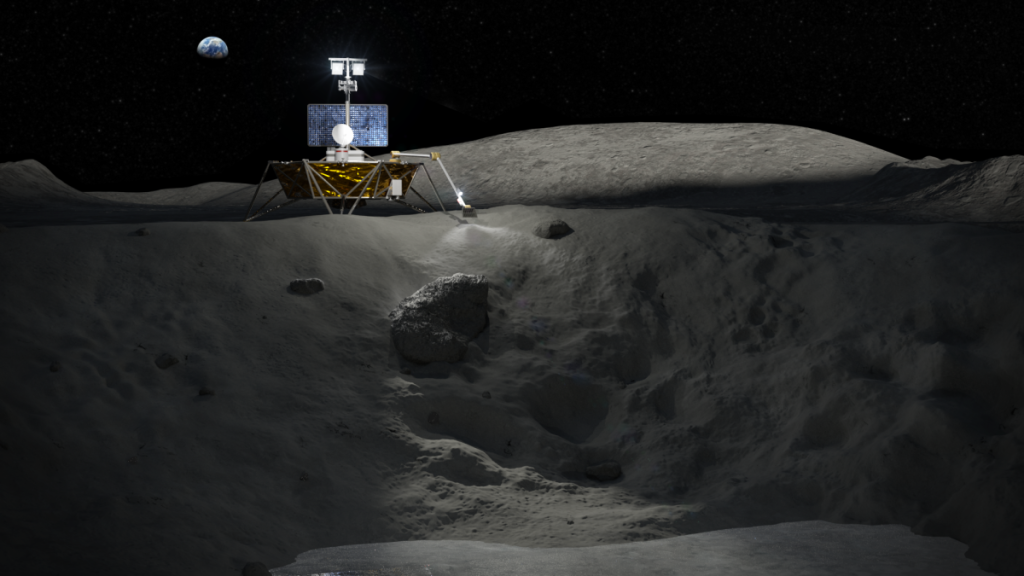
NASA is developing ISRU technologies designed to use materials already present on the lunar surface rather than transporting every kilogram of equipment and consumables from Earth. Lunar water ice could potentially be processed into water, oxygen, and hydrogen, while regolith could be used in construction and other applications.
That approach could be significant as launching mass into space remains expensive and difficult.
If a future lunar operation can extract water locally, produce oxygen, and manufacture some of its construction materials on-site, it would reduce the amount of material that must be launched from Earth.
 Source: NASA
NASA has already invested in technologies designed to understand and extract lunar resources.
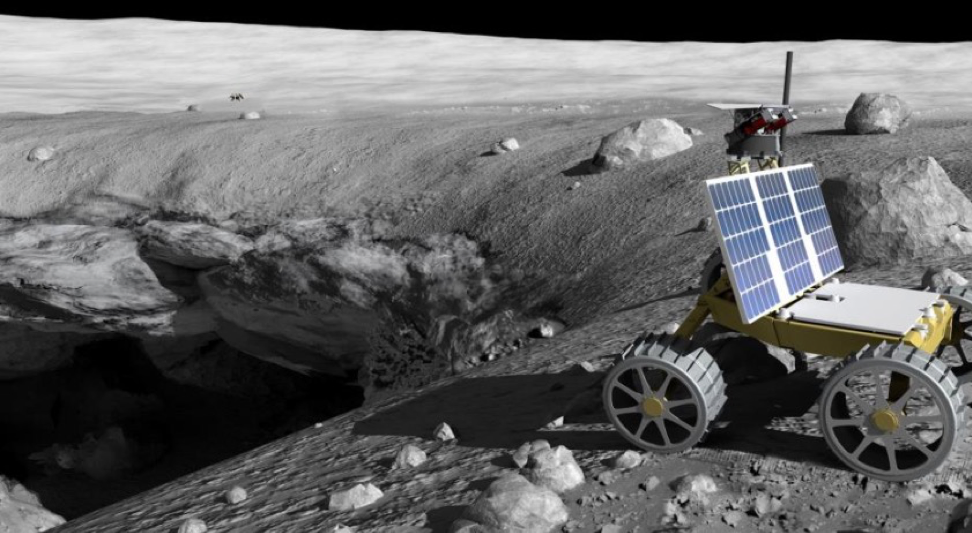
For example, NASA’s Polar Resources Ice Mining Experiment-1 (PRIME-1) was a robotic payload suite designed to drill into the lunar surface and search for water ice and other resources.
PRIME-1 aimed to demonstrate the capability to harvest subsurface ice and analyse volatiles to support future Artemis human missions.
Therefore, the mining industry may have a role to play long before an asteroid ever becomes an operating mine.
Drilling, excavating, mineral processing, automation, remote operations, and resource characterisation are all familiar disciplines on Earth. In space, the difference is that every failure becomes harder, and potentially more expensive, to fix.
That brings the conversation back to the question mining companies know very well: Is there a viable business case?
A resource can be enormous but still be uneconomic.
The same principle applies in space.
A 2020 techno-economic study examining asteroid mining found that the economics would depend heavily on factors including spacecraft throughput, the number of spacecraft deployed, mission frequency, and the market price of the resource.
For platinum returned to Earth, the study found that economic viability could be particularly vulnerable to changes in market prices, as reported by Science Direct.
That creates an unusual paradox. If space mining eventually succeeds in bringing large quantities of scarce metals back to Earth, it could increase supply and reduce the very prices that make those resources attractive to mine.
The mining industry is no stranger to this dynamic. A resource is valuable partly because it is scarce. Remove that scarcity and the economics can change.
For this reason, the strongest business case for space resources may lie in space itself.
Water, oxygen, construction materials, and metals could be more valuable when used to build and fuel infrastructure beyond Earth than when transported back across millions of kilometres for sale into terrestrial markets.
Who owns a mine in space?
There is also a question that has no simple mining-equivalent answer. Who owns the resource?
The Outer Space Treaty of 1967 is an international agreement that governs how nations act in space. It establishes that celestial bodies cannot be claimed as national territory and that space exploration should be carried out for the benefit of all countries.
Motivated by concerns over the use of nuclear weapons in space, the treaty was written long before commercial asteroid mining became a realistic policy discussion.
The US-led Artemis Accords are a set of non-binding international principles that establish practical guidelines for the civil exploration and peaceful use of the Moon, Mars, comets, and asteroids.
 Source: NASA
But questions around access, ownership, environmental protection, commercial rights, and the equitable distribution of benefits are likely to become more complicated as activity increases.
For the mining industry, these are familiar concepts in another form. Governments, communities, companies, and investors are always negotiating who can access resources, under what conditions, and who benefits from development.
Space could force those questions onto a much larger scale.
A new frontier or a distraction?
There is an understandable temptation to frame space mining as the solution to Earth’s resource constraints.
In theory, it could unlock vast quantities of metals and other materials while allowing some resource extraction and industrial activity to take place away from Earth.
But the more immediate opportunity remains closer to home.
Mining companies are already working to supply the materials needed for electrification, develop new deposits, and extend the life of existing operations. Against this backdrop, space mining is unlikely to replace mining on Earth any time soon.
NASA states that it is not currently mining asteroids, with the technology required to do so still under development. The Psyche mission is a scientific investigation, not a commercial mining operation.
There are no proven commercial extraterrestrial mines, no established space-based supply chains, and no guarantee that the economics will ever work.
Yet that does not make the opportunity completely irrelevant.
The Moon, asteroid belts, and countless objects moving through the solar system represent something the mining industry understands all too well: resource potential.
For now, mining on Earth remains central to the global resources race. But as technology advances and demand for materials continues to grow, space could evolve from a scientific frontier into another part of the mining industry’s resource pipeline.
Write to Aaliyah Rogan at Mining.com.au
Main image: Mining.com.au

Add to Watch List:Science DirectNASA