Meanwhile
Surging foreign investment shows that Vietnam is becoming a key hub for semiconductor testing, packaging and advanced materials production.
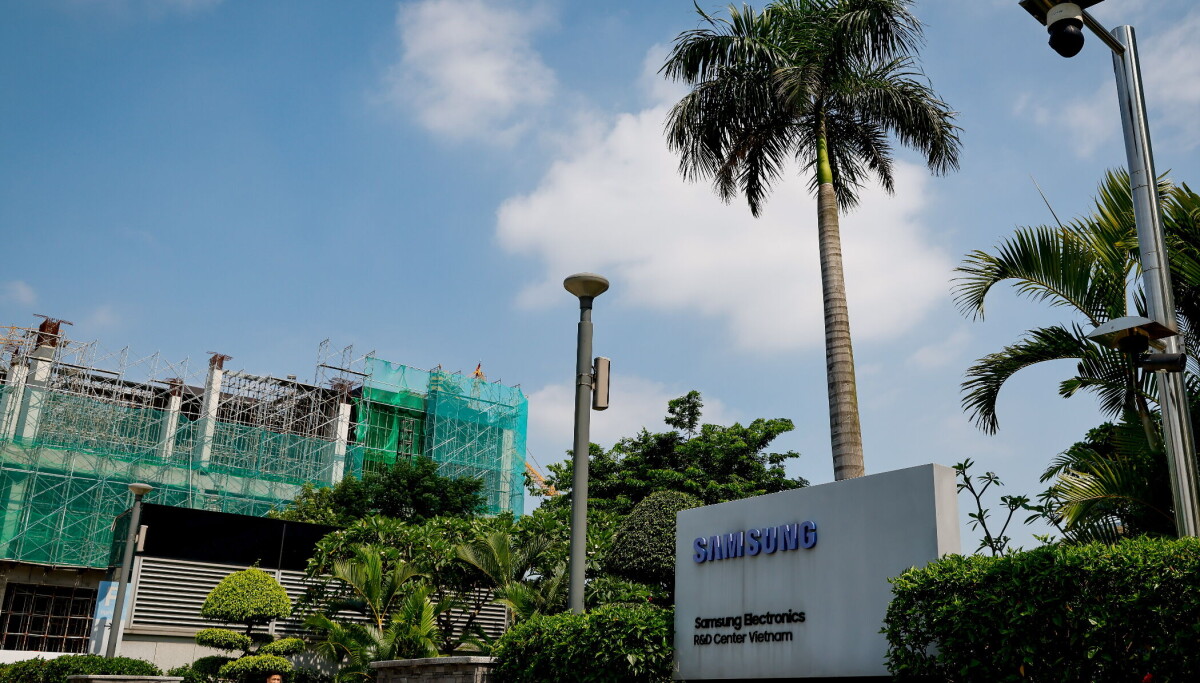
A man walks at the Samsung research and development center in Hanoi, Vietnam, on May 28. Samsung is one of the largest foreign investors in the country, currently operating six manufacturing plants, a research and development center and a sales entity across Bac Ninh, Thai Nguyen, Hanoi and Ho Chi Minh City.
EPA/YONHAP

Ko Young-kyung
The author is a research professor at Yonsei University’s Digital Trade Research Center.
Vietnam’s economy is booming. After it expanded 8.2 percent in the first half, the Asian Development Bank (ADB) raised its growth forecast for this year from 7.2 to 7.8 percent and next year’s from 7 to 7.6 percent, which exceed India’s projected growth. Exports and foreign direct investment (FDI) are driving the expansion.
Vietnam’s registered FDI reached $40.6 billion in the first eight months, up 55.4 percent on year. The investment in electronics and semiconductors is particularly notable.
Samsung Electronics plans to invest approximately 2.2 trillion won ($1.6 billion) in a memory chip testing facility, and Samsung Electro-Mechanics will spend 2.51 trillion won expanding production of flip chip ball grid array substrates used in advanced semiconductors. Both investments reflect the growing demand from AI servers.
Other companies are following. Intel is pursuing an additional $2.6 billion investment, and Japan’s Meiko has begun constructing a $500 million semiconductor substrate plant. Korean companies account for 45.3 percent of Vietnam’s semiconductor FDI, but investment extends beyond Korea.
These developments indicate a restructuring of global value chains, not wholesale relocation of semiconductor fabrication plants. Companies retain front-end manufacturing at home while distributing testing, packaging and substrate production overseas.
Samsung Electro-Mechanics, for example, produces high-value products in Korea while handling volume production in Vietnam. A manufacturing base once centered on smartphones is assuming a broader role.
Taiwanese companies are adopting similar strategies. Semiconductor back-end specialists ASE and Chipbond are expanding capacity in Malaysia, which already has an established assembly and testing ecosystem.
Taiwan-Malaysia trade rose 34.7 percent in the first half, with Malaysia’s exports to Taiwan jumping 66.5 percent. The ADB raised Malaysia’s growth forecast from 4.6 to 4.9 percent.
Vietnam and Malaysia are not equivalent. Malaysia has decades of semiconductor expertise, while Vietnam will not become a semiconductor powerhouse overnight.
Nevertheless, global production networks are shifting toward regional supply chains that reduce dependence on China and geopolitical risks. Their economic performance partly reflects this transformation.
Rumors repeatedly suggest that Samsung is withdrawing from Vietnam, but actual investment trends suggest the opposite. Such baseless speculation undermines the deep value-chain interdependence linking Korea with Vietnam and Southeast Asia.
Rather than focusing exclusively on the United States, Korea needs a global strategy that assigns production roles according to regional strengths.
Like Taiwanese, U.S. and Japanese companies, Korean businesses cannot and need not manufacture everything domestically. Harnessing regional advantages is essential to sustaining and strengthening competitiveness.
This article was originally written in Korean and translated by a bilingual reporter with the help of generative AI tools. It was then edited by a native English-speaking editor. All AI-assisted translations are reviewed and refined by our newsroom.