
This was the opinion expressed by FDI businesses at the seminar “Connecting Vietnamese Businesses in the Global Supply Chain” on October 8th. The seminar, organized by the Finance and Investment Newspaper, aimed to promote the implementation of Resolution No. 10-NQ/TW of the Politburo and Resolution No. 280/NQ-CP of the Government. One of the key issues discussed was how to transform international resources into endogenous capacity of the Vietnamese economy through strengthening linkages between foreign-invested enterprises and Vietnamese businesses.
The risk of becoming an ” island ” still exists .
The foreign-invested sector has made significant contributions to Vietnam, but these have not yet met expectations. Linkages between the domestic and FDI sectors remain limited, and technology transfer, research, and development have not been as successful as desired. The percentage of Vietnamese businesses participating in global supply chains is still low…
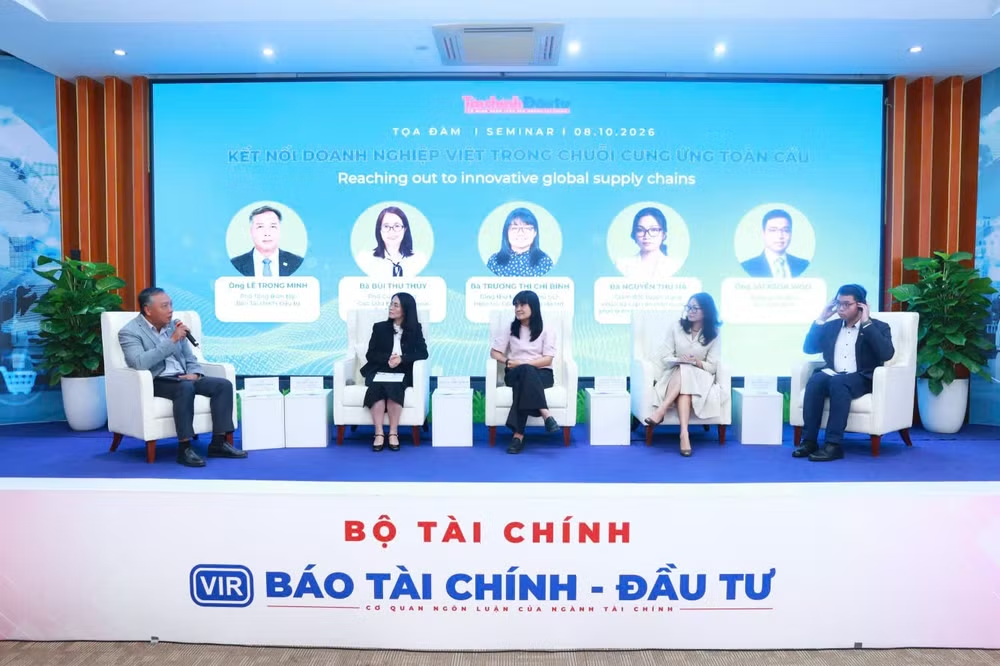 Speakers at the forum. Photo: HL
“That is also one of the reasons why the Politburo decided to issue Resolution No. 10-NQ/TW dated June 8, 2026, on the development of the foreign-invested economy, marking a strategic turning point and comprehensively changing the methods and thinking of attracting foreign investment in Vietnam in the new period,” said Deputy Minister of Finance Tran Quoc Phuong at the seminar.
From the perspective of state management agencies, Ms. Bui Thu Thuy, Deputy Director of the Foreign Investment Department (Ministry of Finance), stated the current situation: “The proportion of FDI in Vietnam’s total export turnover is increasing. Considering the self-reliance of the economy , this is a worrying figure. Without breakthrough solutions, FDI will exist as isolated growth ‘islands,’ failing to create sustainable spillover effects for the domestic economy.”
Strengthening linkages is not a one-sided desire; FDI enterprises also express a wish to promote substantive linkages between FDI enterprises and Vietnamese enterprises, and to have more Vietnamese enterprises participate more deeply in the supply chain.
“Investors are asking broader questions: Can Vietnam support complex and resilient supply chains? And can the ecosystem support long-term expansion?” said Kamijo Hiroki, Deputy General Director and Head of Transaction Banking and Foreign Investment at Vietnam Prosperity Commercial Bank ( VPBank ).
A new chapter on FDI in Vietnam
According to Ms. Bui Thu Thuy, FDI corporations have recently become much more open and have proactively sought cooperation with the Government to build an ecosystem to support Vietnamese businesses.
Mr. Cha Ji Ho, Deputy General Director in charge of Samsung Vietnam’s Purchasing Center, said: Samsung has been continuously promoting cooperation programs with the Government and industry to enhance the production competitiveness of Vietnamese businesses, while creating conditions for businesses with sufficient competitiveness to participate more deeply in Samsung’s supply chain.
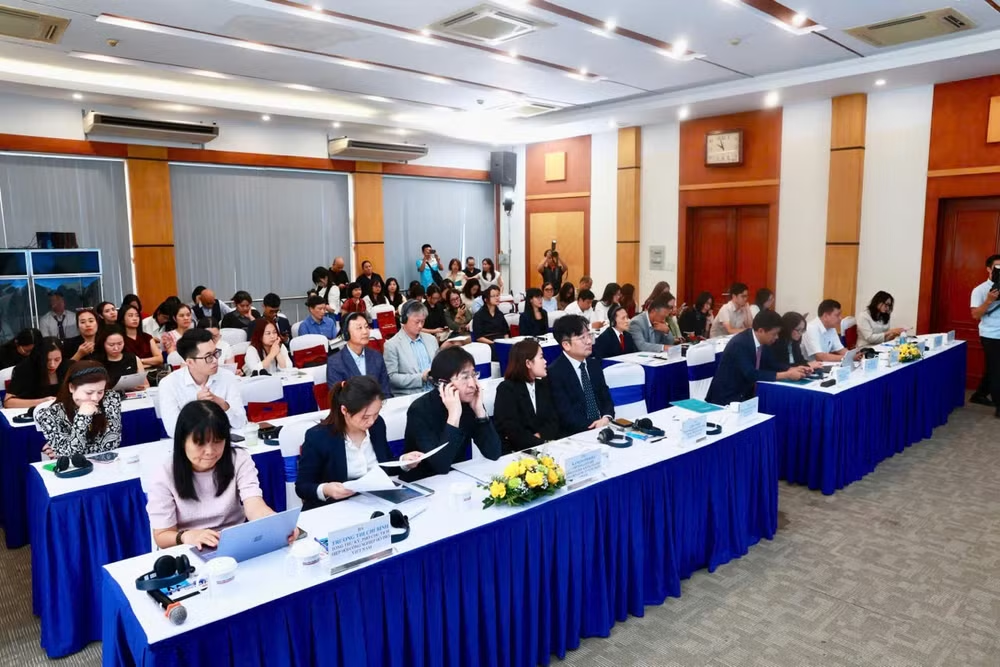 The forum was attended by many representatives from FDI businesses. Photo: HL
After listing numerous outstanding collaborative activities aimed at fostering Vietnam’s supporting industries, Mr. Cha-Ji Ho stated: “Based on the philosophy of shared prosperity, Samsung has connected the enhancement of Vietnam’s manufacturing competitiveness with the goal of building a more stable and robust supply chain for Samsung.”
To establish linkages with Vietnamese businesses, it’s necessary to improve productivity and quality, and to accumulate production capacity. For Samsung, the key is to strengthen the stability of the supply chain and expand the localization of components. “These two directions meet at a common point: a development model based on a Win-Win approach, providing growth opportunities for Vietnamese businesses and helping Samsung build a more competitive and stable supply chain. The goal is not just to increase the number of trading partners, but to jointly create a production ecosystem for sustainable development,” said Mr. Cha-Ji Ho.
Statements made by businesses at the seminar revealed a changing perspective on investment. Vietnam is no longer seen solely as a competitive manufacturing base. Increasingly, investors view Vietnam as a long-term platform for resilient supply chains, capital, talent, innovation, and sustainable growth.
Mr. Kamijo Hiroki, Deputy General Director and Head of Foreign Investment and Transaction Banking at Vietnam Prosperity Bank (VPBank), argues that the next chapter of FDI growth in Vietnam needs to move beyond cost advantages. This new chapter must be built upon the advantages of the ecosystem. This is an ecosystem where capital, capabilities, talent, sustainable development, and partnerships mutually reinforce and strengthen each other. “Sustainable growth will be created by an ecosystem that acts in concert,” according to Mr. Kamijo Hiroki.
Using FDI as a “catalyst”
Vietnamese businesses still face significant challenges in accessing supply chains, and the links between Vietnamese businesses and FDI remain weak due to numerous barriers from both sides. Vietnamese businesses are still limited in both number and capacity to meet the requirements of large corporations and compete with established suppliers within the systems of multinational corporations.
But this is not the only reason why domestic businesses find it difficult to participate in the supply chain, according to Ms. Truong Thi Chi Binh, Vice President of the Vietnam Association of Supporting Industries (VASI). Most multinational corporations have built stable supplier networks abroad and bring their entire supplier ecosystems to Vietnam. Many FDI businesses do not yet fully trust the supply capabilities of domestic enterprises.
Dr. Jackson Woo, General Director of SGS Vietnam, suggested that Vietnam should not only view FDI enterprises as a source of capital, but should use FDI as a “catalyst” to develop domestic supply chain capabilities. He also argued that without building trust with global customers, businesses will never have the opportunity to become their suppliers. To gain trust, businesses must meet international standards; this is the basic ticket to entering the global supply chain. In addition, businesses need to demonstrate their commitment to quality and transparency; followed by training human resources and retaining talent.
Opinions expressed at the seminar indicated that integrating Vietnamese businesses deeper into global supply chains is not just about enhancing the capabilities of individual enterprises, but a process of creating a long-term collaborative ecosystem. When government-backed policies, FDI support, and domestic businesses’ efforts to standardize converge at a common point of “mutual benefit,” Vietnam will gradually and successfully transform international resources into endogenous capabilities, becoming a solid link in the global production network.