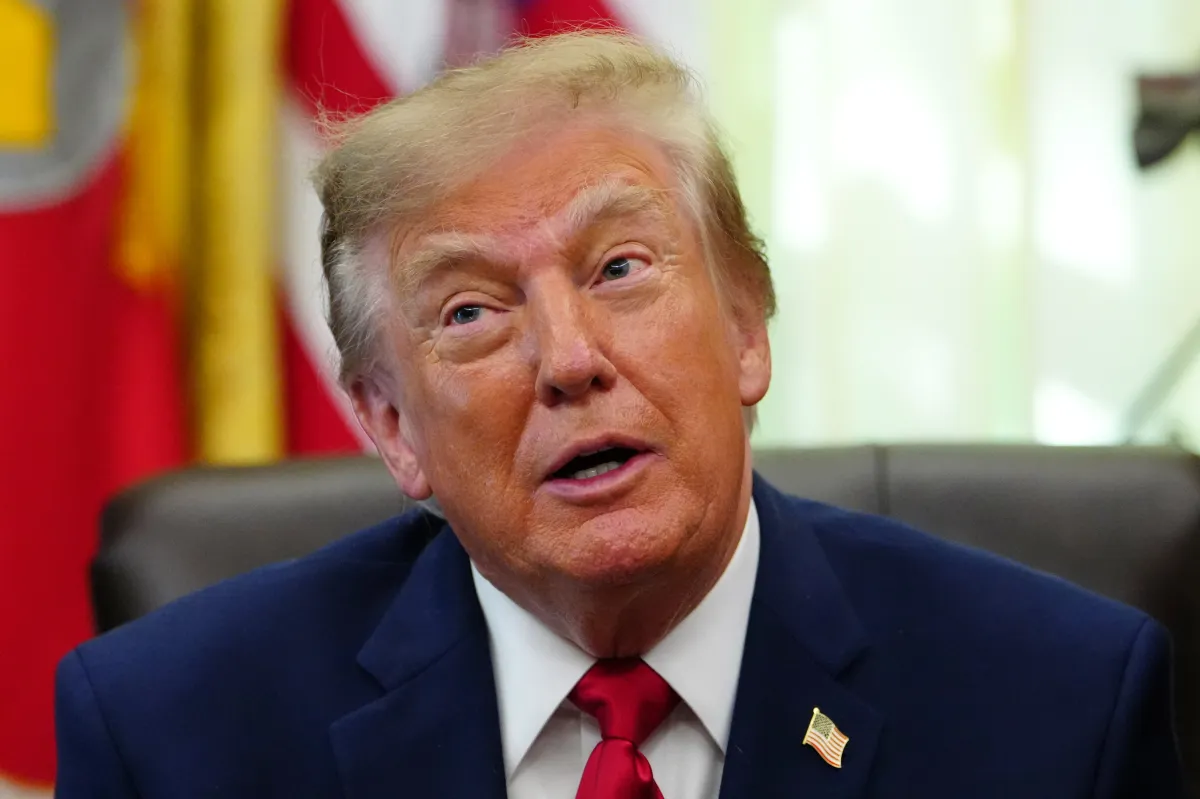
President Donald Trump on Wednesday rejected suggestions that a series of proposed cash payments and benefits announcements ahead of the midterm elections are politically motivated, arguing instead that they reflect what he described as a rapidly expanding U.S. economy.
“We have tremendous growth. We have the greatest growth of any country maybe ever in history,” Trump said. “We’re able to do things that the Democrats can’t because they would have not been able to use tariffs so wisely like we need.”
The question came after the White House highlighted several initiatives in recent weeks, including $500 payments to some Affordable Care Act enrollees, $90 checks for certain seniors, a proposed $5,000 payment tied to Republicans retaining control of Congress, and Wednesday’s announcement of automatic enrollment in Trump Accounts for children.
Read More on Politics
Trump has consistently framed his $5,000 check announcement as a choice between cash and economic collapse.
“If Republicans win the House of Representatives and the Senate, I’m going to give all adult citizens in the United States of America $5,000,” Trump said in a video posted to Truth Social Saturday, reaffirming a commitment he made last month at the Republican National Committee’s inaugural midterm convention in Dallas.
Trump said Democratic policies would increase taxes, damage the economy, and cause a “disaster.”
“If the Democrats win, you will have an economic depression, much like 1929,” he said.
Adult citizens would qualify under Trump’s description, although no legislation, eligibility rules, funding authorization, or payment schedule has been provided.
Republicans Mixed on $5,000 Proposal
House Speaker Mike Johnson, a Louisiana Republican, defended the proposal on Wednesday, arguing that Trump was seeking to highlight what Republicans view as the economic benefits of their policies rather than simply offering voters cash.
“If you want more money in your pocket, you have to keep Republicans in charge because we’re the ones that have actually produced that,” Johnson said during a campaign swing through Pennsylvania for four vulnerable House Republicans.
However, not all Republicans have embraced the idea. Outgoing GOP Kentucky Representative Thomas Massie mocked the proposal, calling it an insult and saying he could not “in good conscience accept a penny less than 10K.” He also warned that such a large payment could fuel inflation.
Former Georgia Representative Marjorie Taylor Greene questioned the proposal’s fiscal impact, arguing that, when combined with Vice President JD Vance’s plan to provide benefits for stay-at-home parents, the measures could cost about $1.6 trillion. Greene said Republicans were opening themselves up to accusations of hypocrisy after spending years attacking Democrats for supporting expansive government spending programs.
“No matter which party you vote for you get socialism,” Greene wrote.
Midterm Headwinds for Republicans
Midterm elections are often viewed as a referendum on the party in power, and the president’s party has historically lost congressional seats during them. On November 3, voters will decide all 435 House seats and 35 Senate contests, with Republicans defending narrow majorities in both chambers. Democrats are increasingly optimistic about their chances of retaking Congress as Trump’s approval ratings have softened in recent months amid persistent concerns about affordability and public skepticism over his handling of issues including the economy, immigration and the war in Iran.
Forecasts have pointed to a challenging environment for Republicans. As of Wednesday, simulations from Race to the White House that incorporate polling, voting patterns and other indicators gave Democrats an 87 percent chance of winning back the House, with a projected 234-201 seat advantage. The model also gave Democrats a 73 percent chance of capturing the Senate, with an expected 53-47 majority.
 Democrats Accuse Trump of ‘Buying Votes’
Against that backdrop, Trump’s $5,000 proposal has especially drawn criticism from Democrats. Appearing on CBS News’ Face the Nation on Sunday, Senator Mark Kelly of Arizona accused the president of attempting to “buy votes” by tying the proposed payments to Republicans retaining control of Congress after the midterms. While acknowledging that some Americans could benefit from financial relief, Kelly said voters should view the offer skeptically, calling it “a payoff.”
Some election law experts, however, dispute the idea that such campaign promises necessarily amount to illegal vote buying. Rick Hasen, a professor at UCLA School of Law, said that Trump’s proposal would likely be protected by the First Amendment.
Writing last month on his Election Law Blog, Hasen pointed to the Supreme Court’s 1982 decision in Brown v. Hartlage, which struck down an attempt to penalize a candidate for promising voters he would forgo his salary if elected. The Court held that campaign promises that may benefit voters financially are generally protected political speech.
“The fact that some voters may find their self-interest reflected in a candidate’s commitment does not place that commitment beyond the reach of the First Amendment,” Justice William Brennan wrote for the Court. Hasen argued that Trump’s proposal is not fundamentally different from candidates promising tax cuts, expanded health-care benefits, or other government policies intended to financially benefit voters.
Newsweek’s reporters and editors used Martyn, our AI assistant, to produce this story. Learn more about Martyn here.
Contact Newsweek editors on this story: Samantha Beech and Sam Wilson.