Connecting Researchers Through Digital Landscapes
Cawood’s second newly funded NSF project demonstrates his commitment to both scientific innovation and educational accessibility. The grant, titled “eRock – An Open Platform and Community Pipeline for Digital Outcrops,” will support the expansion of eRock, a repository founded by Cawood to share digital geological data from outcrops, or rock exposures, at Earth’s surface.
Fieldwork remains a cornerstone of geoscience, but advances in drone technology and three-dimensional imaging have transformed how researchers document and analyze geologic features at the Earth’s surface. Today, scientists can create highly detailed digital models of rock outcrops that preserve critical observations long after field campaigns conclude. However, Cawood notes that many of these valuable datasets remain isolated within individual research groups, making them difficult for other scientists to find, access and reuse.
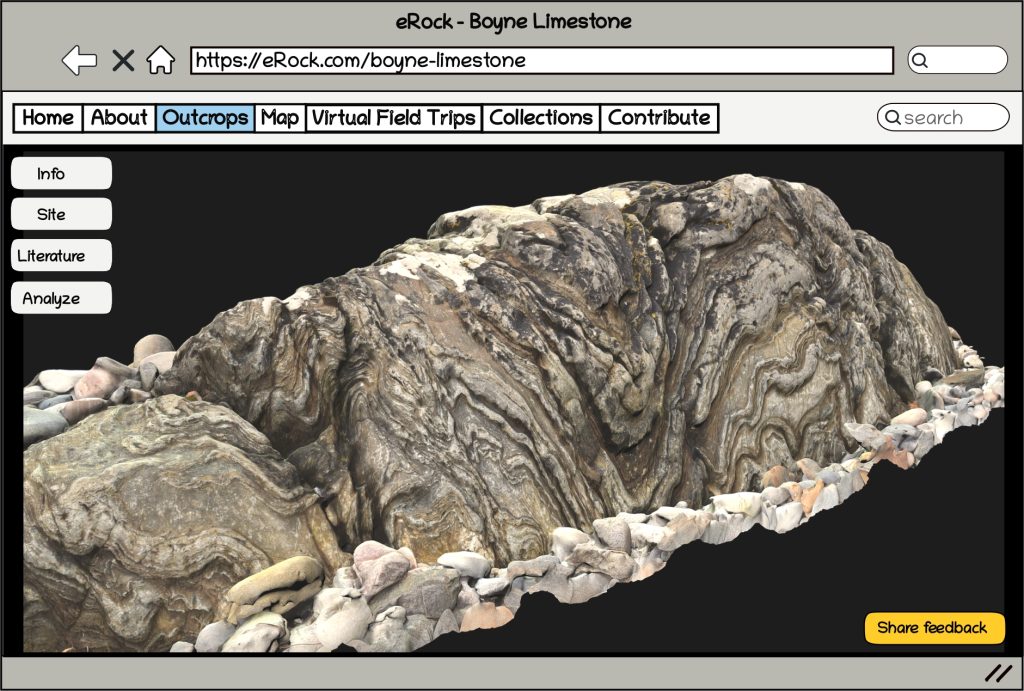 Website mockup of eRock showing a 3D model of the folded, banded Boyne Limestone outcrop, with menu tabs and side buttons for Info, Site, Literature and Analyze.
“eRock grew from the idea that we need a better way to preserve digital outcrop data and make field geology more open and accessible,” he says. His team aims to create a community-driven platform for storing, discovering, visualizing and sharing digital geological models.
Project activities include developing data standards and infrastructure, creating map-based search and visualization tools, and working directly with researchers, educators and students to understand how digital outcrop data can best support research and teaching. Students will also contribute by collecting and curating new datasets.
The long-term goal extends beyond creating a database. Cawood hopes to build a sustainable scientific community that encourages collaboration and data reuse across institutions and disciplines. Researchers will examine how metadata should be organized, how users interact with digital models and how virtual observations can complement traditional fieldwork.