
America is increasingly a fiscal basket case. This fact is enormously consequential for family policy, yet it receives relatively little attention from those focused on child and family outcomes. That should change.
In August, we heard that our national debt has reached over $40 trillion — up nearly $3 trillion in the past year alone. Debt held by the public was 35% of GDP in 2008 during the Great Recession; 79% before the COVID-19 pandemic; and now exceeds 100%.
Interest is going to further blow the budget. In 2025 alone, interest on the federal debt outpaced every federal program except Social Security and Medicare. It was $970 billion in 2025, and it’s projected to reach $2.1 trillion by 2036.
The government cannot simply print money to finance its debt and deficits. History and sound economic experience, as researchers at the Federal Reserve Bank of Richmond have noted, show we’re heading toward a crisis. The government will default on some of its debt unless it raises taxes or cuts spending. Any person or group interested in the well-being of kids and families needs to gear up for the fiscal challenges ahead.
A quick tour of the federal budget
When most people think of “government spending,” they tend to think of social programs and defense. The neighborhood Head Start program, the aircraft carriers, the National Park Service, the TSA, and so on. This is “discretionary” spending, close to half of which goes to defense. Congress (in theory) appropriates money to fund these items in each year’s budget process.
Yet in truth, by far the largest line items and thus the drivers of our long-term debt are Social Security, health care (Medicare, especially), and interest on the debt already accrued. These programs are “mandatory,” meaning Congress does not appropriate funding for them each year. Anyone who meets their eligibility criteria receives the benefit, hence why they are known as entitlements.
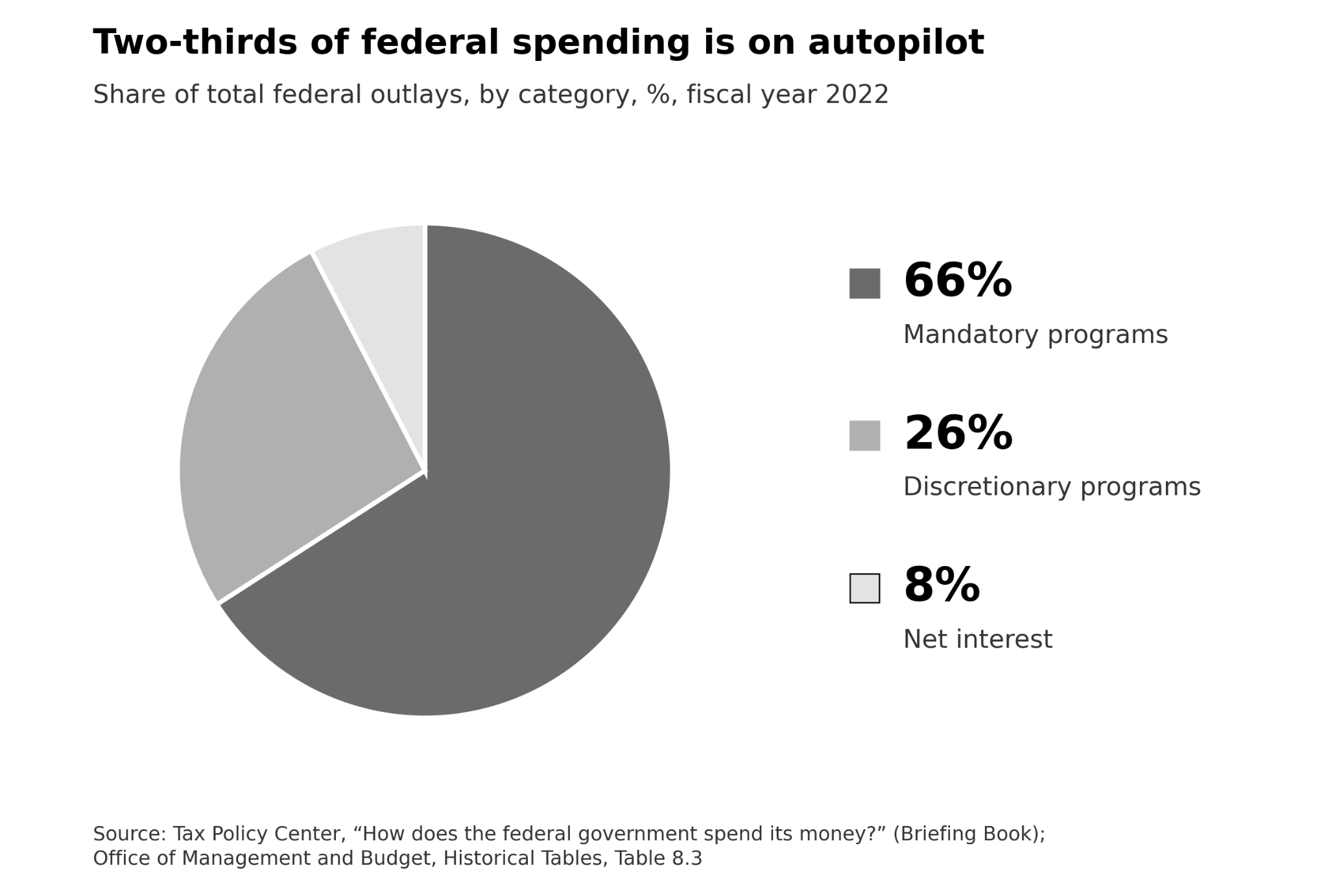
Social Security, in particular, is running out of money as our population ages and lives longer. By 2032, the Social Security Trust Fund will be partially depleted, and by 2040, the Medicare Hospital Insurance Trust Fund will be depleted as well. Fully 81% of the federal government’s projected spending growth between 2023 and 2033 comes from Social Security, Medicare (plus other federal health programs like Medicaid), and interest on the national debt. As a result, fights over Social Security and federal health programs will increasingly consume American politics.
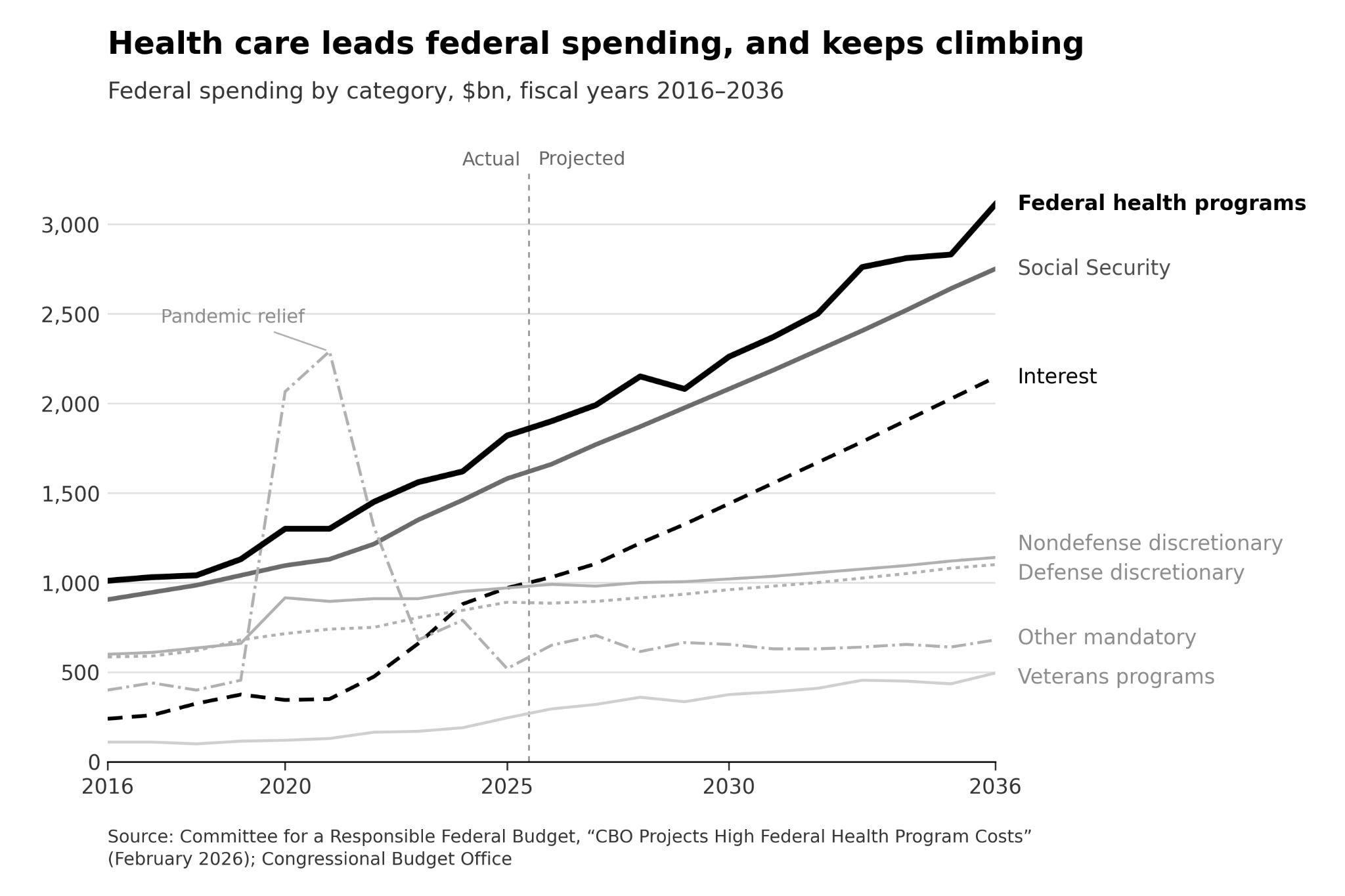
Rising costs, everywhere.
This entitlement-driven federal debt will put the safety net itself at risk. Absent major reform, the austerity eventually required will crowd out discretionary programs families rely on, from child care assistance and home visiting to parenting support, public education, housing aid, parks, federal arts funding, and community development. And that says nothing about how the fiscal picture will significantly increase the difficulty of passing bold new policies such as universal child care, paid family leave, or a larger, refundable Child Tax Credit.
Nor will state budgets be spared, despite their legal requirement to maintain a balanced budget: Already, we have seen an inclination in Congress to shift federal safety net costs to states even as they are battling rising state safety net costs of their own. Medicaid alone consumed 17.1% of every “state-generated dollar” in FY2024, up two percentage points from a year earlier. If federal discretionary funding is held flat or shrinks, states will be hard-pressed to find their own funding sources to replace it.
The COVID pandemic in 2020 showed us what fiscal space allows. Roughly $5 trillion in relief moved quickly: stimulus checks, an expanded child tax credit, support for the unemployed, and eviction moratoriums. None of this will be possible if America no longer has the fiscal space to act boldly and quickly in an emergency, or to act wisely in non-emergency situations to achieve our national goals. Higher debt-service costs also crowd out fiscal space for productive public investment — in education, in research and development, in the roads, bridges, seaports and airports that keep America moving. These are the things that build our long-term resilience and our long-term capacity to grow the economy and build prosperity for every American.
To reiterate: For families, the high cost of servicing U.S. debt and backfilling entitlements means less money available to fund programs at their current levels, let alone expansions of the Child Tax Credit, or increased investments in child care, children’s health insurance, WIC, SNAP, Head Start, and other programs that support families.
It’s personal. The government’s credit affects your credit.
This issue isn’t, however, just a question of public administration or public policy. The fiscal situation means households and businesses are competing with the government for the same pool of lendable capital, pushing up the baseline interest rate for everyone. Family borrowing costs rise — not because of any personal failing, not because their credit changed, but because the government’s credit did.
As borrowing costs rise for the government, they rise across the entire economy because investors demand higher yields. Mortgages will go up. Auto loans will go up. Credit card interest rates may go up. Interest is crowding the federal budget, and it will crowd our family budgets too.
Economic precarity — from household financial instability to an eroded safety net and more — directly affects children. Income loss and financial strain increase parental stress, which reduces the warm, safe, stable, nurturing relationships between parents and children that are foundational to healthy human development in the earliest years — and to flourishing over one’s whole life. The result is poorer lifetime health, lower educational attainment, and the kind of toxic stress that can affect brain development, self-regulation, and executive function.
And precarity also produces loneliness and fear, which erode the stability a person needs to exercise true freedom and pursue the truth and beauty that are the very basis of human happiness and flourishing. A child absorbs the constant anxiety of a financially precarious household into their brain and body. When a family lives paycheck to paycheck, the loss of basic stability interferes with the child’s ability to grow up and pursue a fully human life. Instead, they and their parents are oriented only toward survival.
What’s more, a period of austerity can cause widespread dissatisfaction among voters and drive down trust in the government, which is already in the cellar. A series of ugly fiscal crises that create economic sluggishness is precisely the opposite of what America needs.
It’s time to finally get our fiscal house in order.
This isn’t just about the current Congress’s inability to act. Multiple administrations, on both sides of the aisle, have failed to get America’s fiscal house in order. Republicans run on a commitment to fiscal discipline, but then tend to spend profligately once in office. Democrats generally keep quiet about debt or wave it away with “tax the rich” slogans, even though economists and budget experts across the political spectrum do not believe that solely taxing the rich or big corporations is enough to correct America’s fiscal mess. (To put a fine point on it, even taxing 100% of every dollar of income above $1 million would not close the deficit.) In other words, neither party has taken enough responsibility for acting as a trustee for future generations.
That has to stop — now. America must get its fiscal house in order, not only so we can invest more in families in the future, but so that families enjoy greater financial stability in their own household budgets today, and so that we have the fiscal space to respond to the risks and crises that are likely to emerge in the decades ahead. Advocates, philanthropic funders, and political donors are fooling themselves if they think this doesn’t matter or can be waved away, because the 2030s will present a fiscal situation we haven’t seen before, with effects that are almost unrelentingly negative for all child and family policy goals.
Everyone who cares about the common good, and especially about children and families, should take a long, sober look at America’s fiscal health. Those committed to the next generation should have a considered opinion about what a Social Security, Medicare, and/or Medicaid reform package should look like, and demand a seat at the table as those packages are developed. Political donors and organizers who champion children’s issues should be asking candidates hard questions about entitlement reform. And those working hard to build both grassroots and grasstops political power should start preparing to flex that muscle to provide cover for a needed national conversation that may, in fact, include the third rail of middle-class tax increases alongside tax increases on corporations and the wealthy.
Moreover, while we are busy improving the country’s fiscal situation, we also have a rare opportunity to rethink government-funding approaches that no longer meet Americans’ needs. For example, can we follow economist Kathryn Anne Edwards’s suggestion to run paid leave or a Children’s Trust Fund through Social Security, or embrace some version of what Caring Across Generations and the National Academy of Social Insurance call Universal Family Care, or put resources towards developing other innovative and purpose-fit models of financing care?
The fact is that fiscal reform is coming one way or another. Either we can be proactive and creative, ensuring that the needs and interests of children and families are front and center — especially those from populations most commonly on the wrong end of trade-offs — or we can wait for the storm.
We are living in a time of great transformation: demographic change, climate disruption, political realignment, and the rise of artificial intelligence. All of these present new risks that will require a government response. A government that lacks the fiscal capacity to respond will leave us all much poorer, much more vulnerable, and at far greater risk — now and in the future — than what we have come to expect from America. We can choose a better path.