How a major solar storm could knock out GPS and power grids
“If that had hit, it would have been a world-changing event. Billions of dollars — in terms of loss: power lines, communication grids, electronics in general … And honestly no one’s really prepared for that today.”
That’s Andrew Gerrard, director at the Center for Solar-Terrestrial Research at the New Jersey Institute of Technology.
He breaks down space weather: solar storms in their full range from the tiniest, practically unnoticeable storms to a global catastrophe.

Weather in your inbox
By signing up you agree to the Terms & Privacy Policy. Unsubscribe at any time.The science of solar radiation storms
“When we talk about space weather, it’s kind of like talking about our daily weather here on the surface of the Earth,” Gerrard explains. “A large fraction of that variation comes from the sun. On the sun, there are very intense magnetic fields.”
This can generate solar flares, which are bursts of electromagnetic waves of light. It can also create coronal mass ejections, which are expulsions of electrically charged plasma from the sun’s corona — the outer atmosphere of the sun.
(MORE: New images of the sun show its surface in the finest detail yet)
Get More of Our News on Google
Set The Weather Company as a ‘Preferred Source’ to get quicker access to the news you value.

“They cause a number of different impacts depending on the nature of the event,” Gerrard said.
One of the main ways this happens is by changing the characteristics of the Earth’s ionosphere.
That’s where all low-Earth-orbiting spacecraft and the International Space Station are.
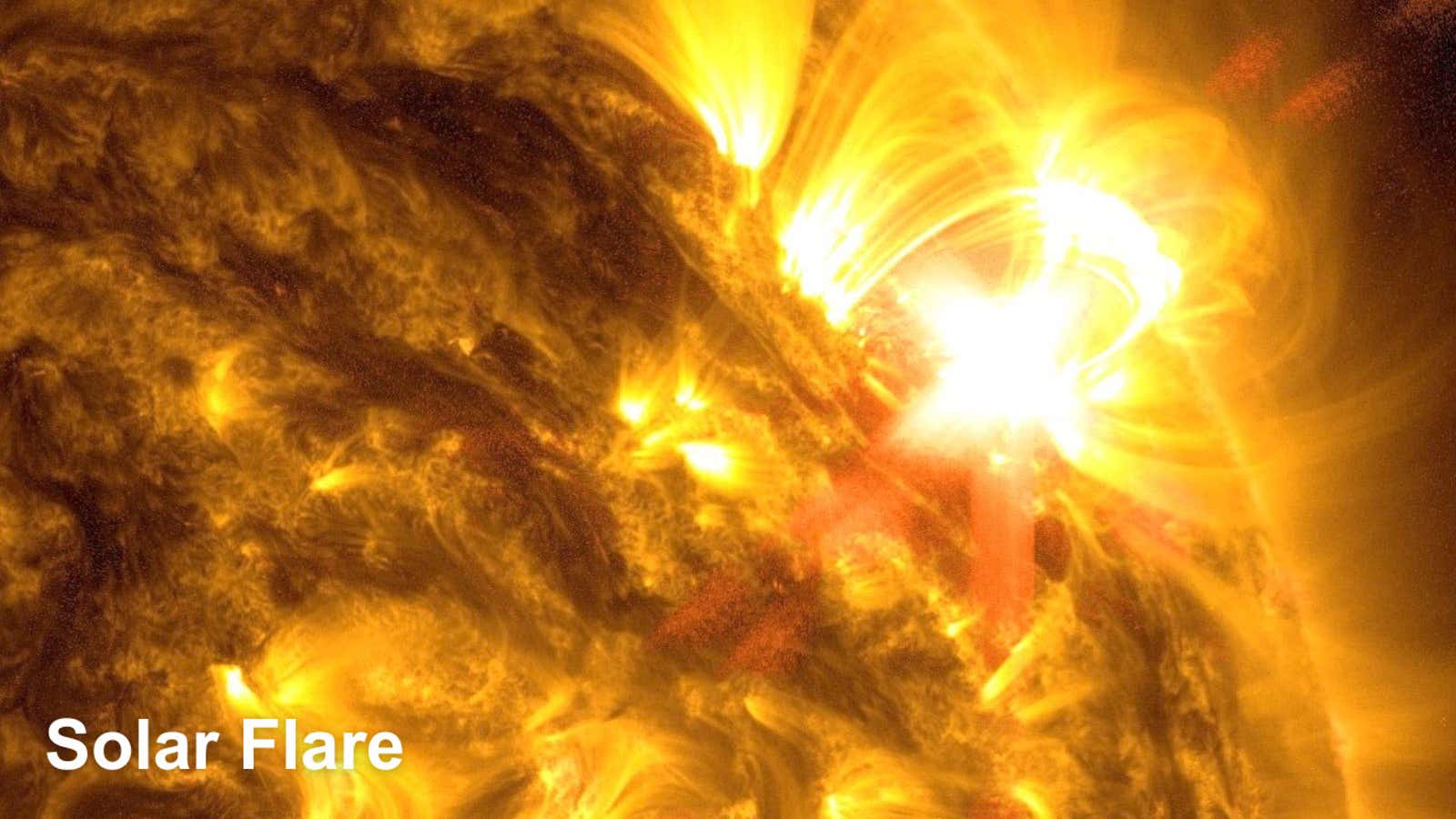
NASA’s Solar Dynamics Observatory captured this image of a strong solar flare (the bright flash of light on the right) on May 8, 2024. The image shows a blend of 171 and 131 Angstrom light, subsets of extreme ultraviolet light.
(NASA/SDO)
How solar storms affect technology
When the Earth’s ionosphere becomes more charged, it can affect two major things: radio waves and GPS.
HF radios are still used by the military and first responders.
As we’re becoming more spacefaring, greater attention is put on these types of storms, since it could impact that realm as well, he says.
(MORE: How space and Earth weather influenced this NASA mission)
Civilian aircraft rely on GPS technology as a means of navigation, which could be lost anywhere from 30 seconds to three minutes.
“And that may not seem very long, but when you’re on a plane coming in for landing using GPS to determine your velocity, location and everything else — yeah, two minutes is gonna be problematic,” Gerrard said.
It’s not something to be worried about on your next flight, though. There are procedures — like using backup systems or diverting — in place for these types of occurrences, Gerrard says. The most you’ll see this affect you personally is possibly a 15- to 30-minute flight delay.
And next time your mapping app is acting up, don’t blame your phone. It’s possible there could be a solar flare. Gerrard says you just need to wait a couple of minutes, and it’ll come back.
“It’s more of a nuisance, really,” he said. “The common person isn’t necessarily going to experience anything horrible.”

This visualization represents energetic particles speeding away from the sun and following magnetic fields toward Earth and into interplanetary space. A coronal mass ejection also travels away from the sun, near the top of the frame.
(NASA’s Goddard Space Flight Center Conceptual Image Lab)
The worst-case-scenario storm
“Now, again, that’s for the 99% of storms that are events that really don’t do much that are occurring daily,” Gerrard says. “There certainly have been more catastrophic events though.”
In March 1989, there was a massive coronal mass ejection, which took out the Quebec power system. That actually pulled current from the U.S. grid, which caused over 200 grid faults, operational interference and a damaged transformer in New Jersey.
Other big events have happened in years like 1921. But since the technological infrastructure wasn’t as developed as it is today, we didn’t see major impacts. The main technology that was really impacted was telegraphs, which were tied to the railroads.
One moment in solar storm history stands out to Gerrard: the 1859 Carrington Event.
This powerful coronal mass ejection generated auroral displays — the type of thing you’d only see in polar regions typically — all the way down into equatorial latitudes.

Northern Lights (Aurora Borealis) illuminate the night sky with vivid purple and green hues above a distant cityscape following a strong solar storm coinciding with the spring equinox in Fairbanks, Alaska, on March 20, 2026. The display peaked after combined coronal mass ejections from the sun on March 16 and 18 intensified geomagnetic activity. The National Oceanic and Atmospheric Administration (NOAA) reported G2 and G3 level geomagnetic storm conditions throughout the night. The aurora band expanded southward, becoming visible across Alaska and in 18 states across the U.S.
(Hasan Akbas/Anadolu via Getty Images)
“Certainly we weren’t using GPS back then,” Gerrard said. “But nowadays we have become so reliant on our technologies.”
And in July 2012, we missed that same type of event by nine days. If Earth’s placement and orbit had just been slightly different, it would have been “world-changing,” Gerrard says.
(MORE: The sun was dark for 18 months: what we can learn from history’s worst volcanic eruptions)
In the instance that we were to lose power in just a portion of the U.S., we could get electrical equipment imported from other areas of the country or world.
“When the entire world’s power grid is knocked down, where are you gonna get those resources, those materials?” Gerrard says.
An event like that, happening today, would take the world 10 years to recover from, according to Gerrard — and we’d only have two hours’ notice for confirmation that it would hit Earth.

Coronal mass ejections, or CMEs, are immense clouds of solar material blasted into space by the sun at over a million miles per hour, often following a solar flare. CMEs expand as they sweep through space, often measuring millions of miles across.
(NASA)
“Currently, we’re preparing for it as a community. Certainly as a science community, we’re trying to do those forecasts more accurately,” Gerrard said.
An event like the Carrington storm is a once-in-250-years type of event, he explains, so the odds that it happens are low.
“Daily impacts of space weather are gonna be much more on spacecraft operations, GPS, HF,” Gerrard says, “and the general public should be aware of it, but not fearful.”
Content writer Ada Wood enjoys exploring the stories that science and climate teach us about our natural world and how it influences the way we live in it.