News world Pakistan Recycles Kashmir Rhetoric To UN Chief Even As Country Faces Economic Collapse, Local Tension | Exclusive
Last Updated:October 06, 2026, 18:17 IST
Top intelligence sources state that Islamabad is using the Kashmir narrative as a political smokescreen to divert international attention away from its governance failures




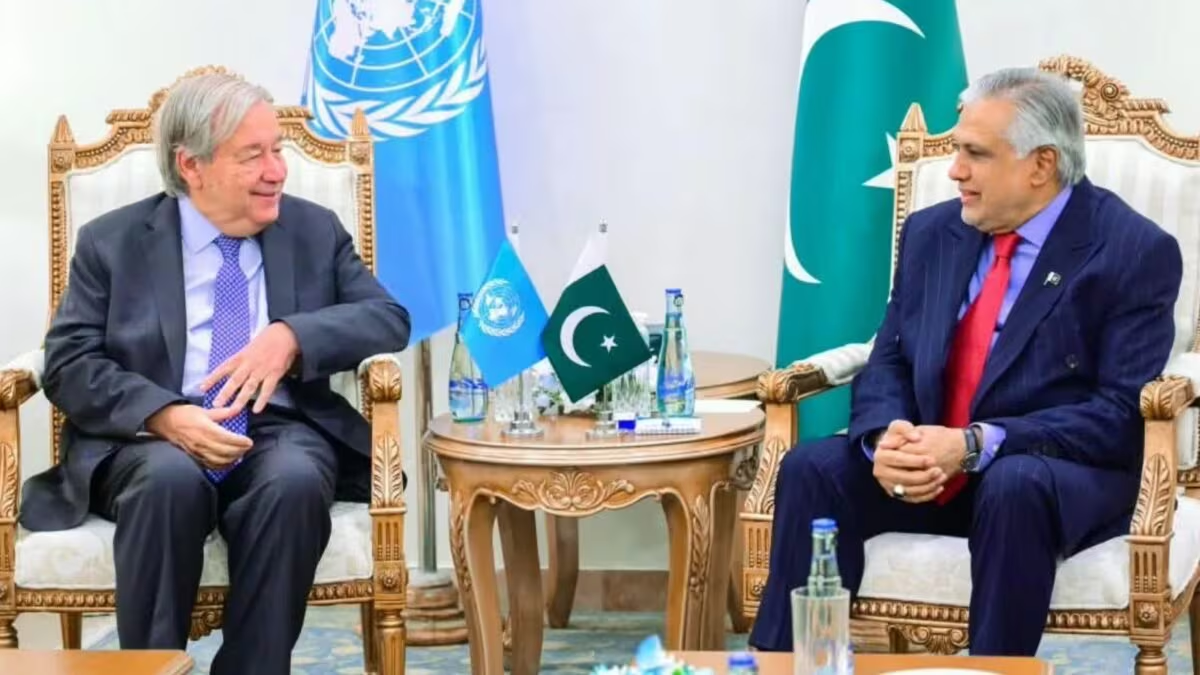
Pakistan’s Foreign Minister Ishaq Dar with United Nations Secretary-General António Guterres.
Facing a severe domestic economic collapse and mounting civil unrest, Pakistan once again recycled its traditional rhetoric on the Kashmir dispute during a high-level meeting with United Nations Secretary-General António Guterres in Islamabad.
According to official statements, Pakistan’s Foreign Minister Ishaq Dar used the engagement to brief the UN Chief on the Jammu and Kashmir issue, reiterating Islamabad’s long-standing demand for a peaceful resolution in accordance with United Nations Security Council (UNSC) resolutions.
However, top intelligence sources state that Islamabad is using the Kashmir narrative as a political smokescreen to deliberately divert international attention away from its escalating homegrown governance failures.
Rather than utilizing high-level UN engagements to address systemic economic instability, rampant inflation, and deep-seated local tensions within Pakistan-occupied Jammu and Kashmir (PoJK), the country’s leadership remains focused on external posturing.
Security and diplomatic analysts note that Pakistan’s diplomatic apparatus remains trapped in a time warp. By rehashing decades-old, obsolete arguments at global forums, Islamabad is systematically ignoring the ground realities of the developmental transformation taking place within Jammu and Kashmir.
PAKISTAN’S INTERNAL CRISIS
Pakistan is currently grappling with a severe macroeconomic crisis marked by astronomical inflation, unsustainable debt levels, and rigid IMF-mandated austerity measures. Headline inflation remains stubbornly high, driven primarily by a 33% surge in electricity tariffs and a 39% hike in domestic fuel prices, which have severely crushed household purchasing power.
At A Glance
1.
Pakistan’s Foreign Minister Ishaq Dar briefed UN Chief António Guterres on the Jammu and Kashmir issue.
2.
Pakistan is experiencing a macroeconomic crisis with a 33% surge in electricity tariffs and a 39% hike in domestic fuel prices.
3.
The power-sector circular debt in Pakistan has breached PKR 1,675 billion.
4.
The IMF projects Pakistan’s current account deficit to widen up to $4 billion.
5.
The Jammu Kashmir Joint Awami Action Committee (JAAC) has led protests in Pakistan-occupied Jammu and Kashmir (PoJK).
Show More
The country’s energy sector is under intense structural stress, with the power-sector circular debt breaching PKR 1,675 billion, directly violating strict fiscal targets agreed upon with the International Monetary Fund (IMF). Compounding these domestic woes are external vulnerabilities; the IMF projects Pakistan’s current account deficit to widen up to $4 billion, leaving the national exchequer highly exposed to external geopolitical shocks and rising global oil import costs.
Simultaneously, this economic strangulation has triggered explosive civil unrest and severe local tensions within Pakistan-occupied Jammu and Kashmir (PoJK). The Jammu Kashmir Joint Awami Action Committee (JAAC) has spearheaded sustained regional protests and mass mobilisations against the central government. While initial public fury focused on the denial of basic wheat and electricity subsidies, the agitation has evolved into a broader political movement against the systemic dilution of local representation, particularly opposing the allocation of legislative seats to non-local refugees. Locals are actively demanding greater regional autonomy, direct control over their natural resources, and the dismantling of Line of Control (LoC) trade barriers to establish direct economic links with India to alleviate severe local shortages of food and medicine.
In response to this growing instability, the Pakistani state has deployed aggressive counter-measures, drawing sharp international condemnation at forums like the United Nations Human Rights Council (UNHRC). The government has attempted to crush the dissent through heavy paramilitary deployments, localized communications blackouts, and the controversial deployment of anti-terror laws against civil rights activists. Observers and intelligence sources note that this combination of regional political alienation, aggressive state crackdowns, and a collapsing national economy has created a volatile security environment, which Islamabad frequently attempts to mask on the global stage by rehashing its traditional, decade-old diplomatic rhetoric regarding the broader Kashmir dispute.
Handpicked stories, in your inbox
A newsletter with the best of our journalism
submit
Quick AnswersPowered by Ask News18Why did Pakistan’s Foreign Minister Ishaq Dar meet with UN Chief António Guterres in Islamabad?
Pakistan’s Foreign Minister Ishaq Dar used the meeting with UN Chief António Guterres to brief him on the Jammu and Kashmir issue, reiterating Islamabad’s demand for a peaceful resolution according to UN Security Council resolutions. However, intelligence sources note this rhetoric acts as a political smokescreen to divert international attention from domestic governance failures.
What are the primary economic crises currently impacting Pakistan’s domestic stability?
Pakistan is facing severe macroeconomic distress driven by astronomical inflation, high debt, and strict IMF-mandated austerity measures, which include a 33% surge in electricity tariffs and a 39% hike in domestic fuel prices. These pressures have pushed the power-sector circular debt past PKR 1,675 billion while the IMF projects the current account deficit to widen up to $4 billion.
What triggered the protests and civil unrest led by the Jammu Kashmir Joint Awami Action Committee?
The Jammu Kashmir Joint Awami Action Committee (JAAC) spearheaded regional protests initially sparked by the denial of basic wheat and electricity subsidies in Pakistan-occupied Jammu and Kashmir (PoJK). The movement has since expanded into a wider political agitation demanding greater regional autonomy, resource control, local representation, and the establishment of direct economic links with India.
Powered byAsk News18About the Author Manoj Gupta
Group Editor, Investigations and Security Affairs, Network18
First Published:
October 06, 2026, 17:15 IST
Disclaimer: Comments reflect users’ views, not News18’s. Please keep discussions respectful and constructive. Abusive, defamatory, or illegal comments will be removed. News18 may disable any comment at its discretion. By posting, you agree to our Terms of Use and Privacy Policy.
Read More