Energy security and the AI infrastructure boom are reshaping trade finance demand across Asia. At a GTR roundtable in Singapore, senior bankers discussed longer supply chains, vast prepayment requirements and why services trade may be the market’s next major opportunity.
Roundtable participants:
Maisie Chong, head of trade and working capital, Asean and South Asia, Standard Chartered
George Fong, managing director, head of trade and supply chain finance, Asia Pacific, and head of Hong Kong, global payment solutions, Bank of America
Belinda Han, managing director, head of transaction banking, Asia Pacific, MUFG
Shannon Manders, editorial director, GTR (chair)
Yoshitaka Morita, managing director, global trade finance and global transaction banking, Asia Pacific, SMBC
Saket Sarda, managing director, Asia Pacific regional sales and structured solutions, Mizuho
Shalin Shroff, head of trade, Asia South, Citi
Abhishek Srivastav, managing director, co-head of trade finance and lending, Asia Pacific, Middle East and Africa, Deutsche Bank
Charley Zhang, head of trade and working capital, Asia Pacific, JP Morgan Payments
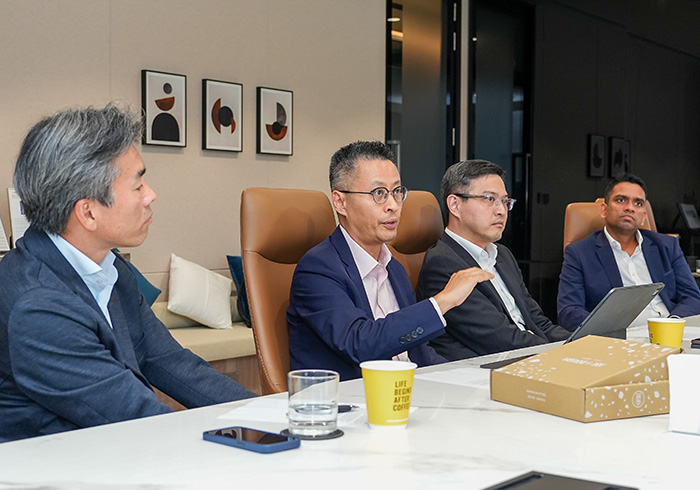
 From left to right, top: Shannon Manders, GTR; Charley Zhang, JP Morgan; Shalin Shroff, Citi; Saket Sarda, Mizuho; Yoshitaka Morita, SMBC.
Bottom: Abhishek Srivastav, Deutsche Bank; Belinda Han, MUFG; Maisie Chong, Standard Chartered; George Fong, Bank of America.
Energy security and the buildout of artificial intelligence infrastructure have emerged as two of the biggest drivers of trade finance demand in Asia, but bankers say their impact extends well beyond higher borrowing volumes.
Both are pushing companies to secure supplies further in advance, diversify trading partners and carry more inventory. Banks are responding with financing solutions for longer supply chains, smaller suppliers and large projects whose funding needs can continue long after the goods are delivered.
Speaking at a GTR Trade Leaders roundtable in Singapore in early September, senior trade finance and transaction banking executives said those shifts are reviving demand for traditional instruments, bringing new clients and trade corridors into view, and changing the risks banks must assess.
The growing cost of security
The search for secure supplies is shifting where Asian companies buy energy – and how much financing they need to get it home.
Shalin Shroff at Citi said conflict in the Middle East had intensified energy security concerns among Asian buyers, which have traditionally sourced much of their oil and gas from the region.
As a result, buyers are increasingly considering supplies from the US and Latin America, Shroff said. But longer routes mean goods spend more time in transit and companies must hold inventory for longer, while new suppliers may require advance payment or different terms.
Those changes increase the amount of financing required even when the value of the sale remains the same. “Every US$1 of sale now probably needs more working capital to finance,” Shroff said.
Historically, trade volumes have grown faster than demand for trade finance, but that relationship appears to be changing as supply chains become longer and more complex, he added.

Belinda Han at MUFG said higher commodity prices were adding to that pressure. Sharp increases across oil, LNG, plastics and fertiliser had forced banks to respond quickly as existing facilities became insufficient.
“There have been instances where we needed to increase facilities within a matter of days to accommodate clients’ funding needs, driven by sharp increases in underlying commodity prices,” she said.
Energy security is also changing the types of projects attracting finance. “The conversation around projects such as coal has become more nuanced. While sustainability remains important, energy security and resilience considerations are playing a much larger role in how governments and companies evaluate their energy needs,” Shroff said.
Renewables investment has not disappeared, but its rationale is changing. Saket Sarda at Mizuho said renewable energy was increasingly being viewed as a means of reducing dependence on vulnerable external supplies, rather than solely as a sustainability exercise.
The focus on security reaches beyond energy, roundtable participants said. Food, critical minerals, defence supplies and liquidity itself are also being treated as resources that must be secured.
Abhishek Srivastav at Deutsche Bank said highly rated Asian companies were exploring committed revolving credit facilities even where they had no immediate funding need. Some are also looking towards bank loans as bond markets are pricing higher geopolitical risks.
“There have been instances where we needed to increase facilities within a matter of days to accommodate clients’ funding needs, driven by sharp increases in underlying commodity prices.”
Belinda Han, MUFG
“Overall, I would say security is the key,” he said, citing “liquidity security, food security… defence security, and then finally the supply chain security”.
That search for certainty is affecting product usage. Maisie Chong at Standard Chartered said despite the industry’s long-running shift towards open account trade, she had recently seen clients move back towards documentary instruments.
“In the past few months, you just see clients moving to the documentary,” she said, adding that the change was visible “everywhere actually” within her portfolio.
Companies are also looking beyond their largest counterparties. George Fong at Bank of America said clients increasingly want to strengthen smaller suppliers further down the chain.
“What we’re hearing from clients is: we understand the focus on large suppliers, but we also need solutions that help us support the long tail of suppliers that are critical to our business,” he said.
That creates demand for supply chain and deep-tier financing structures capable of injecting liquidity without requiring a bank to onboard every supplier individually.
Shroff at Citi said this was one of the harder consequences of resilience planning: large investment-grade buyers may be able to finance additional inventory themselves, but their smaller suppliers often sit much lower down the credit curve.
“Our anchors want resilience, but they need to ensure that the suppliers also have the financial flexibility,” Shroff said.

A new US-Asia financing ecosystem
The AI investment cycle is creating a second, overlapping source of demand. North Asian semiconductor and equipment manufacturers are supplying US technology groups, while new data centre capacity is being developed across markets including Malaysia, Thailand, China and Indonesia.
Charley Zhang at JP Morgan Payments described US-linked demand as a genuinely new feature of the regional trade finance market.
“Historically, we haven’t seen this level of financing demand tied to trade flows between Asia and the US, but we’re seeing that become increasingly important,” he said.
Zhang said the supply chain had historically been cash-rich, but the degree of spending by hyperscalers – large technology companies investing in data centres and cloud infrastructure – was creating new demand for credit and liquidity across Taiwan, South Korea, Japan and, to some extent, China.
The requirement does not stop with advanced semiconductors. “They also ask for memory, hard disk, power and generator systems,” Zhang said. “This is a whole ecosystem financing.”
MUFG’s Han said that was broadening the trade finance client base beyond technology companies and equipment suppliers. “Our clients are not limited to corporates alone,” she said, pointing to the financial sponsors backing digital infrastructure projects.
For those sponsors, trade finance forms one part of a wider financing package.
Han said investment driven by the AI capex cycle was increasing the use of unfunded and contingent instruments, including letters of credit and guarantees, as alternatives to funded borrowing.
The construction of data centres, renewable energy assets and other infrastructure also generates requirements for performance-related instruments alongside project finance.
“No single bank can support these [digital infrastructure] financing requirements on its own.”
Shalin Shroff, Citi
The sums involved mean collaboration between banks will be unavoidable. Citi’s Shroff said trade finance techniques previously used for large commodity traders and industrial companies are becoming increasingly relevant to digital infrastructure investment.
“No single bank can support these financing requirements on its own,” he said.
That is likely to mean more syndicated structures involving several banks from the outset, rather than one institution originating a facility and subsequently distributing the exposure, he said.
Prepay now, deliver later
One of the clearest consequences of the security drive is a growing mismatch between when buyers are willing to provide cash and when goods, infrastructure or computing capacity can be delivered.
Yoshitaka Morita at SMBC said buyers were increasingly willing to prepay to secure long-term supplies from commodity producers, including smaller miners.
“We’ve had more prepayment requirements from our clients,” he said.
The same behaviour is emerging in technology. “Not just commodities, but also chips as well. Hyperscalers want to pay one year in advance, and that’s a huge fund,” he said.
But willingness to pay early does not guarantee that a supplier will accept. Srivastav at Deutsche Bank said some hyperscalers wanted to pay one or even two years ahead, but semiconductor suppliers were reluctant to lock in terms because chip prices could change every month – or even every day.
For banks, financing such large payments well before delivery can create longer-term performance, pricing and counterparty risks, participants said.
Long lead times in renewable energy, engineering, procurement and construction (EPC) and data centre projects are also drawing trade finance banks beyond short-term transactional lending and into the period before longer-term project finance is secured.
“We are actually being asked by our clients to be part of the capex and more [to help with the] transition between starting a project to [securing] project finance,” Mizuho’s Sarda said.
He described demand for deferred-payment arrangements running for “definitely 18 months to even three years”, particularly where clients do not want a large, multi-year commitment immediately reflected as funded borrowing on their balance sheets.
Unlike a conventional supply chain finance programme spanning multiple suppliers, these deferred payments tend to be bespoke, bilateral arrangements involving a single buyer and supplier. The buyer agrees to pay at a later date, while the bank provides the supplier with cash earlier by financing the amount due. The bank’s willingness to do so depends on the strength of the buyer’s payment commitment and any other support for the transaction.
Bilateral flows bring unfamiliar risks
These changes are unfolding as trade relationships become more bilateral and less constrained by traditional geopolitical blocs.
“Global alignment is now getting trumped by energy security of individual countries,” Deutsche Bank’s Srivastav said.

He pointed to the growing presence of Chinese EPC contractors in Saudi Arabia and the UAE, markets where projects had previously been dominated by Western, Japanese and South Korean companies.
Chong at Standard Chartered pointed to rapid overseas growth among Indian EPC companies, including through projects in the Middle East and acquisitions in the US.
“They seem to be having double-digit growth,” she said.
Large Asian companies are also seeking bank support to enter more difficult markets across Africa and Latin America, increasing demand for instruments such as the confirmation of letters of credit issued by smaller local banks.
For Srivastav, that “super emerging market to emerging market” business represents one of the fastest-growing areas of demand. But longer tenors and rapidly changing political alignments also complicate underwriting.
“When you finance these longer tenor projects, you finance these prepays and different supply chains without knowing how things can be one to two years down the line. I think that from a bank perspective, underwriting risk has become very different,” he said.
“Global alignment is now getting trumped by energy security of individual countries.”
Abhishek Srivastav, Deutsche Bank
Sarda at Mizuho said contractors were looking to banks not only for liquidity but for protection from jurisdictional risk. An EPC company entering a market for a two or three-year project might be comfortable with the host country today but uncertain about how political alignments, tax treatment or access to cash could change during the contract.
Some therefore wanted to discount their receivables and remove funds from the country rather than retain cash locally.
Morita at SMBC identified another layer of risk: sanctions checks are becoming more complex as banks examine not only their direct clients but the agents, correspondent banks and other counterparties connected to a transaction.
Potential links to sanctioned markets can cause payments to be stopped for further investigation, slowing flows even where the immediate customer presents no obvious concern, he said.

Services trade: the overlooked opportunity
Fong at Bank of America identified the financing of services trade as an area banks may be underestimating.
“The growth of services trade is much higher than the growth of merchandise trade,” he said. Yet despite that expansion, banks have struggled to develop financing structures for transactions that do not involve the movement of physical goods.
“A lot of banks struggle with how to finance that, particularly from an off-balance-sheet perspective, when there is very little in the way of title documentation to support the transaction,” Fong said.
He described services trade as “one area that’s really growing, and one area that most banks are underestimating the potential for business”.