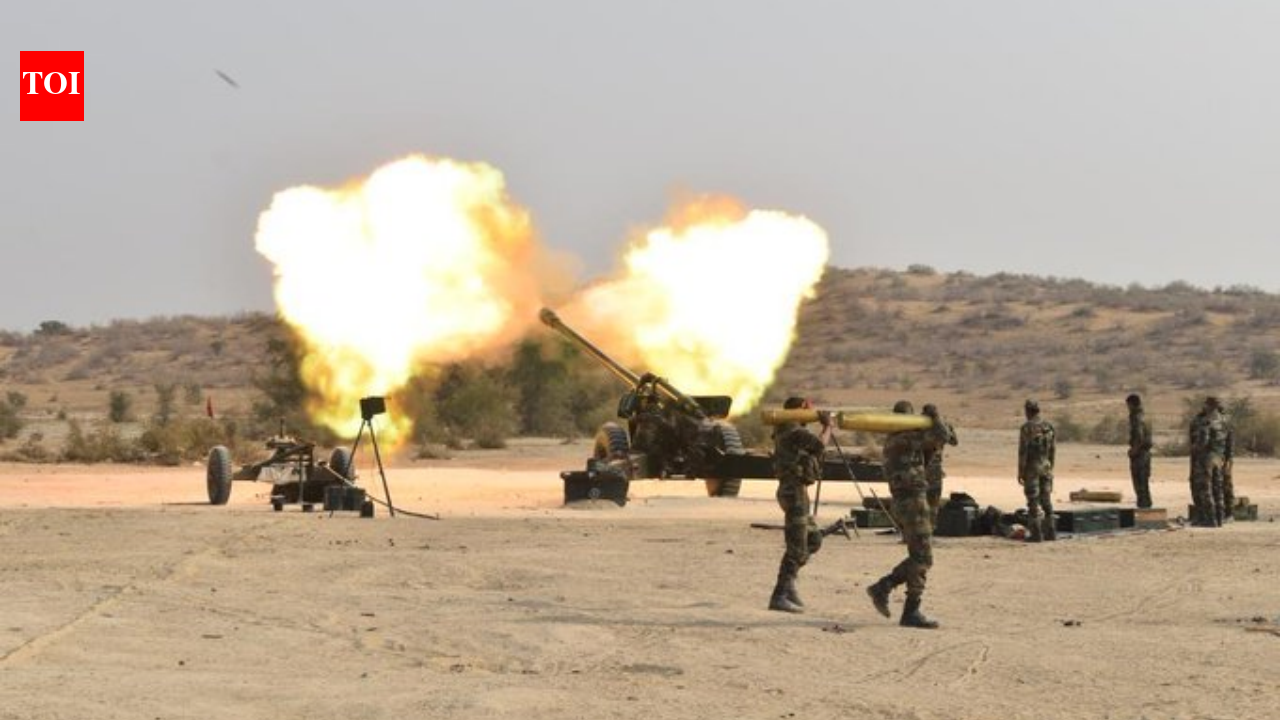
 An artillery gun firing at a target at a distance during a field firing exercise in the western sector. (image credit: Indian Army) Ever since COVID receded, conflict is proliferating ceaselessly across new geographical theaters and operational domains. After four years, the Ukraine Russia war threatens to spread to Europe. West Asia is be-deviled by the Israel – Palestine- Hezbollah war, the Iran- USA war and the Houthi- Saudi war besides civil wars in Yemen, Sudan and Libya. India is locked in simmering tensions with the China-Pakistan combine which periodically erupts into hot war like it happened during OP Sindoor. China is also locked in low intensity tensions with its neighbors in the Western Pacific, that constantly threatens to cross an acceptable threshold.In sum, old wars are prolonging and new wars are sprouting. Each with a characteristic of its own, driven by new technologies and dominated by new weapons. These days it is commonplace to hear about the demise of tanks, artillery, manned aircraft in the battlefield and the mystic rise of drones and algorithms in war. Each conflict has thrown up a new dimension of warfare. Consequently, there is surfeit of opinion on warfare, the threats India faces and how it should prepare to fight its wars in future. It is therefore appropriate to mention that a rising India which has multiple security challenges must have a holistic view of the kinds of future battles it must fight and prepare accordingly. This would also inform us about the forces, capabilities and structures needed for each form of warfare.When viewed simplistically and from first principles, it is my considered opinion that India needs to be able to fight seven forms of warfare. These are explained in succeeding paragraphs.
Conventional Warfare
It is a fallacy to think that conventional operations are passe. The recent lightening offensive by Houthis to grab strategic ground, ports and islands along Yemen’s west coast to completely dominate the Bab el Mandab drives home a fact. Capture of territory through conventional ground offensives remains pivotal and supreme in war. The four-year Ukraine war is replete with examples of territory capture through grinding conventional operations notwithstanding widespread aerial, drone and missile exchanges. Conventional ground-based offensive / defensive operations remain fully relevant as does primacy of holding territory. Possession of land remains 99% of the argument. The lack of ‘boots on the ground’ has been the singular shortcoming in the US war campaign against Iran. In our context the vast frontages which India must defend in the most difficult terrain demands a conventional ‘boots on the ground’ approach. Operations in the high Himalayas or vast deserts will be a combined arms / service enterprise where infantry and mechanized formations hold ground or execute offensive maneuvers on land, backed by firepower of Artillery and the Indian Air Force. Success depends on deploying all arms and services in unison to influence the land battle. Till such time loss of territory is not politically acceptable and our lands in POK and Aksai China are occupied by Pakistan and China respectively, conventional war will remain prime for India.
Conventional Non-Contact Kinetic Warfare
This form of warfare relies on long-range precision standoff weapons, missiles, rockets, and armed UAVs to achieve decisive operational effects without sending troops physically across borders. Body bags are due to enemy action and escalation can be calibrated. It is politically more convenient. It might not involve physical fighting, but it is very attritional in nature. The ability of being able to inflict damage on military / non-military targets is critical. This includes infrastructure which can cripple the opponent’s economy. This form of warfare will probably be the most likely in case of any future conflicts. Nations are preparing to wage non-contact wars as the de facto ‘go to’ option. This is playing out in all contemporary conflicts. During Op Sindoor, non-contact warfare was confined largely to military-to-military exchanges. However, Pakistan attempted to move beyond the military domain and attack civilian targets in depth. A similar and a more magnified threat exists from China too in future. India must therefore plan, build capability, train and prepare to respond through its DRAM (Drones, Rockets, Artillery and Missiles) capability whether it is held by the Indian Airforce, Navy, or Artillery.
Conventional Long-Range Deterrence / Deep Kinetic Warfare
Conventional long-range deterrence and deep kinetic warfare addresses targets far beyond the operational reach of manned aircraft. It will be played out in dense anti-access/area-denial (A2/AD) environments where manned aircraft cannot penetrate or sustain high sortie rates. This is a derivative of non-contact kinetic warfare. Ground-based missile /rocket vectors become the primary means of projection. It will underwrite the India-China conflict equation in the conventional spectrum. Currently Chinese deployments across the elevated Tibetan Plateau create a geographical asymmetry. Major Indian cities and, population centers in North and East India are within their strike range. To establish credible conventional deterrence, India must possess a reciprocal capability not only across Tibet but into some part of mainland China. Ground-based missile forces—specifically long-range Artillery units equipped with vectors like Pralay, extended-range BrahMos, and future hypersonic systems will be the only element capable of delivering high-volume mass precision at such ranges.
Sea Denial / Chokepoint / SLOC Denial
Ground-based forces armed with missiles, drones and uncrewed systems can successfully sink surface fleets and paralyze international shipping corridors. Sea denial is no more the preserve of naval / maritime forces. Ukrainians, IRGC and Houthis have amply demonstrated this in the Black Sea, Strait of Hormuz and the Bab-el-Mandeb Strait respectively. Iran has gone to the extent of firing a warning shot across Suez Canal with its long-range vectors. Choke point / SLOC warfare is the new form of warfare about which India must come to grips with. It enables leveraging its power at global scale and force multiplies India’s sphere of dominance. By integrating ground-based missile regiments, naval and air assets, India can execute total choke point denial over critical maritime passages. Positioning land-long-range vectors and sensors which anchor naval and areal assets across the Andaman and Nicobar Islands enables India exercise considerable control over the Malacca Straits Gateway, 6-Degree and 10-Degree Channels. Similarly long-range vectors deployed across South India and the Lakshadweep islands can exercise control over SLOCs passing through the Chagos archipelago. Similarly long-range artillery located in mainland India or Mizoram in conjunction with our air force can target and neutralize hostile dual-use foreign outposts which are likely to come up at Hambantota, Khyakphu or the Coco Islands, without relying solely on maritime forces. There is a need to think out of the box.
Strategic Deterrence
In times when Pakistan invokes the N word at the drop of a hat and China continues to expand its arsenal, strategic deterrence remains critical for India. It needs to be understood that strategic deterrence does not exist in isolation. It is the upper edge of non-contact warfare. Our adversaries must simultaneously confront the threat of long-range conventional strikes and the catastrophic risks of pushing conflict into the strategic threshold. In this evolving context, maintaining a robust, modernized strategic triad based on MIRV, MARV and Hypersonic capabilities is essential for national survival.Counter Insurgency / Counter Terror OperationsThe CI-CT hybrid paradigm is a continuous, 24/7 operational reality for India. State-sponsored proxy networks, internal insurgencies, and hybrid threats—ranging from cross-border terror incursions to lone-wolf attacks and insider sabotage has been endemic to India. Such warfare demands persistent readiness, vigilance and rapid reaction capabilities. Though India has built up strong capacities through its CAPFs to counter such threats, our indomitable Infantry remains the primary force executing CI/CT operations. History has also proven that whenever the problem is widespread, Artillery has also been pressed into service. This capability needs to be kept relevant, abreast and sharp.
Air defense / Ballistic Missile Defense
The seventh form of future warfare for India is Integrated Air Defense (AD) and Ballistic Missile Defense (BMD). The rapid proliferation of low-cost attack drones, loitering munitions, cruise and maneuvering ballistic missiles means that domestic civil infrastructure, military bases, command centers, and population hubs are likely to be targeted from the outset. The Sudarshan Chakra initiative announced by the PM indicates the primacy of this form of warfare. India requires an integrated, multi-layered air defense network which seamlessly links ground, air and space-based sensors into a unified air defense umbrella capable of shielding the nation’s critical assets.All seven forms of war will be multi domain in nature and technology driven. Cognitive and narrative wars as also AI, cyber/ EW/ space-based wars will be part and parcel of each of the forms of warfare outlined above. Furthermore, India will have to prosecute war in more than one of its forms simultaneously.This demands holistic thinking at national level driven by a clear politico military thought process and a fused joint warfare doctrine. It demands honesty of purpose from our military leaders to do what is good for the nation. Is that in place or are we moving towards that? I do not think so. What is in evidence is segregated thought, driven by color of uniform, lanyards, regimental affiliation. Leaders who drive our defence apparatus must do some honest introspection.