There’s a lot of talk about populism lately, with those on both the right and left denouncing the political elite and calling for major reforms. But through all the conspiracy nonsense about the political elite and unfounded hysteria over things like data centers, I don’t hear much discussion from current populists about what is the greatest threat to our nation — the national debt. It makes one miss the populism of 15 years ago, when the Tea Party movement emerged and demanded action on the national debt.
And they seemed to realize that this can only happen by structural reforms to entitlements. But, to paraphrase what GK Chesterton once said about the Christian religion, reforming entitlements “has not been tried and found wanting; it has been found difficult and left untried.” Ignoring the problem though will not make it go away.
Anyone paying attention to the news should be starting to feel more than a bit uncomfortable by the loud alarms blaring about our national debt.
US Treasury bond yields are now at their highest point since 2007, right before the housing market crash and “Great Recession” started. Foreign investors are not buying our debt because they no longer have as much trust that they will get paid back in strong dollars. And you can’t blame them.
The previous record for US debt-to-GDP ratio was during World War II, when it surged near 120%. During COVID-19, we blew through that, peaking at 130.3% in March 2021, according to US Treasury data, before coming down to 124% in 2025. We remain around that mark, spending like we’re in a global war for survival against Nazi Germany and Imperial Japan. But there’s no real sign that we will drop down to the historic normal ratio of closer to 50%, especially if we start handing $5,000 checks to all adults just because.

The chart below, from the Peter G. Peterson Foundation, lays out how our budget is currently allocated. Social Security is the biggest chunk of the budget, at 22%; Medicare is 14%; and Medicaid is another 10%. Together these entitlements make up about half of the budget (46%). Add in other mandatory spending, and you’re up near 60% of the total pie.

And, in another blaring alarm, we are spending a record amount on interest on our debt, too, which will only eat up more and more of our budget as times goes on.
People want to blame military spending for the budget crisis, because it feels more altruistic to oppose war and support payments to those in need, but our current military spending (at 2.8% of GDP) is actually a bit below the 4% or so we’ve had historically. Many budget analysts warn that without major reform, this number will continue to decline out of necessity, as mandatory spending, especially on entitlements, as well as interest on our debt, crowds out all else, leaving our nation less prepared to defend ourselves in a dangerous world.
So making Social Security, Medicaid, and Medicare solvent is a national security priority, in addition to an economic one. We need to elect leaders who are honest enough to tell the truth about this and brave enough to put forward solutions. When speaking with candidates for office, especially federal office, our first question to them should be: What are you going to do to make these programs solvent and prevent a full-fledged sovereign debt crisis?
And North Carolinians say that’s what they want. The Social Security and Medicare Trustees, in their latest report, say we only have six years before the Social Security trust fund for retirees runs out of money. This would cause immediate mandatory 22% cuts on benefits, $501 less on average per month for North Carolina retirees. When made aware of this, 94% of North Carolina voters in an August Peterson poll said that politicians should have a plan to reform Social Security, and 92% said it was important to make reforms to the system so the cuts do not happen.
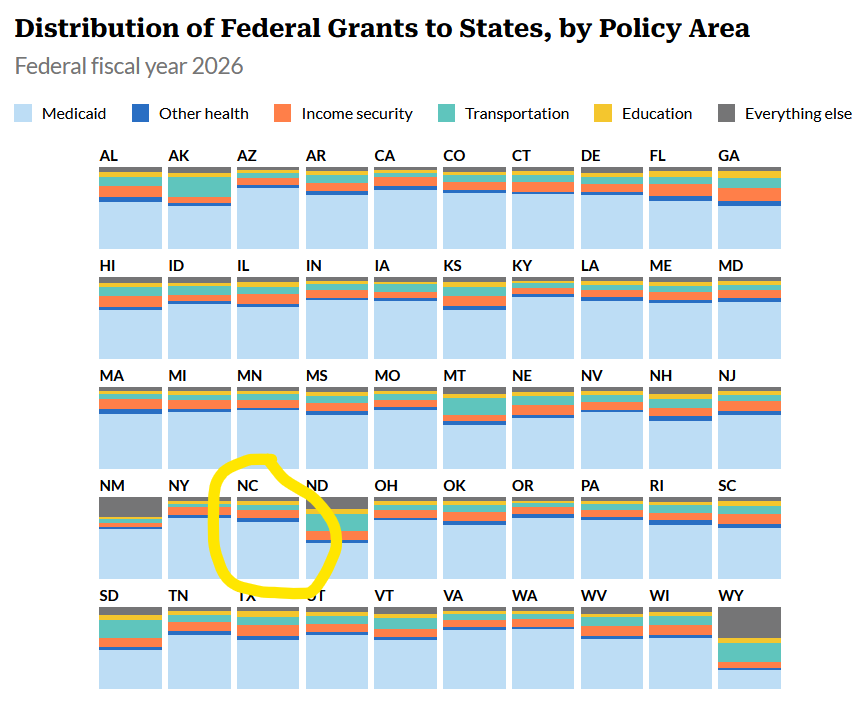
Another area of concern is the degree to which our state relies on federal grants to operate. Pew Research just released a report on what states are receiving from the federal government, and it can be summarized largely in one word — Medicaid. In North Carolina, more than 71% of the federal funds we receive are from Medicaid, which is fairly similar to other states. The cost of Medicaid in North Carolina has nearly doubled since we expanded Medicaid to able-bodied populations in 2023.
Coincidentally, the US House just had a field hearing in Charlotte on healthcare, focusing largely on cost and on Medicaid fraud. They highlighted the need for major reforms at both the state and federal level. State leaders have already made a few recent reforms, like on work requirements and combating fraud.
Of course, to really solve the problem, there will need to be more reforms that bring the program under control. It’s not wise to have such a large portion of the state population (28%) relying on the federal government for their healthcare, when that government is unable to pay its bills. Consider the fact that North Carolina’s latest state budget is for $34 billion for fiscal year 2026-27, while the total amount spent on NC Medicaid last year was $42 billion, with $7.5 billion of that coming from the state budget and most the rest of it from the federal government. So NC Medicaid costs more per year than the entire state budget.
At this point, ignoring the problem will not make it go away. If we do not fix Social Security, there will be automatic cuts. If we cannot sell our bonds, our interest rates will spike and mortgage rates will follow, making housing an even bigger problem. If our dollar is further inflated, people will not be able to afford groceries or other basic necessities, and voters are already telling pollsters high prices is their No. 1 concern. We won’t even be able to properly maintain our military to defend ourselves — since defense spending is considered discretionary not mandatory.
So voters need to think about who they can send to Washington, and Raleigh, who will have the courage to speak truthfully about these problems and make decisions that pull us from the brink.