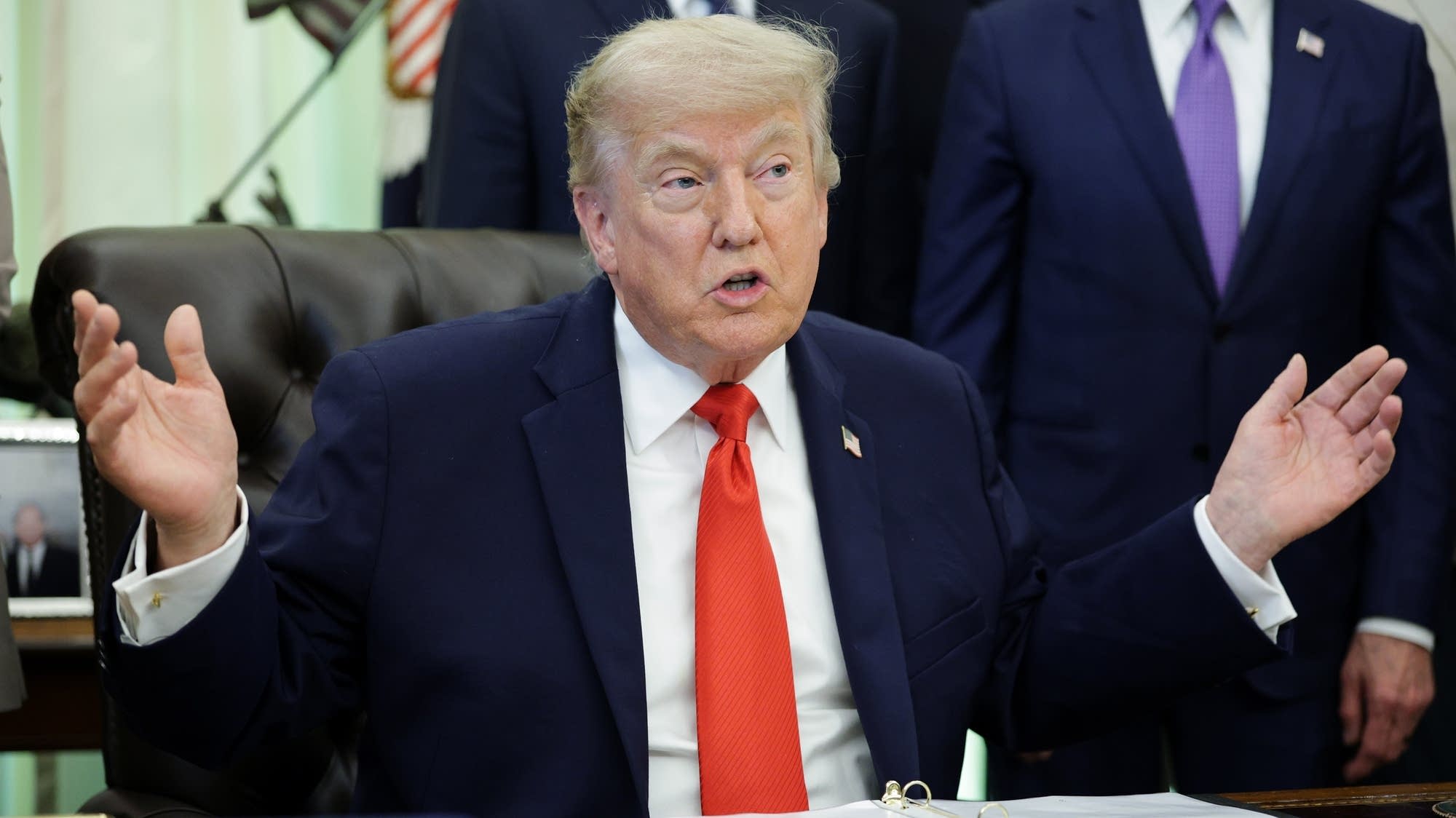
President Donald Trump has proposed yet another plan to distribute multi-thousand-dollar checks to Americans. His latest pitch: $5,000 checks to every American adult if the Republican party remains in control of the House and the Senate in the midterm elections.
Since there are about 245 million adult citizens in the U.S, the proposal could cost $1.2 trillion.
Back early 2025, Trump and billionaire Elon Musk, the CEO of Tesla and former head of the Department of Government Efficiency, seemed receptive to the idea of taking savings from government spending cuts initiated by DOGE, and distributing that money to citizens. “I love it,” Trump said about the proposal. If it had gone into effect, Americans could have received $5,000 each. Later in the year, Trump floated the idea of paying a $2,000 tariff dividend to every American.
Neither have come to fruition, and this latest proposal is likely to have a similar fate.
The plan is seeing resistance from Congressional Republicans, like Sen. John Kennedy of Louisiana, who said “I don’t support going and borrowing $1.2 trillion to be able to write the checks,” and Sen. Steve Daines of Montana who said he’s worried about America’s debt. Republicans are are also unlikely to retain control of both chambers of Congress since Democrats are favored to win the House, according to forecasts.
If this latest proposal does happen to go into effect, experts say that it could boost inflation and add to the deficit, which is already high.
Maclyn Clouse, a finance professor at Denver University, said he thinks the proposal is “pretty ill defined.”
“[Trump] has said that he’ll write a $5,000 check to everybody. Well, do you think Warren Buffett, do you think Jeff Bezos, do you think Elon Musk needs a $5,000 check from the U.S. government? No, of course not. And so you just question what’s the purpose of that,” Clouse said.
There would be some benefits, like helping lower-income Americans afford daily necessities. If we look back to the stimulus checks distributed during the pandemic, those extra funds did help certain groups – like those who were laid off or unable to go to work – provide for their families, said Michael Jones, an associate professor of economics at University of Cincinnati.
But a Fed study found that the government stimulus checks boosted inflation by 2.6 percentage points in February 2022.
We don’t know how much this plan would raise inflation, but Jones said it’s “a surprising proposal given that inflation is still stubbornly above where we want to see it.” Consumer prices rose 0.4% in August, and 3.4% over the past year, which means the Fed could raise interest rates to cool inflation.
We also don’t know where this money will come from. “How do you fund that? We’ve already got a massive U.S. debt,” Clouse said.
That extra trillion or so would add to the deficit, or how much more the government has spent annually than it’s brought in. Right now, the deficit stands at more than $1.9 trillion. Meanwhile, the national debt – the cumulative total of all past deficits and surpluses – is more than $40 trillion.
Vice President JD Vance has indicated that funds from the proposal could be covered by U.S. tariff revenue. But from 2025 up until this August, the U.S. has collected about $362 billion in tariff-related revenue, under a third of the potential price tag.
We have to pay the interest on the national debt, and as interest rates go up, interest expenses are going to become a larger amount of the annual budget, Clouse said.
That makes it harder for the government to spend on education, infrastructure and social programs, said Reilly White, a finance professor at the University of New Mexico, in a 2025 Marketplace interview.
And when the government borrows more, it makes it more expensive for others to borrow money because now everyone’s competing for a loan.
That in turn means car loans and mortgage rates could go up.
Related Topics