
Researchers have developed a carborane-based electron transport material for perovskite/silicon tandem solar cells that offers an alternative to the field’s default choice, buckminsterfullerene (C60).
Electron transfer materials facilitate the transfer of electrons from the light-absorbing layer to the electrode in a solar cell. For over a decade, C60 fullerenes and derivatives thereof have been the standard electron transport materials in high-efficiency perovskite and tandem solar cells due to their high electron mobility. Another advantage of C60 fullerenes is that they are simple to deposit onto a substrate via thermal evaporation, which forms thin, conformal layers. These coatings allow the electrons to travel from the perovskite to the electrode with minimal resistance.
C60 fullerenes do, however, have drawbacks including high interfacial non-radiative recombination losses, which limits the voltage and therefore the efficiency of the device. They also exhibit high parasitic light absorption, which reduces the photocurrent the cells can reach.
These issues prompted a team led by Steve Albrecht, from the Helmholtz-Zentrum Berlin (HZB) in Germany, and collaborator Vytautas Getautis, from Kaunas University of Technology in Lithuania, to consider alternatives.
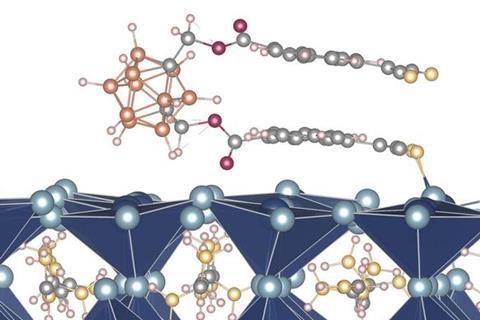
Their investigation has resulted in a carborane-based molecule that works as an electron transport material in perovskite/silicon tandem solar cells. It contains a meta-carborane core and two 9-fluorenylidene malononitrile functional groups.
Like C60, this new molecule is simple to deposit onto the perovskite via thermal evaporation forming thin, uniform films. However, tests showed that it interacts more favourably with the perovskite surface. Density functional theory calculations linked this to the molecule’s nitrile groups interacting with undercoordinated Pb²⁺ defects on the perovskite surface, which promotes highly efficient electron extraction and reduces interfacial non-radiative recombination losses compared with C60.
Moreover, the carborane-based material has a wider optical bandgap than C60-based materials and thus experiences less parasitic absorption in solar cells, allowing more light to reach the photoactive layers. As a result, tandem solar cells incorporating the new material achieved an efficiency of 31.3%, compared with 28.9% for those using C60.
Perovskite chemist Michele Sessolo, from the University of Valencia in Spain, says ‘the broader importance of the work is that it demonstrates a credible route to eliminating one of the long-standing weak interfaces in this type of solar cell. It will have important implications for even wider bandgap perovskites, where the voltage losses are typically even higher.’
One current limitation is its stability. Devices using the new material degraded faster than their C60 counterparts during prolonged operation. The researchers suggest this is due to chemical interactions at the perovskite interface, rather than instability in the carborne-based molecule itself. HZB team member Lea Zimmerman says that to address this issue the group is looking into ‘introducing an interlayer between the perovskite and the new material. This has been done for C60 before, so this is a very simple route that we can explore at first.’