
The US-Philippines trade relationship strengthened significantly in 2025 and remained highly active through the first seven months of 2026. The United States is one of the Philippines’ most important export markets, while American companies supply the Philippines with electronics, machinery, agricultural commodities, aircraft, medical equipment, & other high-value products. According to the latest US export data and Philippines import data, the total value of US exports to Philippines reached $9.1 billion, while US imports from the Philippines reached $18 billion in 2025, according to US import data. The total US-Philippines trade turnover accounted for $27.1 billion in 2025 and $17.1 billion in the first half of 2026 (January to June).
The merchandise relationship is particularly important. U.S. goods imports from the Philippines increased sharply in 2025, while U.S. exports to the Philippines remained broadly stable. This resulted in a substantially wider U.S. goods trade deficit with the Philippines.
US-Philippines Trade at a Glance
Trade Indicator
2025
U.S. goods exports to Philippines
$9.1 billion
U.S. goods imports from Philippines
$18 billion
Total U.S. goods trade
$27.1 billion
U.S. goods trade deficit
$8.5 billion
U.S. services exports
$5.1 billion
U.S. services imports
$8.7 billion
Total goods & services trade
$40.9 billion
USTR data on US-Philippines relations show that U.S. goods imports from the Philippines climbed 25.5% in 2025, reaching $18 billion, while U.S. goods exports to the Philippines were around $9.1 billion. Consequently, the U.S. goods trade deficit increased 73.6% to about $8.9 billion.
The Philippines’ own trade statistics also demonstrate the importance of the American market. The United States was the largest destination for Philippine exports in 2025, receiving $13.46 billion worth of Philippine goods, equivalent to 15.9% of the country’s total exports.
Top Goods US Imports From the Philippines
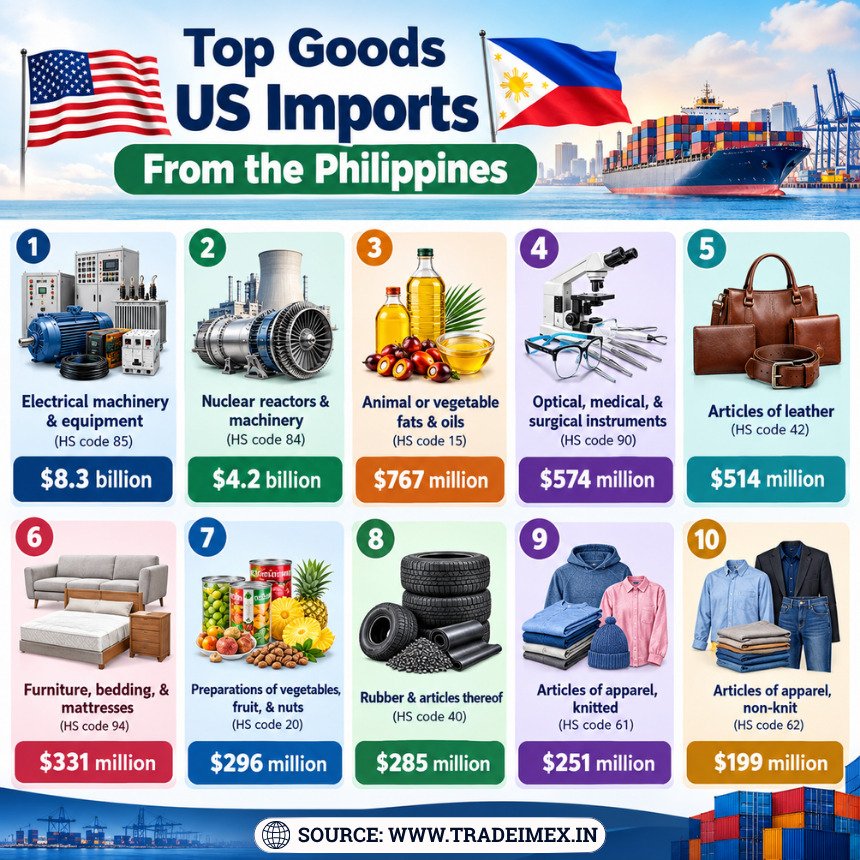
The United States imports a variety of goods from the Philippines, with some of the top products being electronics, machinery, medical devices, and agricultural products. The strong trade relationship between the two countries contributes to the steady flow of these goods into the US market. The quality and competitive pricing of electronics and machinery from the Philippines make them sought after by American consumers and businesses alike. The top 10 goods that the US imports from Philippines, as per the US import statistics for 2025, include:
1. Electrical machinery & equipment (HS code 85): $8.3 billion
2. Nuclear reactors & machinery (HS code 84): $4.2 billion
3. Animal or vegetable fats & oils (HS code 15): $767 million
4. Optical, medical, & surgical instruments (HS code 90): $574 million
5. Articles of leather (HS code 42): $514 million
6. Furniture, bedding, & mattresses (HS code 94): $331 million
7. Preparations of vegetables, fruit, & nuts (HS code 20): $296 million
8. Rubber & articles thereof (HS code 40): $285 million
9. Articles of apparel, knitted (HS code 61): $251 million
10. Articles of apparel, non-knit (HS code 62): $199 million
The data highlights a major structural feature of the bilateral trade relationship: electronics dominate Philippine exports to the American market, as per the data on the Philippines exports to US under HS code 85. Electrical & electronic equipment alone generated $7.26 billion, accounting for more than half of Philippine exports to the United States in the UN Comtrade classification. Within this category, electronic integrated circuits & microassemblies generated around $2.88 billion in 2025. Insulated wires and cables contributed about $1.07 billion, while electrical transformers, static converters, and inductors generated around $860.18 million.
This concentration reflects the Philippines’ role in global electronics manufacturing and supply chains. Electronics are also the Philippines’ largest export commodity group overall. Philippine Statistics Authority data shows that electronic products generated $45.89 billion in 2025, representing 54.3% of the country’s total exports.
Top Goods US Exports to the Philippines
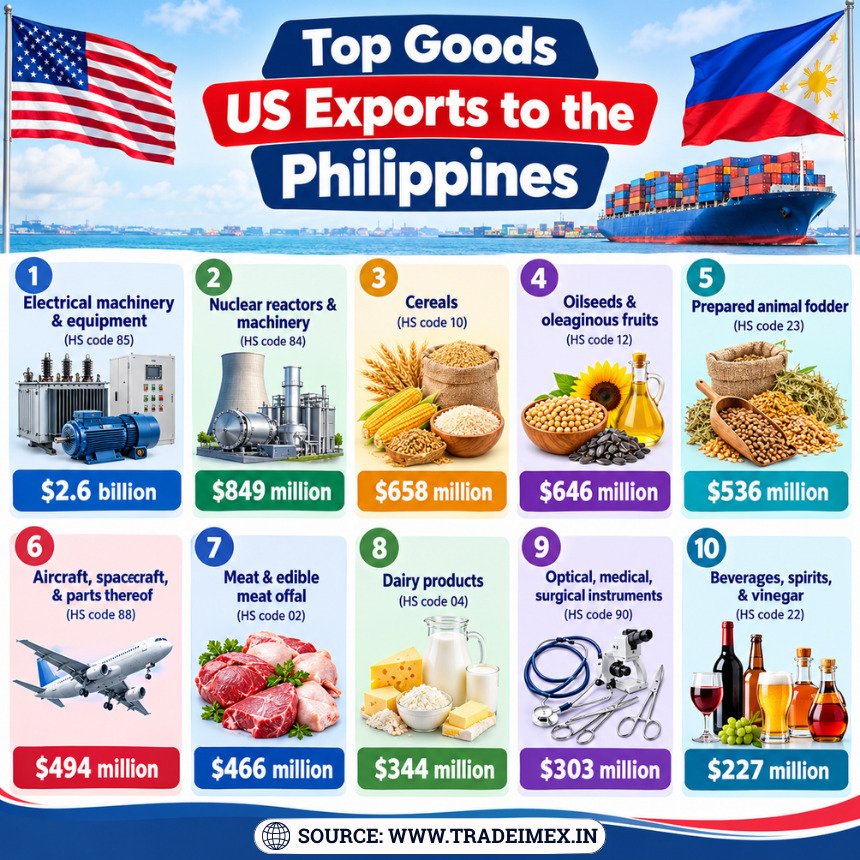
The Philippines, being a key trade partner of the United States, imports a variety of top goods from the US. Among the notable exports from the US to the Philippines are electronics, agricultural products, machinery, and aerospace equipment. These sectors contribute significantly to the bilateral trade relationship between the two countries. The top 10 goods that the US exports to Philippines, as per the data on Philippines trade with US and US shipment data for 2025, include:
1. Electrical machinery & equipment (HS code 85): $2.6 billion
2. Nuclear reactors & machinery (HS code 84): $849 million
3. Cereals (HS code 10): $658 million
4. Oilseeds & oleaginous fruits (HS code 12): $646 million
5. Prepared animal fodder (HS code 23): $536 million
6. Aircraft, spacecraft, & parts thereof (HS code 88): $494 million
7. Meat & edible meat offal (HS code 02): $466 million
8. Dairy products (HS code 04): $344 million
9. Optical, medical, surgical instruments (HS code 90): $303 million
10. Beverages, spirits, & vinegar (HS code 22): $227 million
Electrical and electronic equipment was the largest U.S. export category, at $2.62 billion, followed by industrial machinery, as per the data on US exports to the Philippines under HS code 84. However, the trade basket also shows the importance of American agricultural exports. Cereals, oilseeds, animal-feed products, meat and dairy products collectively represent a substantial portion of U.S. shipments to the Philippines.
This creates a complementary trade structure: the Philippines is highly competitive in electronics and manufacturing, while the United States supplies technology, capital goods, aircraft, food commodities, and agricultural inputs.
US-Philippines Trade in The Last 10 Years: Yearly Bilateral Trade Data
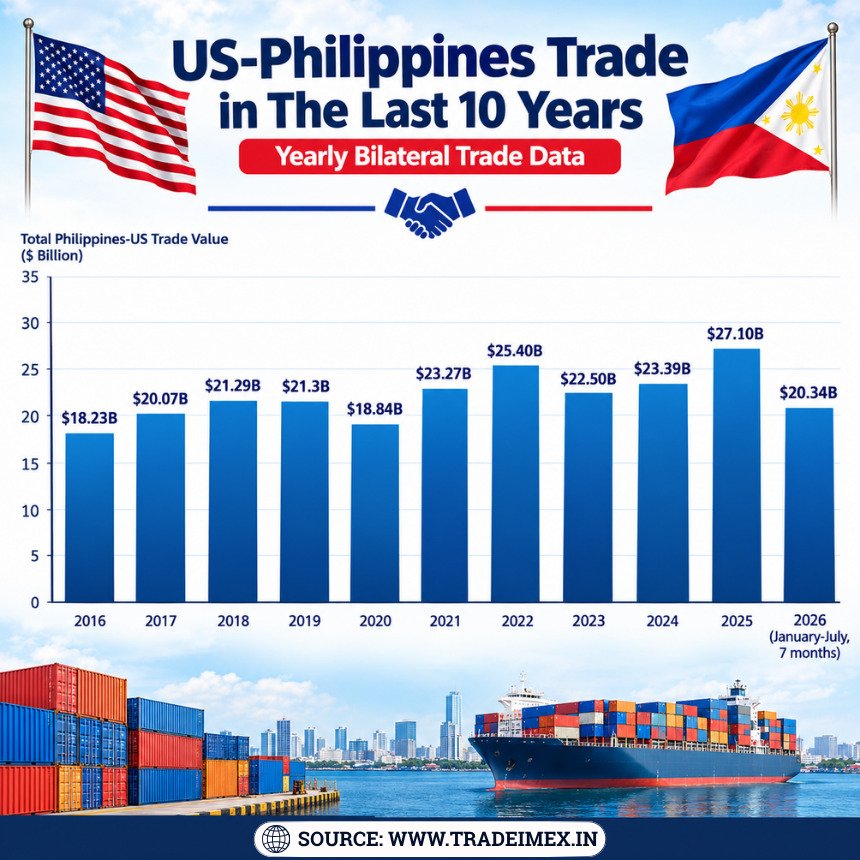
Year of Trade
Total Philippines-US Trade Value ($)
2016
$18.23 billion
2017
$20.07 billion
2018
$21.29 billion
2019
$21.3 billion
2020
$18.84 billion
2021
$23.27 billion
2022
$25.40 billion
2023
$22.50 billion
2024
$23.39 billion
2025
$27.10 billion
2026 (January-July, 7 months)
$20.34 billion

2026 US-Philippines Trade: What the Latest Data Shows
Trade remained substantial in 2026. U.S. Census Bureau data for January through July shows that the United States exported around $5.79 billion in goods to the Philippines and imported around $14.56 billion from the country. That represents around $20.35 billion in two-way U.S. goods trade during the first seven months of 2026, with a U.S. goods deficit of around $8.76 billion over the period.
U.S.-Philippines Goods Trade, January-July 2026
Indicator
Jan-Jul 2026
U.S. exports to Philippines
$5.79 billion
U.S. imports from Philippines
$14.56 billion
Two-way goods trade
$20.35 billion
U.S. goods balance
-$8.76 billion
The monthly data also shows strong Philippine shipments into the U.S. market. U.S. imports from the Philippines reached around $2.80 billion in July 2026, compared with $741.6 million in U.S. exports to the Philippines that month. The July figures produced a U.S. monthly goods deficit of more than $2.05 billion with the Philippines, indicating that the imbalance remained significant as 2026 progressed.
Why Electronics Are Driving Bilateral Trade
Electronics are arguably the most important strategic component of the US-Philippines trade relationship. Philippines electronics exports reached $49.64 billion in 2025, increasing 16.11% from $42.75 billion in 2024. Electronics accounted for around 58.81% of the country’s total exports during the year, according to the Semiconductor and Electronics Industries in the Philippines Foundation.
The sector includes semiconductor components, electronic data-processing equipment, telecommunications equipment, automotive electronics, consumer electronics and industrial instrumentation. The Philippines’ electronics industry therefore connects directly with U.S. demand for semiconductor-related components and electronic equipment. This is particularly relevant as companies continue to diversify Asian manufacturing and sourcing networks.
For U.S. importers, the Philippines offers an established electronics manufacturing ecosystem. For Philippine exporters, the U.S. provides one of the world’s largest end markets for high-value manufactured and technology products.
Agricultural Trade Is Another Key Pillar
While electronics dominate Philippine exports to the United States, agricultural commodities are especially important in the opposite direction. The United States exports significant volumes of:
Corn and other cereals
Soybeans and oilseeds
Animal feed
Meat
Dairy products
Processed food
Beverages
The Philippines is a major food-importing economy, and American agricultural suppliers benefit from the country’s growing consumer market and food-processing industries. The 2025 U.S. export data demonstrates this diversification. Cereals accounted for about $658 million, oilseeds & related products for around $646 million, food-industry residues and animal feed for about $536 million, and meat for roughly $466 million.
What the 2025-2026 Trade Data Means for Businesses
The latest trade figures reveal several important opportunities for importers, exporters, and sourcing companies.
1. Electronics remain the biggest opportunity
With electronic products representing more than half of Philippine exports globally and electrical/electronic equipment accounting for $7.26 billion of Philippine exports to the U.S., electronics remain the core trade opportunity.
2. Supply-chain diversification favors the Philippines
The country’s established electronics and manufacturing base gives American companies another sourcing location within Asia. This can become increasingly relevant as businesses seek to diversify production and reduce concentration risk.
3. U.S. agricultural exporters have a large market
The Philippines’ demand for cereals, animal feed, meat, dairy products, and oilseeds creates significant opportunities for U.S. agricultural suppliers.
4. Machinery and capital goods remain important
Machinery is significant in both directions. Philippine exports of machinery to the U.S. reached around $1.75 billion in 2025, while U.S. exports of machinery and mechanical equipment to the Philippines were around $849 million.
5. Trade data is becoming increasingly important
The widening U.S. goods deficit and rapid growth in Philippine exports make product-level trade intelligence increasingly valuable. Importers can use shipment-level and customs data to identify active buyers, suppliers, product categories, ports, shipment volumes, and sourcing trends.
US-Philippines Trade Outlook for 2026
The 2026 data points to continued strong bilateral merchandise trade. Through July, U.S. goods imports from the Philippines had already reached around $14.56 billion, compared with $17.8 billion for the whole of 2025. If the pace of trade continues, Philippine exports to the U.S. could remain a major contributor to the country’s overall export performance. Electronics are likely to remain the primary engine, supported by machinery, medical equipment, furniture, processed food, rubber products, apparel, and other manufactured goods.
At the same time, U.S. exports to the Philippines are likely to remain anchored by electronics & machinery alongside agricultural commodities, aircraft, medical equipment, and food products. The long-standing U.S.-Philippines Trade and Investment Framework Agreement (TIFA), or the US Philippines Trade Deal, provides an institutional mechanism for the two countries to address bilateral trade issues and coordinate on broader commercial matters.
Conclusion
The US-Philippines trade relationship entered 2026 with strong momentum, following a major increase in Philippine exports to the American market during 2025. U.S.-Philippines goods and services trade reached an estimated $40.9 billion in 2025, while goods trade alone stood at around $27 billion. The most important trade pattern is clear: the Philippines exports high-value electronics, machinery, and manufactured goods to the United States, while the U.S. supplies electronics, machinery, agricultural commodities, aircraft, food products, and specialized equipment to the Philippines.
With Philippine electronics exports expanding rapidly and U.S. goods imports from the Philippines reaching $14.56 billion in just the first seven months of 2026, the bilateral trade corridor is becoming increasingly important for global supply chains.
Note For Our Readers
For businesses looking to capitalize on this growth, detailed US import-export data, Philippines trade data, or to search US or Philippines trade records by country or HS code, contact TradeImeX at [email protected] for deeper visibility into which products are moving, which companies are trading them, and where new market opportunities are emerging. Get exclusive access to customized trade reports & market insights to grow your business.
Disclaimer: TradeImeX provides global trade database, including import-export data of 100+ countries and customized data report. We do NOT buy or sell any products. For purchasing or selling inquiries, please contact the actual importers/exporters listed in our database reports.