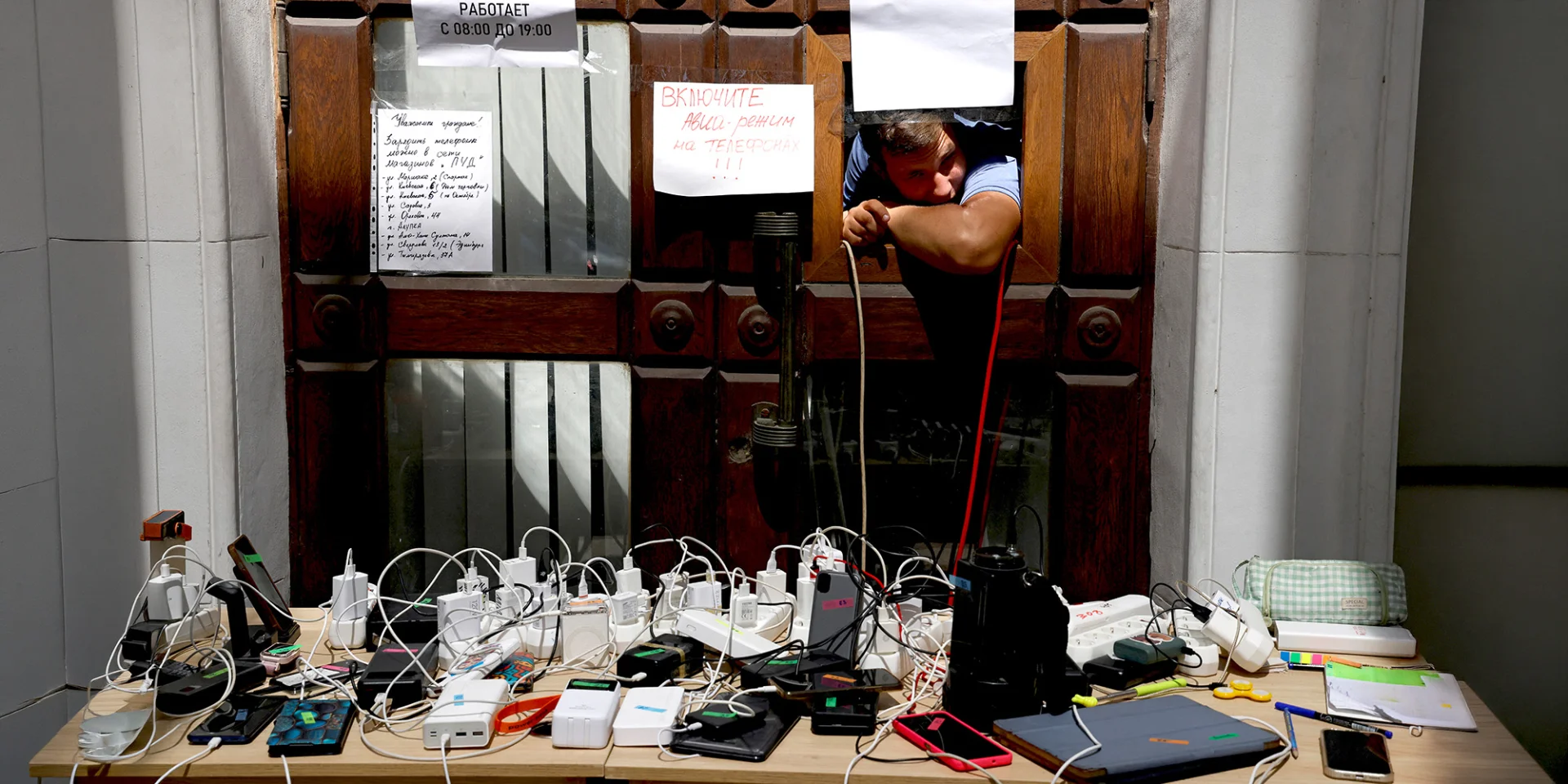

A charging station for phones and power banks during prolonged power outages in occupied Yalta. (Photo: Reuters)
Three waves of crisis — energy, fuel and economic — have shattered the
Kremlin’s central myth of Crimea as a safe harbor capable of shielding the
peninsula from any problems.
People carrying buckets, plastic canisters and even cooking pots as they
wait once a day for a water tanker to arrive have become a common sight in
villages in northern Crimea.
A resident of the occupied peninsula, speaking to NV on condition of
anonymity, said she repeatedly saw such scenes in the summer of 2026. She said
generators are sometimes connected to pumps in villages, but there is still not
enough water pressure for everyone and there are no schedules: centralized
water supplies may run for two to three hours a day or not at all.
The problem became just one manifestation of the systemic crisis that has
engulfed occupied Crimea since early summer.
As recently as spring, the local occupation “administration” predicted a 20%
increase in tourist arrivals and was preparing for a record season. A record
did come — just not the kind the Russian “authorities” expected.
In the spring, Ukrainian drones launched a large-scale operation to blockade
the peninsula. Crimea was first hit by a wave of fuel shortages. Energy
problems followed, leading to blackouts. Behind both was a third wave of crisis
— Ukraine’s Defense Forces severing logistics routes and striking the Russian
section of the power bridge that supplied the peninsula. No electricity means
no water, no commerce and, ultimately, no tourists.
Russian business outlet The Bell calculated that electricity consumption in
Crimea fell 42% year over year from July 1–20. In mid-July, satellite images
showed nighttime illumination on the peninsula had fallen 83% compared with
April.
HUR estimated that about 1.4 million customers in occupied Crimea were
simultaneously without electricity at the height of the July blackout. Since
July 1, Ukraine’s Unmanned Systems Forces have knocked out at least 267 power
facilities, and after Aug. 22 they carried out further strikes whose final
results the Ukrainian military has not yet disclosed.
But the problem goes beyond electricity.
The Crimean resident told NV that for 12 years Moscow and state media under
its control had assured Crimeans that they were under the protection of a
genuinely powerful and wealthy state capable of providing complete security and
every convenience.
“People can now see with their own eyes: there is the strength they claim to
have, and there is the strength they actually have,” she told NV. “And everyone
can feel the difference now.”
Three waves of problems
Crimea’s power system rests on three pillars: the Balaklava and Tavriiska
thermal power plants, which together provided about 940 MW, and the power
bridge from Russia’s Kuban region running beneath the Kerch Strait. Since
mid-June, Ukrainian strikes have systematically hit the entire system: first
substations and then both thermal power plants. As a result, Crimea lost power
completely for the first time on July 6. After a July 14 strike, the Balaklava
plant, which had provided up to a third of local generation, did not return to
service. The Tavriiska plant was hit three times in June.
Moscow built the Kuban-Crimea power bridge after the 2015 blackout as
insurance against another total outage. Four cable lines crossing the Kerch
Strait had a design capacity of 800 MW. Ukrainian strikes hit the Crimean
section of the system on July 8 and 13, while the Taman substation on the
Russian side, through which all four cables pass, caught fire overnight into
Aug. 20. Infrastructure intended to guarantee Crimea’s electricity supply
became a target.
The result was not only power outages in Crimean homes — industrial
businesses also began shutting down. Crimean Titan, a large business in
Armyansk, has been idle since June; a dairy plant in Dzhankoi stopped operating
in August; and a soda plant sent workers “on vacation” at one-third of their
salaries.
For residents of the peninsula, strikes on generating facilities and the
power bridge quickly turned into a household crisis. “There was a period when
there was no electricity at all for about three weeks. Then they started
turning it on for two to three hours. But the voltage during those hours is
barely enough to turn on light bulbs — no household appliances work,” a
resident of the peninsula told NV on condition of anonymity. The longest
uninterrupted blackout, lasting up to a month, hit the northern Crimean cities
of Armyansk and Krasnoperekopsk, while the Dzhankoi district became the most
troubled area on the peninsula.
Electricity conditions in the south are better by Crimean standards:
Sevastopol currently operates on a schedule of “two hours with power, six
without.”
At the same time, on July 19 the occupation authorities stopped publishing
lists of cities and districts without power. “We are restricting information in
the public domain,” Crimea’s “head,” collaborator Sergei Aksyonov, explained.
Water disappeared along with electricity. “In the cities, it is more or less
available, but in the villages, without electricity, it simply cannot be pumped
into the water towers,” the Crimean source told NV.
On Aug. 13, Rospotrebnadzor acknowledged that residents of Yevpatoria,
Krasnoperekopsk, Saky, Dzhankoi, Armyansk and three districts in northern and
western Crimea were receiving water that did not meet standards.
Crimeans have largely had to adapt to the blackouts at their own expense.
“Everything is bought from the family budget — generators, power stations and
everything else. Yes, some generators are distributed to villages, and critical
facilities and hospitals are being equipped, but it isn’t enough,” the NV
source said.
The second major problem is fuel. In Sevastopol, for example, it is sold
using QR codes, with a limit of 20 liters per vehicle once a week. In
Chornomorske District, the westernmost district of the peninsula, fuel is sold
using special coupons at the same interval. Similar systems, with some
variations, are in place elsewhere in Crimea.
The shortage immediately created a black market. A liter of 92-octane
gasoline cost 450 rubles ($5.30) from resellers in early August, compared with
80 rubles ($0.90) before the crisis in the spring, while AI-92 gasoline was
also selling for as much as 450 rubles. After Putin announced on Aug. 4 that
gasoline subsidy payments would begin, the official price fell to 100 rubles
($1.20) per liter, but the fuel itself did not return to gas stations.
Even according to official Rosstat figures, gasoline prices in Crimea rose
211% year over year in July, compared with an average 26% increase across
Russia, while inflation on the peninsula reached 15.8%, compared with 6%
nationwide.
Food prices alone rose by an average of 30%.
Demand fell at the same time. “People are simply saving money and giving up
everything that is not an essential need,” the Crimean resident told NV. She
said acquaintances working in the service sector had lost nearly half their
orders.
Some data indicate that 398 food-service establishments closed on the
peninsula in the first half of the year — 42% more than last year — while
one-third of small-business owners plan to close or sell their businesses.
That is hardly surprising, because the peninsula depended largely on
tourists, and this year’s season has been a complete failure. TravelLine data
show bookings fell 58–72%, depending on the month, compared with last year.
“For any hostel to operate normally now, it needs a generator, solar panels —
all this expensive equipment. And there is no income to cover and pay for it,”
the Crimean source told NV. Most privately owned hostels and boarding houses
therefore simply did not open this year, some properties have been put up for
sale, and most customers at those still operating are locals taking advantage
of steep discounts.
Crimean real estate agents, meanwhile, report that demand for local housing
has fallen by as much as 30%, while prices have dropped from 180,000 rubles
($2,000) to 130,000 rubles ($1,500) per square meter. According to NV’s source,
some Russians who moved to the peninsula after 2014 and bought property in the
“resort paradise” are now trying to move their families “to the mainland.”
“If the husband cannot leave for some reason because he is a career
serviceman or a member of the security services, they try to get at least the
wife and children out of Crimea,” the Crimean resident said.
Moscow has not publicly acknowledged the scale of the crisis. Putin first
addressed the fuel shortage on June 28, calling supplies to Crimea a priority
but describing the shortage as “some, but not critical.” Kremlin spokesman
Dmitry Peskov repeated the same formulation on July 16.
“Why Moscow is silent, I don’t know,” NV’s Crimean source said. “People
expected that when all this started, it wouldn’t be local officials dealing
with it — the center would immediately step in. Crimea has effectively been
subsidized by the Russian budget all this time and lived off that money.”
What comes next
Crimea’s power demand typically reaches 1,780 MW in January — about 100 MW
above its summer peak. If the Balaklava thermal power plant does not return to
service and power flows from Kuban remain unstable, the Tavriiska plant, with a
capacity of about 470 MW, will remain the peninsula’s main large-scale source
of generation, supplemented by smaller and mobile units. NV calculations based
on open data indicate that this would cover less than half of the peninsula’s
winter needs.
There is also the question of natural gas, which currently powers some
backup generation.
“In the north, people are mostly getting by with portable power stations or
generators running on natural gas,” NV’s Crimean source said. “If the situation
develops in such a way that the gas runs out, that will be an entirely new
challenge.”
The risk of a winter shortage fits into the broader logic of Ukraine’s
campaign. Ukraine’s Defense Ministry announced a “logistics lockdown” program,
then-minister Mykhailo Fedorov spoke of plans to turn the peninsula into an
island, and on June 26, Volodymyr Zelenskyy called the operation in Crimea
“carefully calculated” and set out its political goal — to force Russia to
choose peace.
Western analysts agree that the occupied peninsula has become a source of
significant strategic pressure on Moscow, though they differ in their
assessments of its effectiveness.
“The strikes on Crimea have completely destroyed the Kremlin’s years-long
promises to protect the peninsula. Instead of security, there is now a serious
fuel and energy crisis there,” said Natia Seskuria of Britain’s Royal United
Services Institute (RUSI). She said the cost of the war for the population is
rising, although it is too early to speak of Crimea’s complete isolation.
Michael Clarke of King’s College London also does not view the military
liberation of Crimea as an immediate Ukrainian objective. Instead, he describes
the peninsula as an important lever in Kyiv’s hands: if it can be kept in its
current condition, it could become additional leverage for President Volodymyr
Zelenskyy in hypothetical peace negotiations with the Kremlin.
Peter Dickinson of the Atlantic Council sees another dimension: the campaign
of strikes on Crimea could make the peninsula unsuitable for Russia to use as a
major military base.
CSIS analysts Seth Jones and Riley McCabe, meanwhile, acknowledge the scale
of the strikes but stress that they have not yet broken Russia’s war machine.
But they have changed the mood.
It is impossible to accurately gauge Crimeans’ reaction to the problems:
there have been no representative surveys on the peninsula in 2025–2026, while
authorities open administrative cases against residents for publicly
complaining about the lack of electricity. In Krasnoperekopsk, for example, 29
people were detained over calls for a rally, a collective appeal to Putin by
2,500 employees of the TES fuel company, and “critical” social media posts. The
Crimean Solidarity movement, which documented such persecution, also ceased
operations in July after the Russian “authorities” designated it a “foreign
agent.”
According to NV’s Crimean source, however, the tone of private conversations
among local residents is changing.
“There are significantly more people saying: we need to end it, we need to
stop, all this is pointless, people are dying on both sides,” she said. She
added that such views had become more common even among pro-Russian Crimeans.
According to NV’s source, there have been many people with pro-Ukrainian
views in Crimea throughout these years, but most avoided publicity because of
the risk of administrative or criminal prosecution. Such people therefore lived
“as if in a capsule.”
“Now they see events differently — with anticipation and hope,” the Crimean
resident said.
Follow us on Twitter, Facebook and
Google News