With the announcement that the US national debt has passed the $40 trillion mark and is rising at what is widely acknowledged as an “unsustainable” rate, with no sign of abatement, attention is being directed as to how it is being funded.
The financing of the ever-growing debt mountain takes place through the $32 trillion US Treasury market where the government issues new debt by selling bonds and where bonds bought in the past are bought and sold by investors.
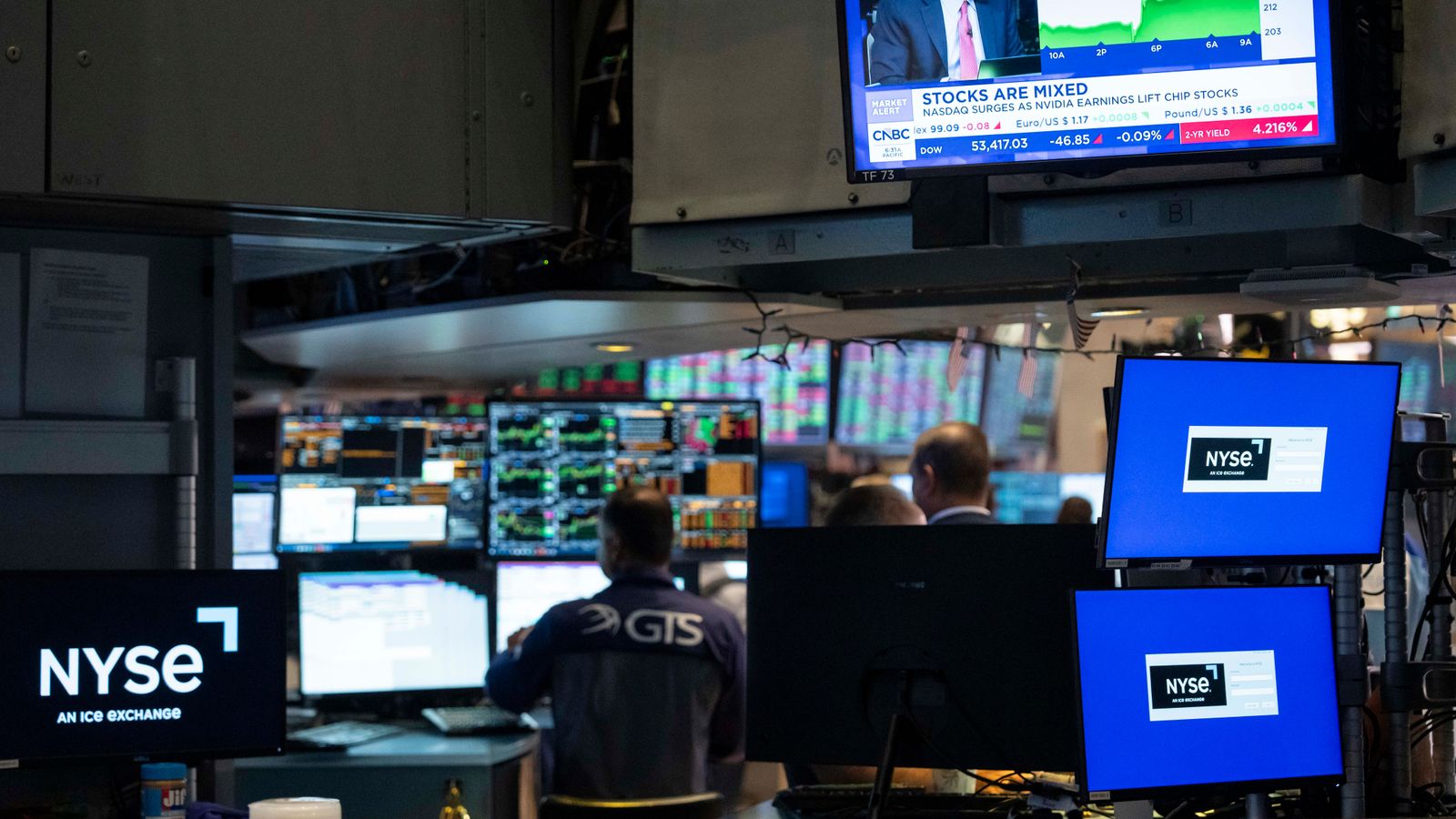
 A screen displays Nvidia stock price on the floor of the New York Stock Exchange, Thursday, Aug. 27, 2026, in New York. [AP Photo/Yuki Iwamura]
This market, which forms the basis of the US and the global financial system, has become transformed in recent years. Previously it was dominated by institutions such as banks, insurance companies and bond-trading firms which invested long term.
Today the market is increasingly impacted by hedge funds which trade rapidly in the search for quick, speculative profits, with their operations financed by large amounts of borrowing. This enables them to leverage their returns when their bets prove successful, but which can bring about major losses if they are not.
In a post on his Chartbook blog last week, the economic historian Adam Tooze directed attention to the growing financial dangers residing in the Treasury market and the real possibility of a repeat of the crisis of March 2020 when it froze—for days there were no buyers for US debt—and a crisis developed across the financial system.
While it was alleviated through the intervention by the US Federal Reserve, amounting to several trillions of dollars, the March 2020 crisis was in a number of respects even more serious than that of 2008.
Tooze began a post on August 23, by noting: “In 2026 we are worrying about bond markets again. Long yields are surging across the developed world. The US Treasury is engaged in unprecedented intervention and markets are not responding. Yields are back up and the dollar is down.”
This was a matter of “global concern.” He then posed the question: “What is the worst thing that could happen? A large-scale sell off and a collapse of the Treasury market as a functioning institution.”
This was not merely hypothetical, he continued, because “the near collapse of the US Treasury market, the most important financial market in the world, is something we have already lived through, in March 2020 as COVID spread around the world.”
The meltdown of the Treasury market at that time “remains the most underrated shock in modern financial history.”
The full minutes of the Fed meetings of March and April 2020, released earlier this year after a five-year statutory delay, provide a graphic account of what was taking place. A couple of citations will show the extent and depth of the crisis.
Lorie Logan, a key financial official at the Fed and now the head of the Dallas Fed, pointed to the extent of the crisis at a meeting on March 15. She listed a series of developments, including airline bonds trading as if they were in default, massive outflows from bond funds, trading in good grade corporate bonds becoming “sporadic” and the market in commercial paper becoming “nearly non-existent.”

Most significant of all was the “extraordinary flows” out of Treasury securities in what was later to be dubbed the “dash for cash.”
New York Fed president John Williams said: “We are seeing stress and market dysfunction across a number of key… cornerstones of our financial system.” The issue was not volatility in the stock market or some other market but in US Treasury securities “the most important market in the world” which had shown “a rapid deterioration in liquidity.”
After the crisis had passed, following the massive intervention by the Fed, Neel Kashkari at an April meeting of the Fed noted that all the regulations introduced after the 2008 crisis, supposedly aimed at rendering banks and other financial institutions self-insuring, had failed.
And he said the crisis has raised “fundamental questions about the structure of our financial markets” pointing to the use of the Fed’s repo market which provides short run and overnight funding to banks and others.
“Is there any social value to allowing institutions—banks or nonbanks—to fund themselves overnight? The only social value that occurs to me is that they can maximize their profits in the short run, knowing that the Federal Reserve is going to be there in the long run when things get scary.”
In the six years since the March 2020 heart attack all the conditions that produced it have intensified. The repo market is integral to the massive speculation which operates in the Treasury market, especially in the so-called basis trade where speculators borrow large amounts of money to make a profit by exploiting the tiny difference in price of a bond in the futures market and its existing value in a process known as arbitrage.
Investigations into the March 2020 crisis have pointed to the role of hedge funds which set off the “dash for cash.”
Their activity has grown by leaps and bounds since then as laid out in a report by the Federal Reserve Board in June this year.
Its investigation found that from 2023 to September 2025 “large hedge funds’ gross US Treasury exposures doubled to $4 trillion, comprising $2.4 trillion in long exposure and $1.6 trillion in short exposure.”
The hedge fund intervention into the Treasury market is of a highly speculative character. It found that “highly leveraged arbitrage strategies dominate hedge funds’ Treasury positioning” as they “rely heavily on repo markets.”
It found that hedge funds’ repo cash borrowing had risen to $3 trillion as of September last year and was concentrated in the 50 largest funds which accounted for 90 percent of the total.
The basis trade, it said, “presents financial stability risks” and that the March 2020 crisis was “partly attributed to the rapid unwinding of hedge funds’ basis trade positions.”
In conclusion the report noted: “With hedge funds holding about 8.5 percent of total outstanding Treasuries and about 90 percent of these exposures concentrated among the top 50 funds, the combination of large scale, high concentration, and elevated leverage creates the potential for systemic stress if multiple strategies face simultaneous pressure or if severe shocks affect the largest participants.”
Questions about this article? Ask Socialism AI
The conclusion drawn by Adam Tooze in his blog post was that while there had been considerable research on the March 2020 crisis and some efforts made to reform markets “this scenario of dramatic, self-reinforcing selling that overwhelms private actors, remains the nightmare vision haunting the markets today, in 2026.”
There are clear indications that a new crisis is developing which is being acknowledged in the Fed leadership.
In comments to journalists on the significance of the US debt passing $40 trillion Fed Richmond chair Tom Barkin said there was going to be a “reckoning” if US debt continued to rise “because at some point, people stop buying your debt and that’s the risk out there.”
Recent actions of Treasury secretary Scott Bessent point to the growing fragility of the US Treasury market and the entire global financial system.
First came the intervention by the US to try to stabilise the value of the Japanese yen.
The US move was not to “help out a friend” as it was presented but was to defend the US dollar and the Treasury market out of fear that if Japan started selling Treasury bonds to obtain dollars with which to buy yen and halt the slide this would have an adverse impact on the US financial system.
This fear was underscored in the way the intervention was carried out. The US organised to have Japan borrow money from the US rather than sell its dollar assets while its own intervention was financed by the selling of euros rather than using dollars.
This intervention, which has been characterised as “unusual,” “extraordinary” and even “desperation,” was followed by the announcement by Bessent that Treasury buybacks of 10 and 30-year bonds would be lifted from $2 billion to $4 billion in each operation starting early next month.
Then came the announcement that the US was intending to impose sanctions against any country which had economic and financial dealings with Iran. Asked why a timeline had not been set, especially with regard to China which provides crucial support for Iran, Bessent replied: “Why would I want to blow up the global financial system?”
Questioned about Bessent’s bond market move last Friday, US president Trump made a revealing remark pointing to the interconnection between the growing financial crisis and ever-increasing US militarism.
Indicating his support for Bessent’s move, Trump said his Treasury secretary had a very good “touch” for bonds and interest. In a follow-up question, the reporter pointed out that yields had come back up since the announcement and asked if Trump had talked to him about another type of intervention.
“We have many types of intervention. That’s one,” Trump replied. “The ultimate intervention is our military. And if we have to use that, we will.”
No one can exactly know what the fevered brain of Trump meant by this, but the implication is clear: Buy our debt and support the crisis-ridden US financial system or we will bomb you.
Sign up for the WSWS email newsletter